
Close Menu
    Trending
    • Pentagon Requests $54 Billion For AI War
    • Clavicular Hit With New YouTube Crackdown
    • Beijing’s new supply chain rules deepen concerns for US firms in China
    • India denounces ‘hellhole’ remark shared by Trump | Donald Trump News
    • New photos of Mike Vrabel and Dianna Russini emerge
    • AI search demands a new audience playbook
    • How do earthquakes end? A seismic ‘stop sign’ could help predict earthquake risk
    • Trump Announces Cease-Fire Between Israel and Lebanon
    Benjamin Franklin Institute
    Friday, April 24
    • Home
    • Politics
    • Business
    • Science
    • Technology
    • Arts & Entertainment
    • International
    Benjamin Franklin Institute
    Home»Science»Physicists create formula for how many times you can fold a crêpe
    Science

    Physicists create formula for how many times you can fold a crêpe

    Team_Benjamin Franklin InstituteBy Team_Benjamin Franklin InstituteMarch 19, 2026No Comments3 Mins Read
    Share Facebook Twitter Pinterest Copy Link LinkedIn Tumblr Email VKontakte Telegram
    Share
    Facebook Twitter Pinterest Email Copy Link


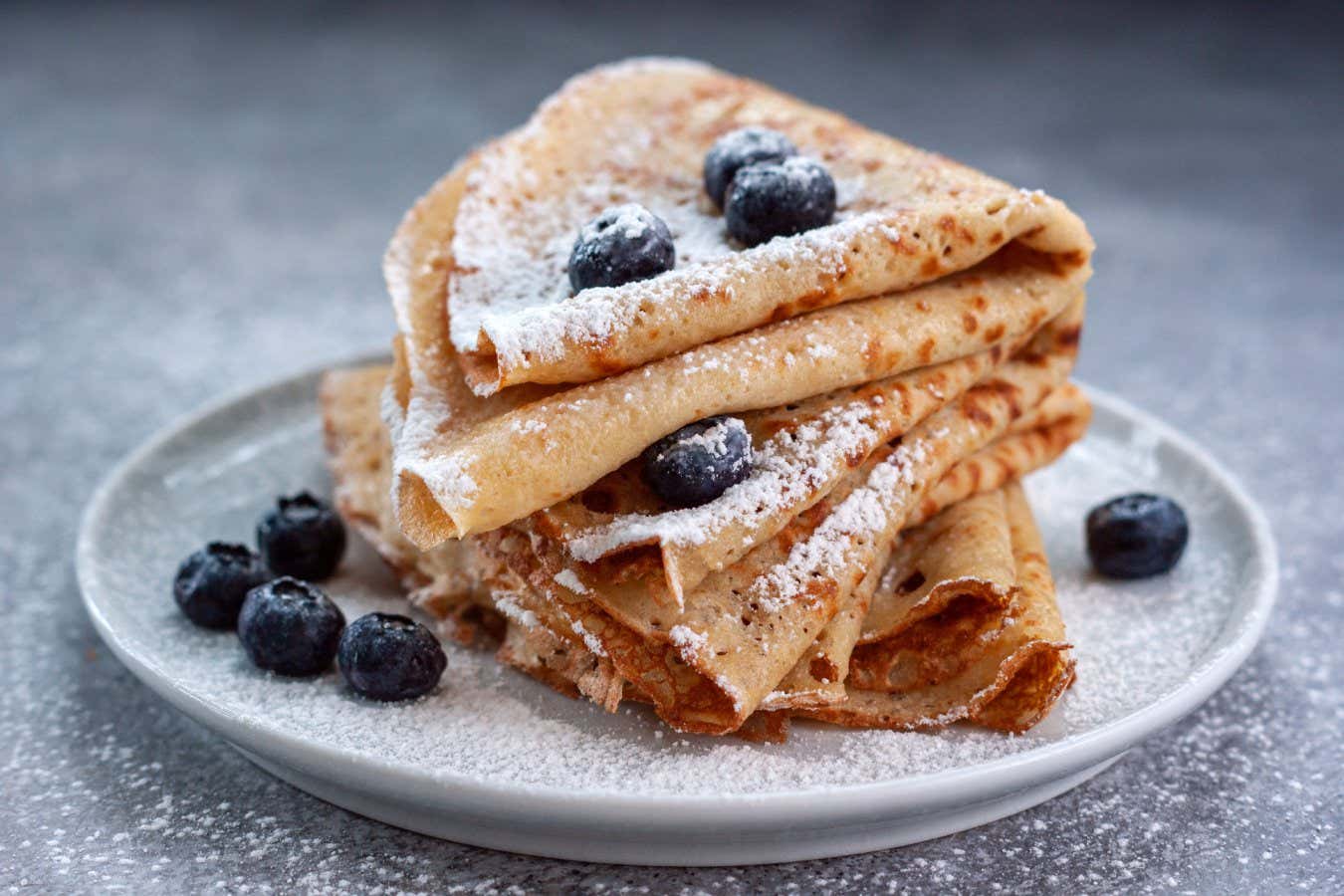
    There is a limit to how many times you can fold a crêpe

    ResonX /Jasmin Schoenzart

    If you gently fold a disc made of some flexible and possibly tasty material, what makes it stay folded? And how many times can you fold it before it puts up a fight and flips back?

    A physicist from France, home of the crêpe, decided to find out. He discovered that just one number tells you all you need to know.

    Tom Marzin at Cornell University in Ithaca, New York, wondered about crêpe-folding when he was on holiday in his home region of Brittany, France, where this thin pancake is especially popular. Just folding a tip of it would result in it flipping back, but with a larger fold, friction and gravity would conspire to keep it still. What rules could govern this behaviour?

    Marzin turned it into a research project, the results of which he will present on 20 March at a meeting of the American Physical Society in Denver, Colorado.

    His work is different from the origami-like folds some physicists study, which are permanent. “What we’re dealing with here is what I call a soft or smooth fold. And it is just a competition between gravity and elasticity,” says Marzin.

    One way to observe this competition is to stick part of a pancake to a tabletop, let the other end hang over the edge and measure how much it sags. Marzin worked out that the answer can be predicted with one number, dubbed the elasto-gravity length, which combines the material’s density, its stiffness and the force of gravity. He suspected that this number would also govern the behaviour of flexible materials in other situations, and in a computer model this turned out to be the case.

    To check his simulations in the real world, Marzin experimented with plastic discs, store-bought tortillas and, of course, crêpes. He started out making the latter himself, but scientifically they weren’t fit for purpose.

    “I didn’t control the thickness well,” he says. “So I asked my mom to perform the experiments over in France. I asked her to buy the callipers and rulers and a bunch of crêpes from a commercial brand. Those were probably made by a machine, [so] that guarantees a good uniform thickness. And she did it really correctly.”

    Marzin’s experiments confirmed that all aspects of crêpe-folding depend on the elasto-gravity length. For instance, it governs how much of the area of a sheet that’s folded will go into the part that loops over. This determines if there will be enough flat area left for another fold.

    His equations correctly predict that a crêpe 26 centimetres in diameter and 0.9 millimetres thick can be folded up to four times, whereas a 1.5-mm-thick tortilla of the same size, with an elasto-gravity length 3.4 times as large, will allow only two folds. “This length captures all the physics underneath,” Marzin says.

    Topics:


    Source link

    Share. Facebook Twitter Pinterest LinkedIn Tumblr Email Telegram Copy Link

    Related Posts

    Science

    How do earthquakes end? A seismic ‘stop sign’ could help predict earthquake risk

    April 24, 2026
    Science

    ‘Kraken’ fossils show enormous, intelligent octopuses were top predators in Cretaceous seas

    April 24, 2026
    Science

    Largest ever octopus was great white shark of invertebrate predators

    April 24, 2026
    Science

    Do you need to worry about Mythos, Anthropic’s computer-hacking AI?

    April 23, 2026
    Science

    How many dachshunds would it take to get to the moon?

    April 23, 2026
    Science

    The Age Code review: Can you slow ageing with your diet? A new book gives it a go

    April 23, 2026
    Editors Picks

    How this retirement community is using virtual reality to help residents build social connections

    December 28, 2025

    The US Trade Deficit – A Cause For Concern?

    February 20, 2026

    Iran strikes Tel Aviv with cluster warheads in retaliation for killing of security chief

    March 18, 2026

    The moment that kicked off the AI revolution

    March 7, 2026

    Sofia Coppola Calls Britney Spears A ‘Symbol Of Women’s Rights’

    March 20, 2026
    About Us
    About Us

    Welcome to Benjamin Franklin Institute, your premier destination for insightful, engaging, and diverse Political News and Opinions.

    The Benjamin Franklin Institute supports free speech, the U.S. Constitution and political candidates and organizations that promote and protect both of these important features of the American Experiment.

    We are passionate about delivering high-quality, accurate, and engaging content that resonates with our readers. Sign up for our text alerts and email newsletter to stay informed.

    Latest Posts

    Pentagon Requests $54 Billion For AI War

    April 24, 2026

    Clavicular Hit With New YouTube Crackdown

    April 24, 2026

    Beijing’s new supply chain rules deepen concerns for US firms in China

    April 24, 2026

    Subscribe for Updates

    Stay informed by signing up for our free news alerts.

    Paid for by the Benjamin Franklin Institute. Not authorized by any candidate or candidate’s committee.
    • Privacy Policy
    • About us
    • Contact us

    Type above and press Enter to search. Press Esc to cancel.