

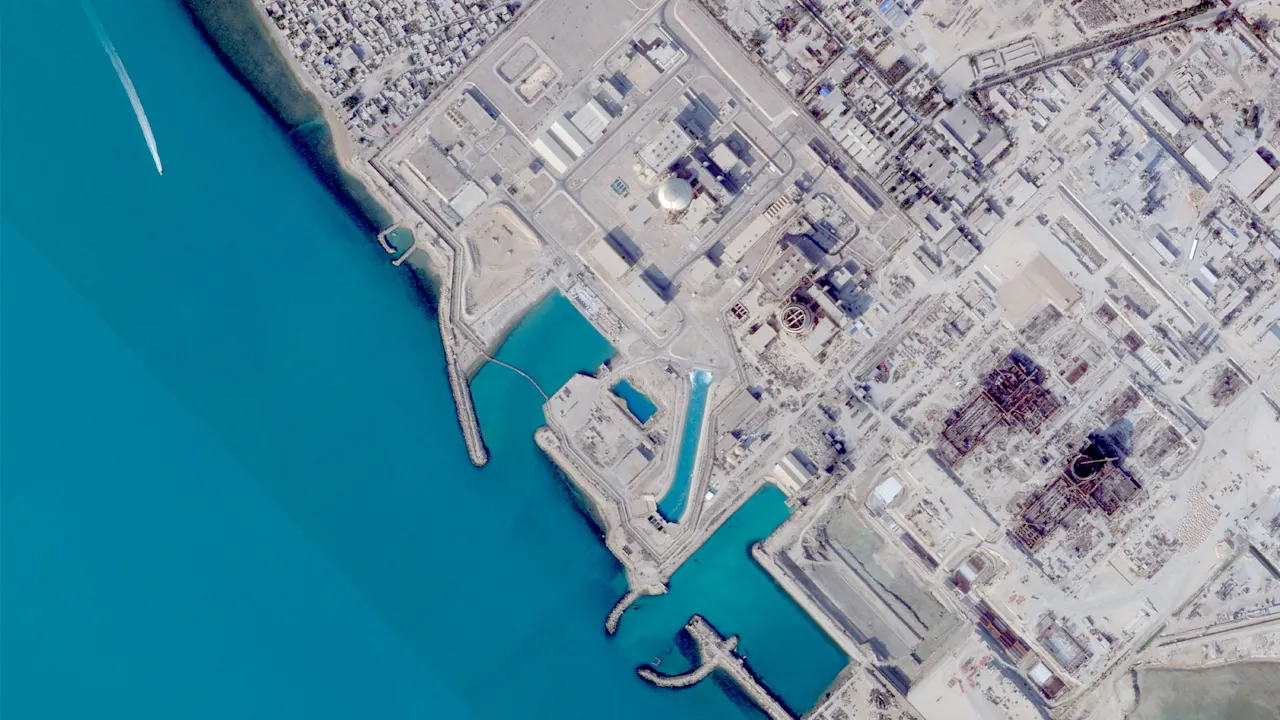
Iran and Russia both allege a projectile struck the grounds of the Bushehr nuclear power plant in the Islamic Republic, raising the specter of a radiological incident as Tehran’s war with Israel and the United States rages.
Neither Iran nor Russia say there was any release of nuclear material in the incident on Tuesday evening, but it again underlines a longtime worry of Iran’s neighbors — that the power plant on the shores of the Persian Gulf could be hit by either an attack or an earthquake.
Here’s what to know about the incident, the plant itself and Iran’s wider nuclear program, which remains a reason U.S. President Donald Trump points to for starting the war alongside Israel against Iran on Feb. 28.
Reports of a projectile striking there
Russia’s state-run Tass news agency quoted Rosatom CEO Alexey Likhachev late Tuesday as claiming “a strike hit the area adjacent to the metrology service building located at the Bushehr Nuclear Power Plant site, in close proximity to the operating power unit.” Russian technicians from Rosatom operate the plant, using Russian-made, low-enriched uranium.
“There were no casualties among Rosatom State Corporation personnel,” Likhachev said. “The radiation situation at the site is normal.”
About 480 Russian nationals remain at the plant, Likhachev said, and authorities are preparing for another round of evacuations from there.
The Atomic Energy Organization of Iran later issued a statement saying “no financial, technical, or human damage occurred and no part of the plant was harmed.” Iran blamed the incident on the United States and Israel, Tass later reported.
The International Atomic Energy Agency, which has had its inspections of Iran restricted over years of tensions over Tehran’s program after Trump unilaterally withdrew America from the 2015 nuclear deal with world powers, issued a carefully worded statement early Wednesday.
“The IAEA has been informed by Iran that a projectile hit the premises of the Bushehr NPP on Tuesday evening,” the United Nations agency said, using an acronym for nuclear power plant. “No damage to the plant or injuries to staff reported.”
No other independent expert has seen the damage. Neither Iran nor Russia published images of the damage. Moscow has made claims about nuclear sites during its war on Ukraine that turned out not to be true, while Iran has been trying to use both force and coercive diplomacy to pressure its neighbors to in turn push the U.S. to halt the war.
It remains unclear what the “projectile” that hit the complex was. The U.S. military’s Central Command, which is in charge of forces launching airstrikes across southern Iran, did not immediately respond to a request for comment.
Shrapnel from missile interceptions and other air defense fire also have caused damage in the region since the war started. Bushehr, some 750 kilometers (465 miles) south of Iran’s capital, Tehran, is home to an Iranian navy base and a dual-use, civilian-military airport with air defense systems protecting the area.
Bushehr a long sought project by Iran
Iran’s Shah Mohammad Reza Pahlavi announced plans in the 1970s to build 23 nuclear reactors while also having full control of the nuclear fuel cycle — opening the door to being able to build atomic weapons. That rattled U.S. officials, who imposed limits on American companies from selling to Iran. German firm Kraftwerk Union began construction of the Bushehr plant in 1975 as part of $4.8 billion deal for four reactors.
But the 1979 Islamic Revolution halted the project. Iraq repeatedly bombed the site during its eight-year war with Iran in the 1980s, seeking to stop Tehran’s program.
Russia ultimately signed onto the project, which saw the power plant connected to the Iranian grid in 2011, running a pressurized-water reactor that generates up to 1,000 megawatts of electricity, which can power hundreds of thousands of homes and other businesses and industries. But it contributes only 1% to 2% of Iran’s power.
Iran has been trying to expand Bushehr to multiple reactors. In 2019, it began a project that ultimately plans to add two additional reactors to the site, each adding another 1,000 megawatts apiece. A satellite image from December from Planet Labs PBC showed the construction still ongoing at the site, with cranes over both sites.
The reactor currently running at Bushehr uses uranium from Russia enriched to 4.5%, a low level needed for power generation in such plants.
Bushehr was untouched in 12-day war in June
Bushehr, as a running, civilian nuclear power plant, was left untouched during the 12-day war in June between Israel and Iran. During that war, the U.S. bombed three Iranian nuclear enrichment sites, destroying centrifuges and likely trapping Tehran’s stockpile of highly enriched, 60% uranium underground. In the time since, Iran has blocked IAEA inspectors from visit those sites.
A possible strike on a nuclear power plant could see a leak of radiation into the environment. That’s been a major concern in the years after Russia launched its full-scale invasion of Ukraine in 2022. Nuclear plants in Ukraine, built when the country was part of the Soviet Union, have come under attack and found themselves on the front lines of that war.
Such a leak into the Persian Gulf would be an existential crisis for the Gulf Arab states, which rely on desalination plants on the gulf for their water supplies.
The Associated Press receives support for nuclear security coverage from the Carnegie Corporation of New York and Outrider Foundation. The AP is solely responsible for all content.
—Jon Gambrell, Associated Press