
Close Menu
    Trending
    • Beijing’s new supply chain rules deepen concerns for US firms in China
    • India denounces ‘hellhole’ remark shared by Trump | Donald Trump News
    • New photos of Mike Vrabel and Dianna Russini emerge
    • AI search demands a new audience playbook
    • How do earthquakes end? A seismic ‘stop sign’ could help predict earthquake risk
    • Trump Announces Cease-Fire Between Israel and Lebanon
    • Google Is Tracking Your Life – Photo Cloud Feeding AI System
    • Rachel Zoe Confronts Amanda Frances In ‘RHOBH’ Reunion Clip
    Benjamin Franklin Institute
    Friday, April 24
    • Home
    • Politics
    • Business
    • Science
    • Technology
    • Arts & Entertainment
    • International
    Benjamin Franklin Institute
    Home»Business»Housing market squeeze: The income needed to purchase a typical U.S. home is up 79% since 2020
    Business

    Housing market squeeze: The income needed to purchase a typical U.S. home is up 79% since 2020

    Team_Benjamin Franklin InstituteBy Team_Benjamin Franklin InstituteMarch 14, 2026No Comments3 Mins Read
    Share Facebook Twitter Pinterest Copy Link LinkedIn Tumblr Email VKontakte Telegram
    Share
    Facebook Twitter Pinterest Email Copy Link


    Want more housing market stories from Lance Lambert’s ResiClub in your inbox? Subscribe to the ResiClub newsletter.

    Here’s the annual U.S. household income needed to purchase the typical valued U.S. home:

    • January 2020: $52,041
    • January 2021: $52,087
    • January 2022: $63,111
    • January 2023: $87,092
    • January 2024: $93,227
    • January 2025: $98,900
    • January 2026: $93,061

    While the income needed to buy the median-priced U.S. home is +78.8% higher than it was in January 2020, it’s down -5.9% year over year.

    Methodology: This Zillow calculation is conservative and assumes a 20% down payment and that the homebuyer spends less than 30% of their monthly income on the total monthly payment. This is a financed purchase, of course. For typical home value, Zillow economists used the latest Zillow Home Value Index reading.

    window.addEventListener(“message”,function(a){if(void 0!==a.data[“datawrapper-height”]){var e=document.querySelectorAll(“iframe”);for(var t in a.data[“datawrapper-height”])for(var r,i=0;r=e[i];i++)if(r.contentWindow===a.source){var d=a.data[“datawrapper-height”][t]+”px”;r.style.height=d}}});

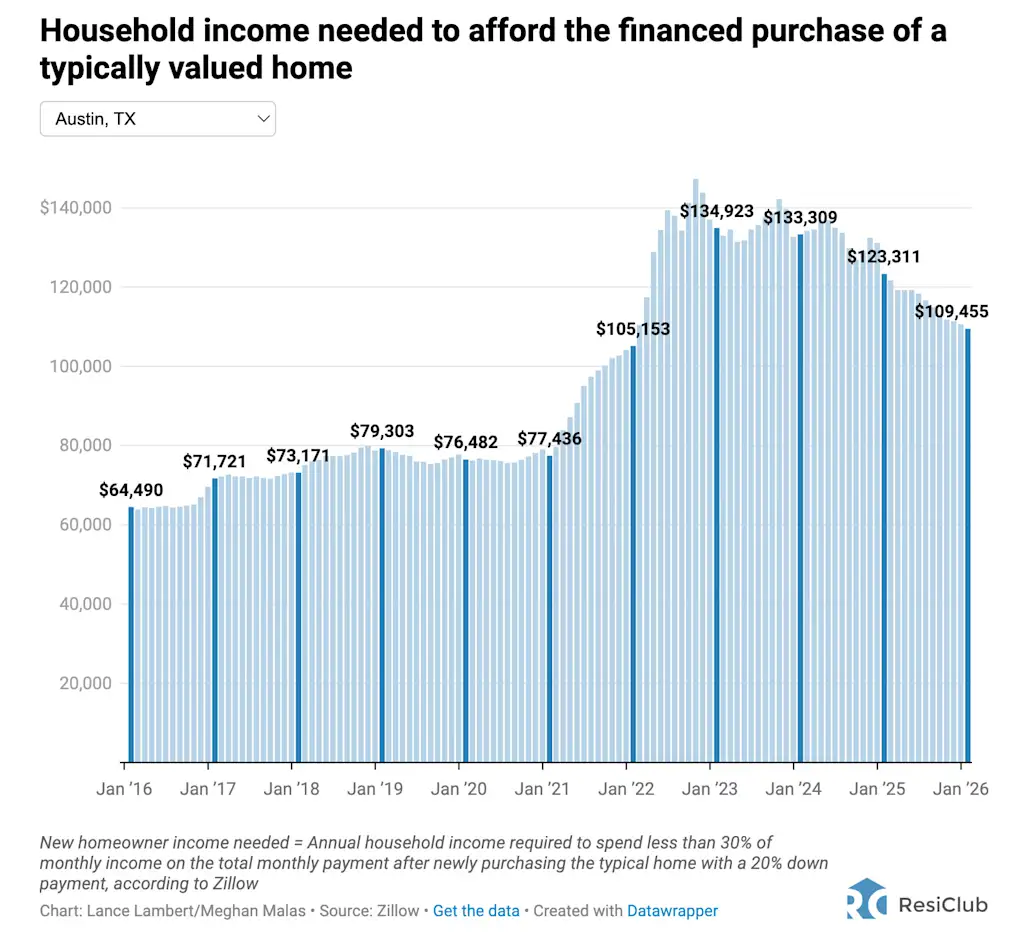
    Regional housing markets that have experienced outright home price corrections since the end of the pandemic housing boom have seen faster affordability improvements. That said, many of those places—like the Austin, Texas, metro area—also experienced greater home price overheating during the pandemic housing boom.

    How did we get here?

    During the pandemic housing boom, housing demand surged rapidly amid ultralow interest rates, stimulus, and the remote work boom. Federal Reserve researchers estimate that “new construction would have had to increase by roughly 300% to absorb the pandemic-era surge in demand.”

    Unlike housing demand, housing supply isn’t as elastic and can’t quickly ramp up like that. As a result, the heightened pandemic-era demand drained the market of active inventory and sent national home prices soaring. The typical U.S. home value measured by the Zillow Home Value Index in January 2026 is still a staggering +44.7% greater than in January 2020.

    That overheated home price growth, coupled with the ensuing mortgage rate shock, with the average 30-year fixed mortgage rate jumping up from under 3% to over 7%, created the fastest-ever deterioration in housing affordability in 2022. Over the past two years, housing affordability has improved some; however, it still remains challenged.

    While the exact hit has varied, this decade’s affordability squeeze has spread across much of the country—just look at the two maps below.

    window.addEventListener(“message”,function(a){if(void 0!==a.data[“datawrapper-height”]){var e=document.querySelectorAll(“iframe”);for(var t in a.data[“datawrapper-height”])for(var r,i=0;r=e[i];i++)if(r.contentWindow===a.source){var d=a.data[“datawrapper-height”][t]+”px”;r.style.height=d}}});

    window.addEventListener(“message”,function(a){if(void 0!==a.data[“datawrapper-height”]){var e=document.querySelectorAll(“iframe”);for(var t in a.data[“datawrapper-height”])for(var r,i=0;r=e[i];i++)if(r.contentWindow===a.source){var d=a.data[“datawrapper-height”][t]+”px”;r.style.height=d}}});

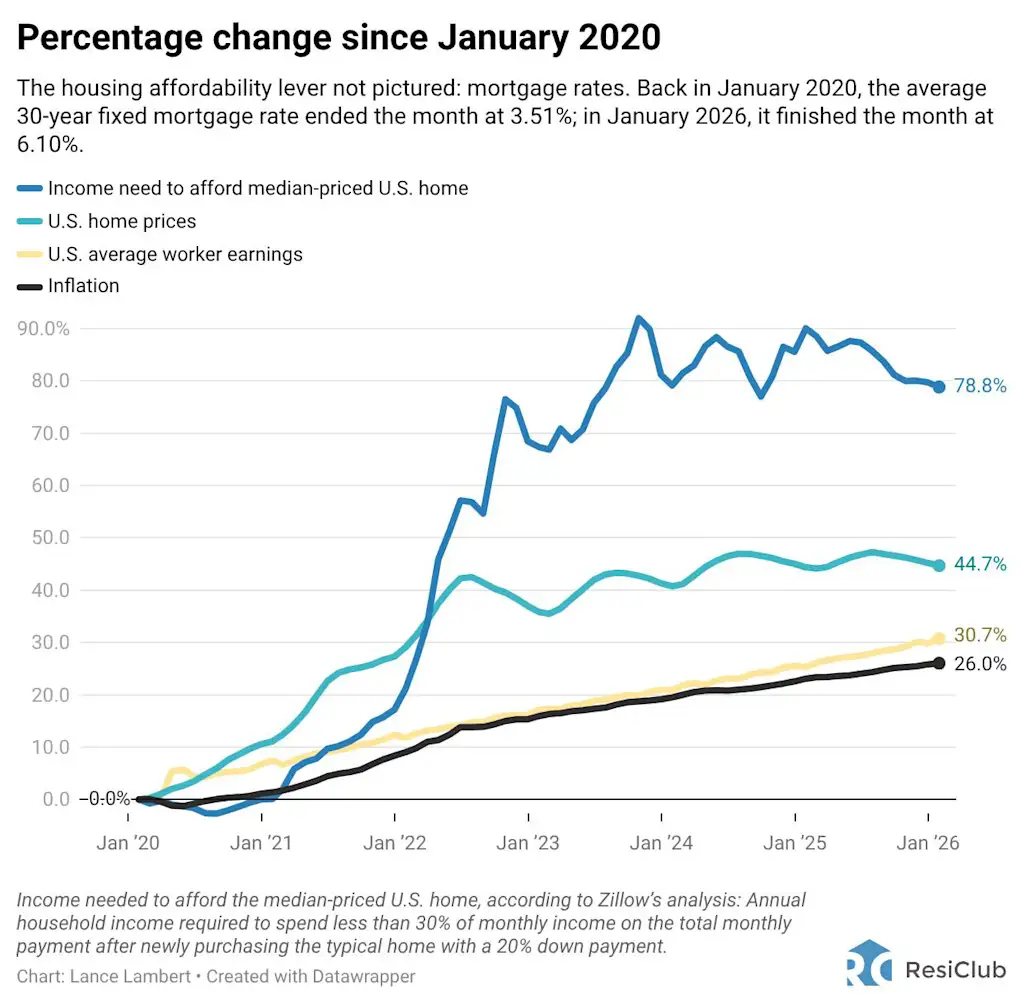
    The challenge, of course, is that incomes haven’t kept up. The gap has narrowed since the end of 2022; however, it’s still wide.

    While the annual U.S. household income needed to purchase a typical U.S. home increased by +78.8% between January 2020 and January 2026, average weekly earnings of U.S. workers have risen by +30.7%, and overall U.S. consumer inflation has grown by +26% during the same period.


    Source link

    Share. Facebook Twitter Pinterest LinkedIn Tumblr Email Telegram Copy Link

    Related Posts

    Business

    AI search demands a new audience playbook

    April 24, 2026
    Business

    AI is replacing creativity with ‘average’

    April 24, 2026
    Business

    Palantir is dropping merch and stirring pots

    April 24, 2026
    Business

    NASA’s awe-inducing iPhone moon video is a free ad for Apple, but there’s a catch

    April 23, 2026
    Business

    The U.S. just changed marijuana law for the first time in decades

    April 23, 2026
    Business

    Want to live a longer, happier life? Science says work to be more successful (but not in the way you might think)

    April 23, 2026
    Editors Picks

    3D printing could enable a safer long-term therapy for type 1 diabetes

    July 4, 2025

    Long-term mortgage rate drops to lowest point in more than 3 years

    January 16, 2026

    Blake Lively Ripped By Exec As A ‘Terrorist’ Over 17-Point List Of Demands

    January 21, 2026

    How leaders can harness productivity to unlock creativity

    January 11, 2026

    This week in business: From recalls to resurrections (and an unraptured Tuesday)

    September 28, 2025
    About Us
    About Us

    Welcome to Benjamin Franklin Institute, your premier destination for insightful, engaging, and diverse Political News and Opinions.

    The Benjamin Franklin Institute supports free speech, the U.S. Constitution and political candidates and organizations that promote and protect both of these important features of the American Experiment.

    We are passionate about delivering high-quality, accurate, and engaging content that resonates with our readers. Sign up for our text alerts and email newsletter to stay informed.

    Latest Posts

    Beijing’s new supply chain rules deepen concerns for US firms in China

    April 24, 2026

    India denounces ‘hellhole’ remark shared by Trump | Donald Trump News

    April 24, 2026

    New photos of Mike Vrabel and Dianna Russini emerge

    April 24, 2026

    Subscribe for Updates

    Stay informed by signing up for our free news alerts.

    Paid for by the Benjamin Franklin Institute. Not authorized by any candidate or candidate’s committee.
    • Privacy Policy
    • About us
    • Contact us

    Type above and press Enter to search. Press Esc to cancel.