
Close Menu
    Trending
    • India denounces ‘hellhole’ remark shared by Trump | Donald Trump News
    • New photos of Mike Vrabel and Dianna Russini emerge
    • AI search demands a new audience playbook
    • How do earthquakes end? A seismic ‘stop sign’ could help predict earthquake risk
    • Trump Announces Cease-Fire Between Israel and Lebanon
    • Google Is Tracking Your Life – Photo Cloud Feeding AI System
    • Rachel Zoe Confronts Amanda Frances In ‘RHOBH’ Reunion Clip
    • China’s DeepSeek says it released long-awaited new AI model
    Benjamin Franklin Institute
    Friday, April 24
    • Home
    • Politics
    • Business
    • Science
    • Technology
    • Arts & Entertainment
    • International
    Benjamin Franklin Institute
    Home»Science»Our extinct Australopithecus relatives may have had difficult births
    Science

    Our extinct Australopithecus relatives may have had difficult births

    Team_Benjamin Franklin InstituteBy Team_Benjamin Franklin InstituteMarch 13, 2026No Comments4 Mins Read
    Share Facebook Twitter Pinterest Copy Link LinkedIn Tumblr Email VKontakte Telegram
    Share
    Facebook Twitter Pinterest Email Copy Link


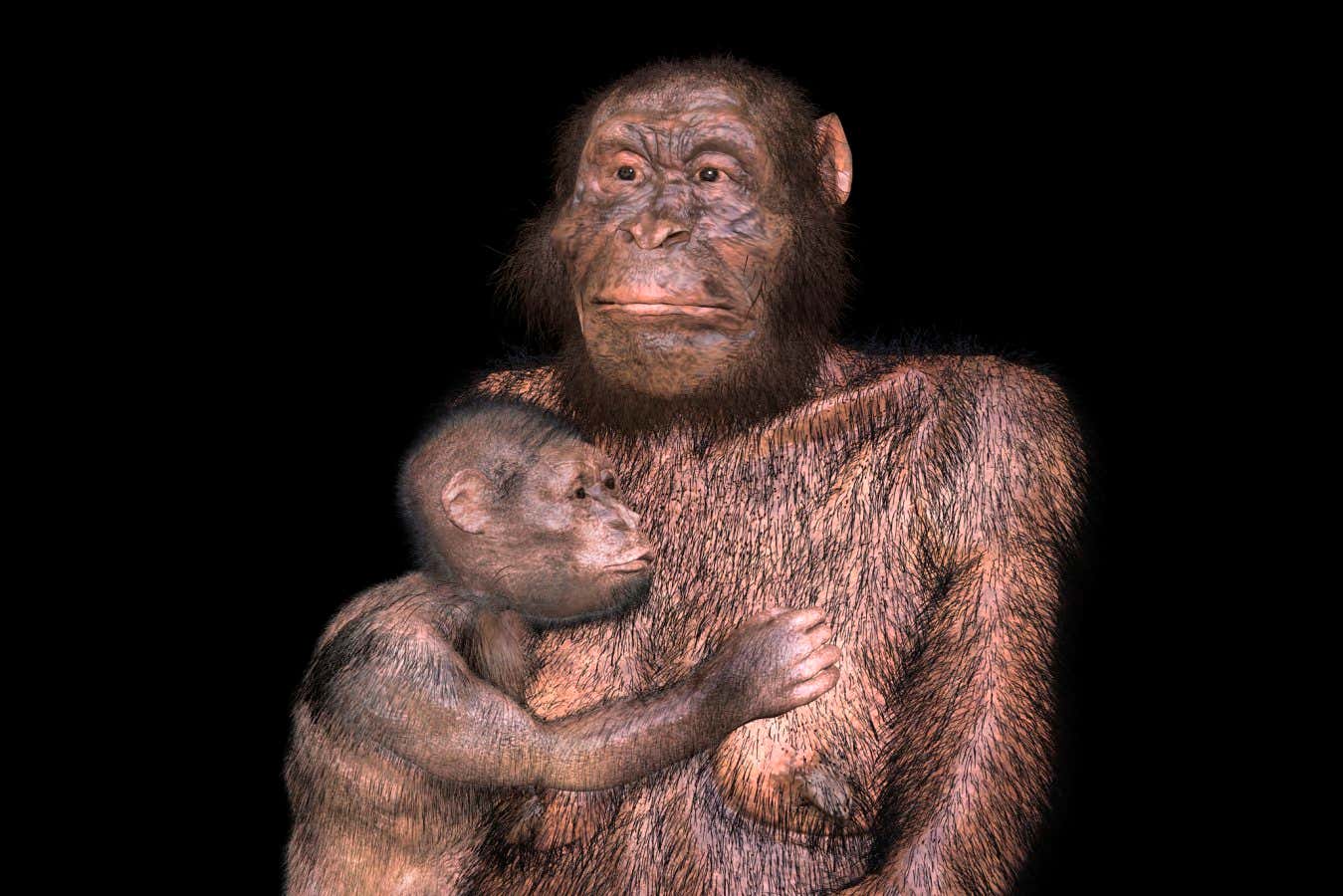
    Illustration of a female Australopithecus sediba carrying an infant

    JOHN BAVARO FINE ART/SCIENCE PHOTO LIBRARY

    Childbirth was difficult and dangerous for our ape-like ancestors, much as it is for women today. A new study of the pelvises of Australopithecus suggests that labour exerted powerful forces on their pelvic floors – meaning Australopithecus mothers risked perineal tearing.

    “We show that Australopithecines are quite similar to modern humans,” says Pierre Frémondière, a midwife at Aix-Marseille University in France. “If they had lots of deliveries, probably they would have a greater risk of pelvic floor disorder.”

    For modern humans, vaginal childbirth requires a lot of force, as a large-headed baby is forced through a relatively narrow pelvis. One region that is prone to damage is the pelvic floor, a sheet of muscles that links the left and right halves of the pelvis. Many women tear their pelvic floor during labour, and it’s been estimated that 1 in 4 women experience pelvic floor disorders such as incontinence or organ prolapse.

    Frémondière and his colleagues wanted to find out if similar difficulties afflicted our extinct ancestors. They focused on Australopithecus, which lived in Africa between about 2 million and 4 million years ago. These early hominins walked upright but were also still adapted to spend time in trees, and may have made and used stone tools. They may have been the ancestors of Homo, the genus to which we belong.

    Based on the handful of Australopithecus pelvises that have been found, the team knew that the Australopithecus birth canal was oval: it was wide from left to right, but narrow from front to back. Non-human primates like chimpanzees have the opposite set-up, whereas the modern human birth canal is more circular.

    To investigate what would happen in Australopithecus labour, the team simulated the pelvises of three individuals from different species: Australopithecus afarensis, Australopithecus africanus and Australopithecus sediba. To model the pelvic floor muscles, the researchers took an MRI scan of a pregnant woman, extracted the three-dimensional image of the pelvic floor, and morphed it to fit the Australopithecus pelvises. Then they simulated a baby being pushed through the pelvises, and estimated how much force would be exerted on the pelvic floor.

    They found that the Australopithecus pelvic floor experienced forces of 4.9 to 10.7 megapascals, similar to the 5.3 to 10.5 MPa exerted on the human pelvic floor during labour.

    The team did well to use multiple Australopithecus pelvises, and to make the comparison to data from a live human birth, says Lia Betti at University College London. “This is a really good way of checking that your model is robust.”

    Despite that, Betti is cautious about the results. She says we don’t know if the pelvic floor muscles of Australopithecus differed from ours, which could have made them more or less resilient to tearing. Also, as a check, the team modelled two modern human births, and in one case the baby did not rotate in the birth canal as they do in real life. This indicates that the simulations are missing key factors, she says.

    “The problem is just we do not have a huge amount of evidence,” says Betti. Three Australopithecus pelvises – all from different species – is a small dataset. There are no known pelvises from earlier hominin species.

    “I think that we are just at the beginning of this kind of study,” says Frémondière.

    New Scientist. Science news and long reads from expert journalists, covering developments in science, technology, health and the environment on the website and the magazine.

    Discovery Tours: Archaeology, human origins and palaeontology

    New Scientist regularly reports on the many amazing sites worldwide, that have changed the way we think about the dawn of species and civilisations. Why not visit them yourself?

    Topics:
    • human evolution/
    • ancient humans


    Source link

    Share. Facebook Twitter Pinterest LinkedIn Tumblr Email Telegram Copy Link

    Related Posts

    Science

    How do earthquakes end? A seismic ‘stop sign’ could help predict earthquake risk

    April 24, 2026
    Science

    ‘Kraken’ fossils show enormous, intelligent octopuses were top predators in Cretaceous seas

    April 24, 2026
    Science

    Largest ever octopus was great white shark of invertebrate predators

    April 24, 2026
    Science

    Do you need to worry about Mythos, Anthropic’s computer-hacking AI?

    April 23, 2026
    Science

    How many dachshunds would it take to get to the moon?

    April 23, 2026
    Science

    The Age Code review: Can you slow ageing with your diet? A new book gives it a go

    April 23, 2026
    Editors Picks

    Pentagon Considers Raising Budget By 50%

    January 12, 2026

    SpaceX’s Starship explodes in latest launch setback for Elon Musk | Space News

    March 7, 2025

    Are humans degenerating genetically and getting dumber as a result?

    March 24, 2026

    Explosion at Dubai landmark The Palm, as Iran launched strikes across the Gulf

    February 28, 2026

    Mel Kiper Jr. makes big statement about Raiders, Lamar Jackson trade rumors

    January 22, 2026
    About Us
    About Us

    Welcome to Benjamin Franklin Institute, your premier destination for insightful, engaging, and diverse Political News and Opinions.

    The Benjamin Franklin Institute supports free speech, the U.S. Constitution and political candidates and organizations that promote and protect both of these important features of the American Experiment.

    We are passionate about delivering high-quality, accurate, and engaging content that resonates with our readers. Sign up for our text alerts and email newsletter to stay informed.

    Latest Posts

    India denounces ‘hellhole’ remark shared by Trump | Donald Trump News

    April 24, 2026

    New photos of Mike Vrabel and Dianna Russini emerge

    April 24, 2026

    AI search demands a new audience playbook

    April 24, 2026

    Subscribe for Updates

    Stay informed by signing up for our free news alerts.

    Paid for by the Benjamin Franklin Institute. Not authorized by any candidate or candidate’s committee.
    • Privacy Policy
    • About us
    • Contact us

    Type above and press Enter to search. Press Esc to cancel.