

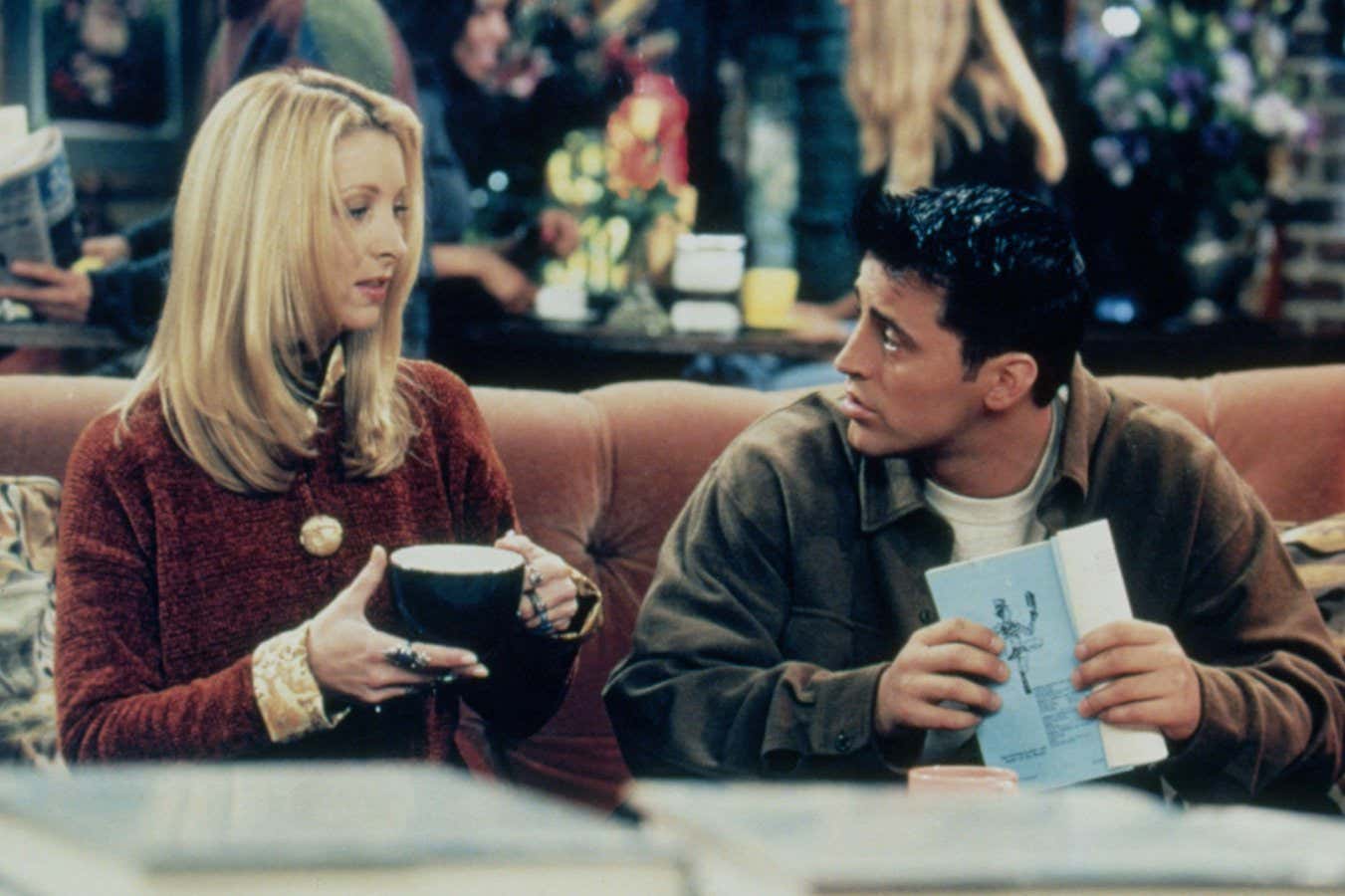
In an episode of Friends, Phoebe (left) and Joey get into a deep philosophical debate
Photo 12 / Alamy
If you are a person of a certain age, you might remember an episode of Friends in which aspiring actor Joey Tribbiani (played by Matt LeBlanc) is given the chance to host a charity telethon on PBS. “A little good deed for PBS plus some TV exposure, now that’s the kind of math Joey likes to do!” he exclaims.
Phoebe Buffay (played by Lisa Kudrow) is less than impressed. “This isn’t a good deed, you just want to get on TV! This is totally selfish.” In the ensuing argument, Joey maintains that all altruistic acts are ultimately selfish, while Phoebe attempts to find an example of pure altruism that will prove him wrong.
I was reminded of their exchange while reading a recent paper on “do-gooder derogation”, our knee-jerk revulsion at others’ selfless acts. Like Phoebe, we tend to look for someone’s ulterior motive, and – once it has been found – we may treat them worse than people who acted with blatant self-interest.
Consider the classic experiment known as the public goods game, in which people are each given a small sum of money that they can choose to put into a pool with the other participants. In much the same way our bank accounts accrue interest, each of those donations will grow in value by the end of the game, when the pot is evenly split up and doled out to every player.
One way of maximising everyone’s income is for each person to put as much money as they can into the shared pool. But this is risky: selfish actors can share very little, keeping their own account relatively full, and then take a bite out of everyone else’s contributions.
You might expect people to treat these free riders with contempt. In reality, the most generous contributors are often criticised just as badly by the other players, who end up resenting them for their displays of trust. “When asked to explain this resentment, people said things like, ‘No one else is doing what [the big contributor] does. He makes us all look bad,’” notes psychologist Nichola Raihani at University College London in her book The Social Instinct.
In some experiments, Raihani notes, players are given the chance to pay out some of their own money to punish the do-gooder – and many will take that opportunity. Some even want to kick them out of the game entirely. She argues we’re all playing a “status game” – and so we’re highly suspicious of anyone who might be faking virtue to boost their own standing within a group.
Occasionally, of course, our suspicions are proved correct: people often do have ulterior motives. Imagine, for example, that your friend Andy is volunteering at a homeless shelter. He appears to be driven by his concern for the vulnerable, but you later discover that he secretly fancies the organisation’s manager, Kim. He is only giving up his time so that he can potentially go on a date with her – and eventually, he succeeds.
If that behaviour gives you the ick, you are not the only one. Yet we do not tend to be so critical of people’s ulterior motives for non-charitable activities. Studies suggest that we take a worse view of Andy than someone who had taken a shift in a coffee shop in order to get close to the manager, for instance. This isn’t logical: in both cases, people are hiding their true motives. Their “crime” is essentially the same, yet we are ironically much more judgemental of the person who is benefitting the needy through a more stereotypically charitable act – a phenomenon known as the tainted altruism effect.
That’s the topic of the new paper that caught my eye by Sebastian Hafenbrädl at the University of Navarra in Spain. He suspected that this effect arises from an unconscious calculation that weighs up the social rewards people are receiving for their apparently good deed, with the size of the deed itself and how much it has cost them personally. “What taints prosocial actors is not the mere presence of self-interest, but the perception that actors try to reap social rewards without deserving them (i.e., without paying the price), which makes them seem deceptive,” Hafenbrädl hypothesised – and then put this to the test in a series of studies.
In the first experiment, he asked a few hundred online participants to consider the situation of the guy named Andy who was either volunteering for a homeless shelter or a coffee shop, before rating how moral and how deceptive he had been. As expected, Andy’s actions were judged far more harshly when he was volunteering to help the needy, rather than acting as a barista. This difference vanished in two further conditions, when Andy confessed his ulterior motive to Kim herself. The participants no longer judged him so harshly because he had eliminated the unearned social reward of seeming altruistic.
To be sure this wasn’t a fluke, Hafenbrädl tested the idea in a variety of other contexts. He asked participants to consider Tom, for example, the owner of a resort in the Maldives who spends $100,000 to clean up the local beaches. It sounds like environmental responsibility, but Tom is primarily concerned about the benefits for his business. In one scenario, participants are told that he uses this allegedly charitable act to advertise the resort. In another, he doesn’t mention the deed beyond a small circle of friends.
As in the case of the first experiment, people considered Tom to be less moral when he uses the good deed to greenwash his (and his business’s) reputation, rather than keeping it on the down-low.

A beach clean-up can be seen as selfish if you stand to benefit personally from it
Fitria Nuraini/Shutterstock
Some people, of course, may be motivated by the mere wish to feel good about themselves. This mood boost is ultimately selfish, yet Hafenbrädl’s work suggests that it isn’t judged nearly as harshly as deliberately reaping the so-called social rewards that come from kind actions. He found that people who had donated blood or given to charity for their own sense of self-satisfaction were considered to be more moral than those who were attempting to enhance their reputation – though they still didn’t fare quite as well as the people who declared absolutely no ulterior motive.
Such results would have resonated with Phoebe. At the end of the Friends episode, she ends up donating to Joey’s telethon, despite a personal dislike of PBS – an act that helps Joey to get more TV exposure. She thinks she has proved her point, until she recognises the pleasure his happiness brings her.
Perhaps Joey is correct: there is no such thing as pure altruism. Personally, I’m very happy to forgive someone for the warm glow that comes from helping others, if it means that there is a little more kindness in the world. There are certainly far worse ways to get high.
David Robson’s latest book is The Laws of Connection: 13 social strategies that will transform your life. If you have a question that you would like answered in his column, please send him a message at www.davidrobson.me/contact
Topics: