

For more than a century, Utah has kept gambling almost entirely out of the state. There are no casinos, no lotteries and no racetracks that allow bets, a prohibition rooted in the conservative ideals of The Church of Jesus Christ of Latter-day Saints, which views gambling as a vice that leads to selfishness and addiction.
But now, the state is fighting a new, more challenging battle to keep gambling outside its borders. It’s on the verge of enacting a law intended to undercut prediction markets like Kalshi and Polymarket, which allow anyone with a smartphone to wager on anything from whether it will rain in Los Angeles to whether the United States will go to war.
While regulators and other states are still debating whether those markets constitute finance or gambling, Utah has already made up its mind.
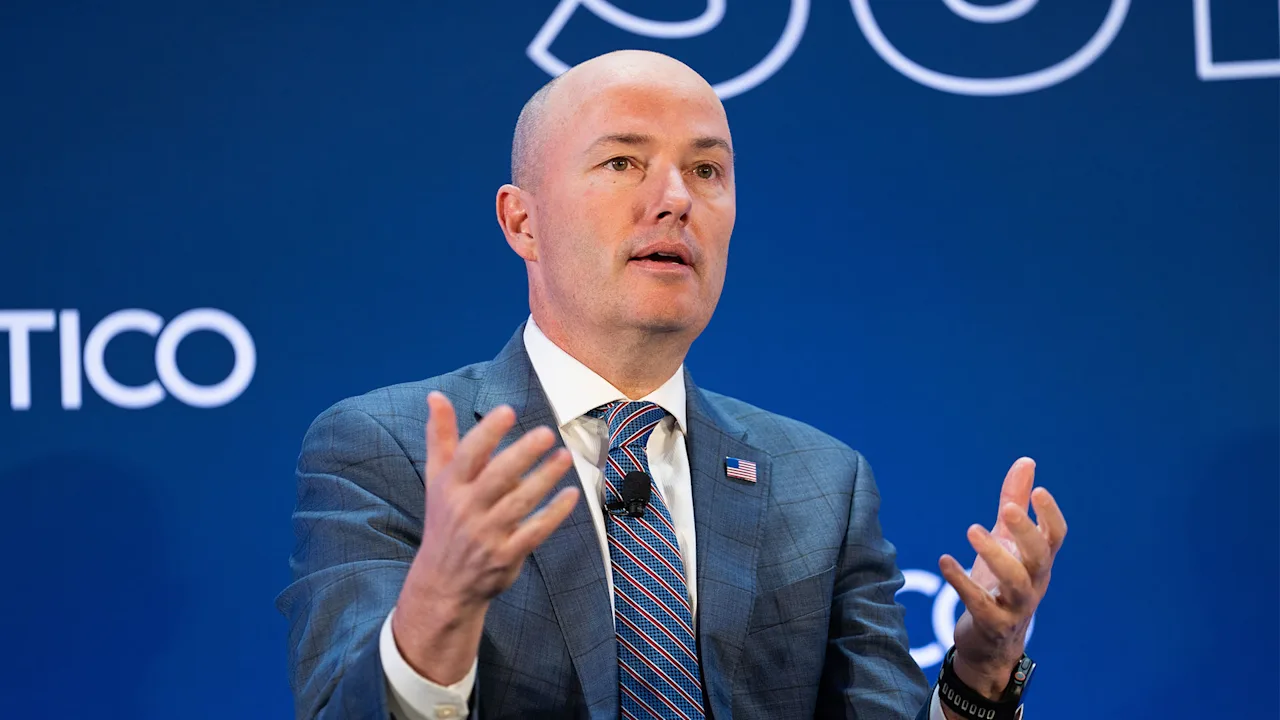
“We are putting a casino in the pocket of every single American, and they are targeting especially young people,” said Gov. Spencer Cox. “It is really awful what they are doing, and we are going to make sure this doesn’t happen in our state.”
Cox said he will sign the legislation, putting conservative Utah at odds with the federal government. Kalshi has already sued the state, and the company is backed by the Commodity Futures Trading Commission, the federal agency responsible for regulating financial markets.
The conflict puts Utah, a place that’s not known for picking fights, on the frontlines of a cultural, political and economic battle sweeping the country. On one side is a state deeply rooted in what is widely known as the Mormon church, where both politicians and faith leaders have treated the issue as a moral crusade. On the other is a growing industry — Kalshi and Polymarket are estimated to be worth $20 billion each after their last fundraising rounds — with connections in Washington that may offer some regulatory protection.
President Donald Trump‘s eldest son is an adviser for both Kalshi and Polymarket and an investor in the latter. Trump’s social media platform Truth Social is also launching its own cryptocurrency-based prediction market called Truth Predict.
Whoever wins this round could shape how other states handle the issue in the future.
“What’s at stake here is whether states will be able to regulate gambling or if gambling is going to be subsumed into finance and ultimately regulated by Congress,” said Todd Phillips, a professor at Georgia State University who has written extensively about prediction market regulation.
Utah takes aim at prop betting
Polymarket and Kalshi allow participants to buy and sell contracts tied to the probable outcome of an event. Contracts are typically priced between one cent and 99 cents, which roughly translates to the percentage of customers who believe that event will happen.
The companies argue they offer products that allow customers to manage risk, like how farmers can buy corn futures to lock in the price of their crops ahead of time. And derivative markets like the Chicago Board of Trade and Chicago Mercantile Exchange have long offered what are known as binary options to investors, which bet on whether an event will or will not happen.
But unlike those derivative markets, the bulk of Kalshi’s trading volume and roughly half of Polymarket’s are now tied to sports. Kalshi said it saw more than $1 billion in volume traded on the Super Bowl alone.
Utah is seeking to limit prediction markets from doing business in the state by taking aim at proposition betting in sports, which can be a significant source of their revenue.
The bill that Cox plans to sign would expand the state’s gambling ban to include wagers on certain events happening in a game rather than the game’s outcome. An example of these “prop bets” would be how well a particular player performs, or a team hitting a specific threshold like rebounds or other metrics.
The legislation also aims to stop sportsbooks companies like FanDuel and DraftKings that have set up their own prediction markets, which analysts say could allow the companies to get around state gambling prohibitions.
Because of the vocal opposition of Utah officials, Kalshi preemptively sued the state in late February, asking a federal judge to stop Utah from enforcing its gambling restrictions on the platform. The judge has yet to rule on Kalshi’s request. Other judges in Nevada and Massachusetts have issued early rulings in favor of states looking to ban Kalshi and Polymarket from offering sports betting in their states, while judges in New Jersey in Tennessee have ruled in favor of Kalshi.
Kalshi argues its product is different from sportsbooks companies or casinos because customers are betting against each other instead of against the “house,” spokesperson Elisabeth Diana said.
The Commodity Futures Trading Commission under Trump has agreed with Kalshi and has asserted that it has exclusive regulatory oversight of prediction markets. The agency argues states cannot ban the products from operating in their jurisdiction just because they are morally opposed to them.
“To those who seek to challenge our authority in this space, let me be clear, we will see you in court,” chairman Michael Selig said recently in a video posted to social media.
A moral crusade with religious roots
It’s the first major issue in which Cox has clashed with Trump in the year and a half since the Republican governor worked his way into Trump’s good graces after not voting for him in 2016 and 2020.
Patrick Mason, the chair of Mormon history and culture at Utah State University, said he is not surprised to see Cox and other Utah Republicans take a stand against prediction markets, even if it means going against their own party’s leadership in Washington. In the state, where about half of the 3.5 million residents are Latter-day Saints, even a simple game of church bingo is a rare sight.
“Maybe they play for M&Ms, but never money,” he said.
All the state’s major politicians, including the governor, lieutenant governor and its entire congressional delegation, are members of the church headquartered in Salt Lake City. When they view an issue as moral rather than political, the faith’s teachings often take precedence over appeasing the party, Mason explained.
Church doctrine prohibits gambling in any form, saying it is motivated by “a desire to get something for nothing” and is destructive to individuals and families.
“The idea that it goes against a sense of work ethic, a kind of fair exchange, has always been at the heart of the way a lot of people think about themselves in terms of Utah identity, and certainly Latter-day Saint identity and ethics,” Mason said.
Because of Utah’s religious roots, the state has prohibited gambling since it was admitted to the Union in 1895. Along with Hawaii, it has the strictest gambling prohibitions in the country. Utah doesn’t even allow broad multi-state lotteries like Powerball or Mega Millions.
Utah leads on both state and federal fronts
Phillips, the professor focused on industry regulation, said if Congress does not step in to clarify whether these new prediction markets are legal, the issue will be left to the courts.
“The line between gambling and finance is very, very fine,” Phillips said. “There’s a reason why Congress has, over and over again, stepped in to define and regulate financial markets when the products skew too close to gambling.”
There is already some movement on Capitol Hill, led in part by another Utah Republican.
Republican Rep. Blake Moore of Utah and Democratic Rep. Salud Carbajal of California introduced bipartisan legislation this week to more aggressively regulate prediction markets. The bill would prohibit the platforms from allowing bets on war, assassinations, terrorist attacks or election outcomes, and allow states to ban sports-related betting.
“We, as a society, should not be taking bets on whether we are going to invade Cuba,” Moore said.
Democratic senators have also said they will introduce legislation to ban wagers on violence.
“It’s insane this is legal,” Sen. Chris Murphy of Connecticut said on social media.
In court filings, Kalshi has tried to argue that its sports prediction market has economic utility and usefulness. It uses an example of an insurance company that underwrites the careers of college athletes using prediction markets to hedge the risk. Kalshi also argues that hotels, travel agencies and stadium management companies may be able to use prediction markets to hedge their risk against underperforming sports.
Moore said he is not swayed by Kalshi and Polymarket’s economic arguments.
“Utah’s economic outlook has been strong for many years,” he said. “I see no need why we need to embrace these as an economic tool.”
—Ken Sweet and Hannah Schoenbaum, Associated Press