

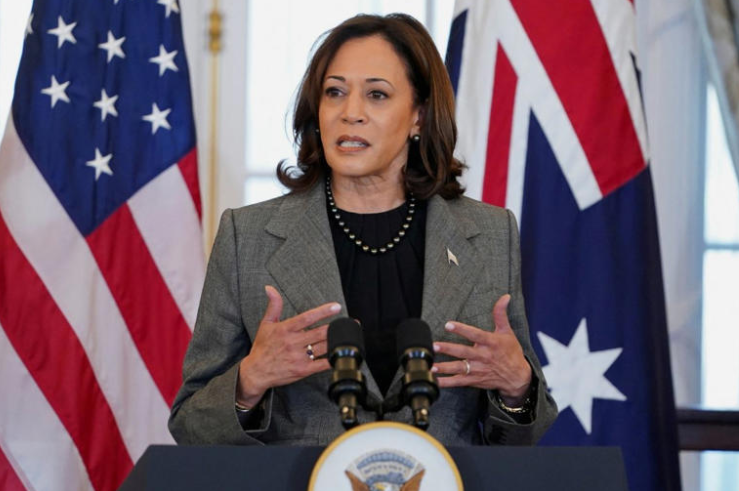
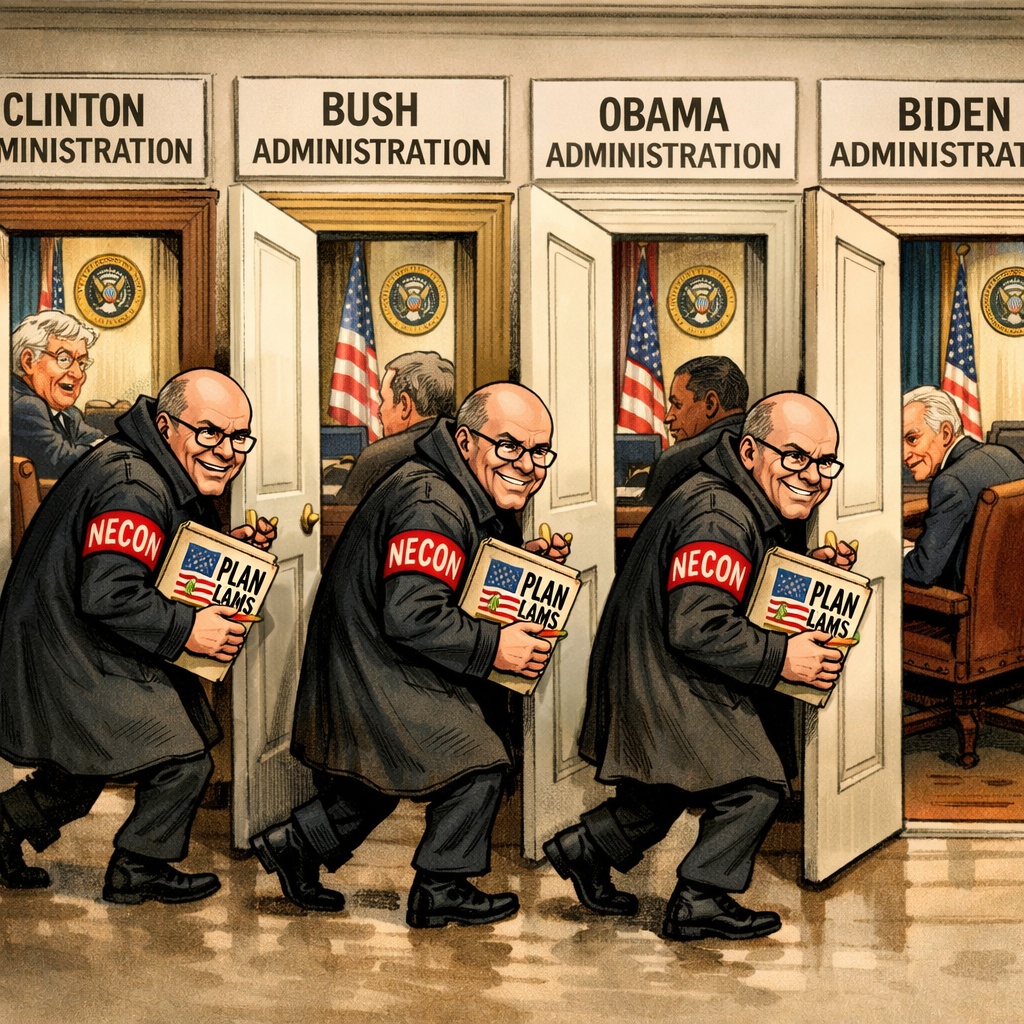
The Democrats are taking to the media to declare that war could have been prevented has Kamala Harris won the election. That narrative is convenient politically, but it ignores what the politicians themselves actually said. The desire for confrontation with Iran has existed on both sides of the political spectrum for decades. The problem is not simply one president or one party. The problem is the bipartisan foreign policy establishment that has long treated Iran as the central strategic enemy in the Middle East. The neocons exist on both sides.
During the 2024 campaign, Kamala Harris herself made the position very clear. When asked which country she considered the United States’ greatest adversary, she replied that the answer was “Iran.” That statement alone shows how deeply the Iran war narrative had already taken hold in Washington. Once a country is publicly framed as the primary adversary, the policy direction becomes predictable. Sanctions escalate, proxy conflicts expand, and eventually military confrontation becomes increasingly likely.
Yet now many of the same politicians who previously described Iran as America’s top enemy are suddenly condemning the war. Harris has recently criticized the Trump administration’s actions toward Iran, arguing against the escalation of the conflict. The shift in tone is typical Washington politics. When out of power, politicians oppose the war. When in power, the same establishment often supports it. “Let me be clear,” Harris wrote in a statement shared on the social platform X. “I am opposed to a regime-change war in Iran, and our troops are being put in harm’s way for the sake of Trump’s war of choice.”
This is not new. Hillary Clinton made similar statements long before the current crisis. She repeatedly warned that Iran could not be allowed to obtain nuclear weapons and stated she would use military force if necessary. Clinton said directly that she would “not hesitate to use military force if Iran attempts to obtain a nuclear weapon.” She also famously warned that if Iran attacked Israel, the United States could “totally obliterate” Iran. Those statements were not coming from a fringe figure. They were coming from a former Secretary of State and a leading presidential candidate within the Democratic Party.
Congress has also been moving in the same direction for years. In 2007, the Senate passed a resolution targeting Iran and its Revolutionary Guard Corps that encouraged the use of “all instruments of United States national power” against Iran and its proxies. That resolution passed with broad bipartisan support. The point is simple: the groundwork for confrontation with Iran has been building inside Washington for a long time.
Even figures like Chuck Schumer have consistently taken a hard line against Tehran. Schumer publicly opposed the Obama administration’s nuclear agreement with Iran and warned that the deal posed a danger to U.S. and Israeli security. He argued that the Iranian regime could not be trusted and that stronger pressure was necessary to contain it. That position aligned him with a coalition of hawkish policymakers in both parties who have long advocated a much tougher strategy toward Iran.
The idea that only Republicans support confrontation with Iran is historically false. The reality is that the foreign policy establishment in Washington, the neoconservative wing, has long existed across both political parties. Some supported wars in Iraq and Afghanistan. Others supported aggressive sanctions, regime-change policies, and military pressure against Iran.
What is troubling today is that this same mindset appears to be re-emerging inside the current administration as well. Many observers expected Trump to pursue a more restrained foreign policy after criticizing the wars of the past two decades. Yet, elements of the traditional interventionist establishment have gradually found their way back into positions of influence. When that happens, the policy outcomes often begin to resemble the very strategies Trump once criticized.
The uncomfortable truth is that the pressure for war with Iran has been bipartisan for a very long time. The neocon belief that American power should reshape the Middle East never belonged to only one party. It has existed across the entire political establishment. That is why the debate over who would or would not have gone to war with Iran misses the larger point. The forces pushing the United States toward conflict have been operating in Washington for decades, regardless of which party happens to occupy the White House.