
Close Menu
    Trending
    • Netanyahu says he was successfully treated for prostate cancer
    • Negotiations that enable Israel’s land-grabs | Israel-Palestine conflict
    • True-or-false for Round 1 of 2026 NFL Draft: Will Cowboys regret their trade?
    • Opinion | Stewart Brand, Silicon Valley’s Favorite Prophet, on Life’s Most Important Principle
    • Struggling to scale your company? Here are five things that could be holding you back
    • What happens if you’re hit by a primordial black hole?
    • When is London Marathon 2026? Start time and how to watch race for FREE
    • Pentagon Requests $54 Billion For AI War
    Benjamin Franklin Institute
    Friday, April 24
    • Home
    • Politics
    • Business
    • Science
    • Technology
    • Arts & Entertainment
    • International
    Benjamin Franklin Institute
    Home»Science»Miniature magnet rivals magnetic behemoths in strength for the first time
    Science

    Miniature magnet rivals magnetic behemoths in strength for the first time

    Team_Benjamin Franklin InstituteBy Team_Benjamin Franklin InstituteMarch 11, 2026No Comments3 Mins Read
    Share Facebook Twitter Pinterest Copy Link LinkedIn Tumblr Email VKontakte Telegram
    Share
    Facebook Twitter Pinterest Email Copy Link


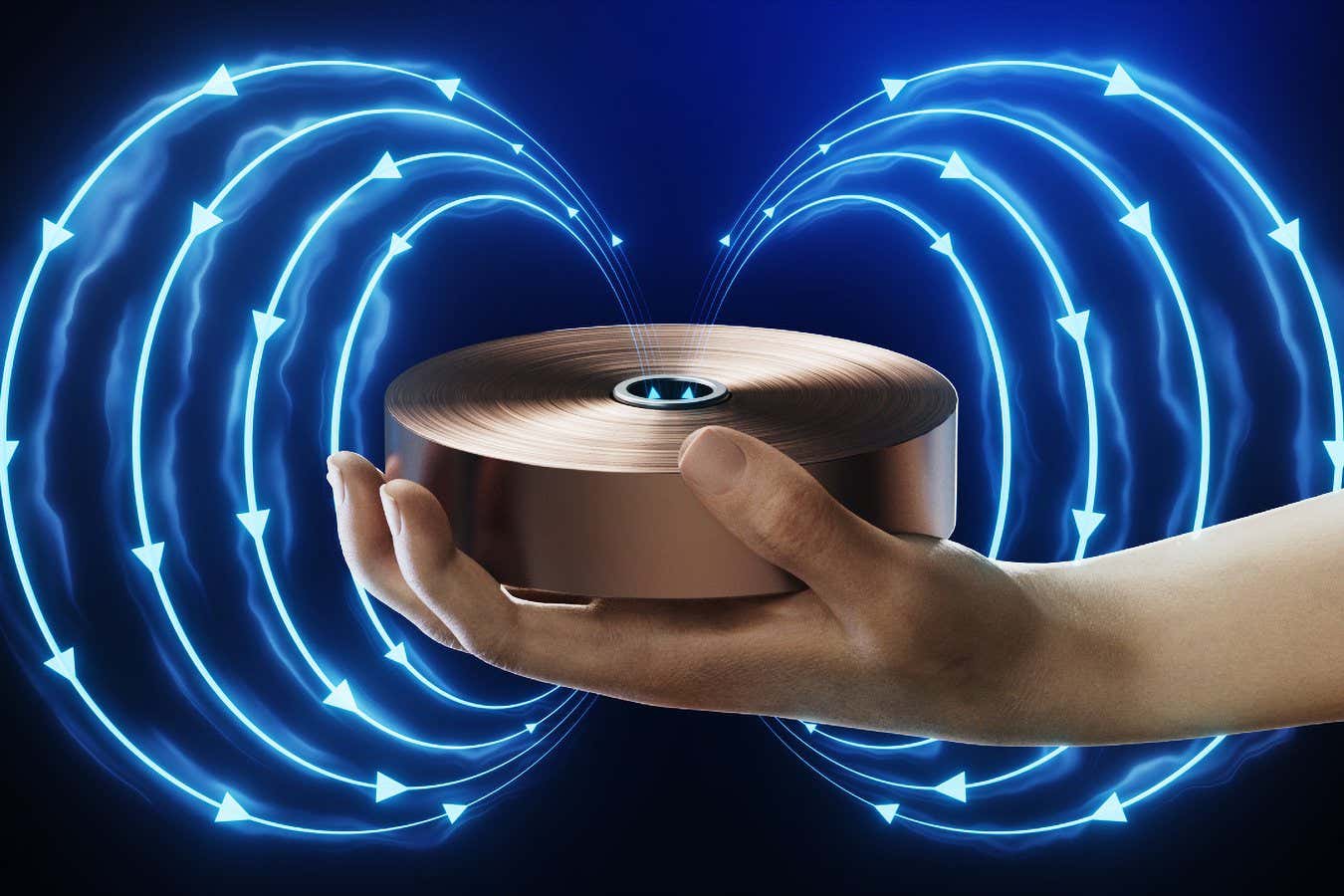
    Even small magnets can sometimes be exceptionally powerful

    ResonX /Jasmin Schoenzart

    A magnet small enough to fit in the palm of your hand can match the strength of some of the world’s most powerful magnets for the first time.

    Strong magnets play many roles across science and technology, with uses in everything from MRI imaging and particle accelerators to nuclear fusion efforts. The most powerful among them are made from superconductors, materials that conduct electricity with near-perfect efficiency.

    But superconducting magnets that produce strong magnetic fields are often bulky: smaller ones are typically the same size as the Star Wars robot R2D2, while the largest are comparable to a two-storey building, says Alexander Barnes at ETH Zurich in Switzerland.

    He and his colleagues have now built a superconducting magnet that is competitive with those large magnets in strength, but measures only 3.1 millimetres in diameter. They made it by coiling a thin tape of a ceramic material called REBCO, which superconducts when cooled to extremely low temperatures. These coils produce magnetic fields when electric currents are passed through them.

    The team bought the REBCO tape from a commercial company, then set out to find the best magnet design, which involved making and testing over 150 of them, says Barnes. “Our strategy was to develop and embrace a ‘fail often and fail fast’ approach.”

    They ultimately settled on a design that involves either two or four pancake-shaped coils of REBCO that could produce magnetic fields with strengths of 38 Tesla and 42 Tesla, respectively. For comparison, a fridge magnet typically has a magnetic field strength under 0.01 Tesla. The two magnets that currently produce the world’s strongest steady magnetic fields reach around 45 Tesla, weigh many tonnes and require up to 30 megawatts of power. Barnes and his team’s magnet is smaller than your hand and requires less than 1 watt of power.

    Barnes says their ultimate goal is to use this magnet for nuclear magnetic resonance (NMR), an experimental technique that uses magnetic fields to reveal the structure of molecules such as drugs and catalysts for industrial processes. In his view, this powerful technique is stymied by how big and expensive magnets are, but the researchers hope to make it accessible for more chemists. The team has already begun testing the magnet in an NMR setup, says Barnes.

    “Producing magnetic fields above 40 Tesla traditionally requires very large and expensive facilities, so achieving similar field strengths in such a compact device using superconducting tapes is significant,” says Mark Ainslie at King’s College London. “It suggests that extremely high-field magnets could become more accessible to a wider range of laboratories in the near future.”

    But questions remain before the magnet can achieve widespread use – for instance, how uniform the magnetic field can be made and how the electromagnetic behaviour of these coils can be managed and controlled, he says.

    Topics:


    Source link

    Share. Facebook Twitter Pinterest LinkedIn Tumblr Email Telegram Copy Link

    Related Posts

    Science

    What happens if you’re hit by a primordial black hole?

    April 24, 2026
    Science

    How do earthquakes end? A seismic ‘stop sign’ could help predict earthquake risk

    April 24, 2026
    Science

    ‘Kraken’ fossils show enormous, intelligent octopuses were top predators in Cretaceous seas

    April 24, 2026
    Science

    Largest ever octopus was great white shark of invertebrate predators

    April 24, 2026
    Science

    Do you need to worry about Mythos, Anthropic’s computer-hacking AI?

    April 23, 2026
    Science

    How many dachshunds would it take to get to the moon?

    April 23, 2026
    Editors Picks

    How One Founder Is Rethinking Supplements With David Beckham

    July 2, 2025

    Opinion | A Bad Investment in Trump Vibes

    April 23, 2026

    Opinion | The Case for Real Regime Change in Venezuela

    January 7, 2026

    Kelly Osbourne’s Weight Loss Raises Health Concerns

    February 7, 2026

    These 6 quotes from OpenClaw creator Peter Steinberger hint at the future of personal computing

    February 18, 2026
    About Us
    About Us

    Welcome to Benjamin Franklin Institute, your premier destination for insightful, engaging, and diverse Political News and Opinions.

    The Benjamin Franklin Institute supports free speech, the U.S. Constitution and political candidates and organizations that promote and protect both of these important features of the American Experiment.

    We are passionate about delivering high-quality, accurate, and engaging content that resonates with our readers. Sign up for our text alerts and email newsletter to stay informed.

    Latest Posts

    Netanyahu says he was successfully treated for prostate cancer

    April 24, 2026

    Negotiations that enable Israel’s land-grabs | Israel-Palestine conflict

    April 24, 2026

    True-or-false for Round 1 of 2026 NFL Draft: Will Cowboys regret their trade?

    April 24, 2026

    Subscribe for Updates

    Stay informed by signing up for our free news alerts.

    Paid for by the Benjamin Franklin Institute. Not authorized by any candidate or candidate’s committee.
    • Privacy Policy
    • About us
    • Contact us

    Type above and press Enter to search. Press Esc to cancel.