

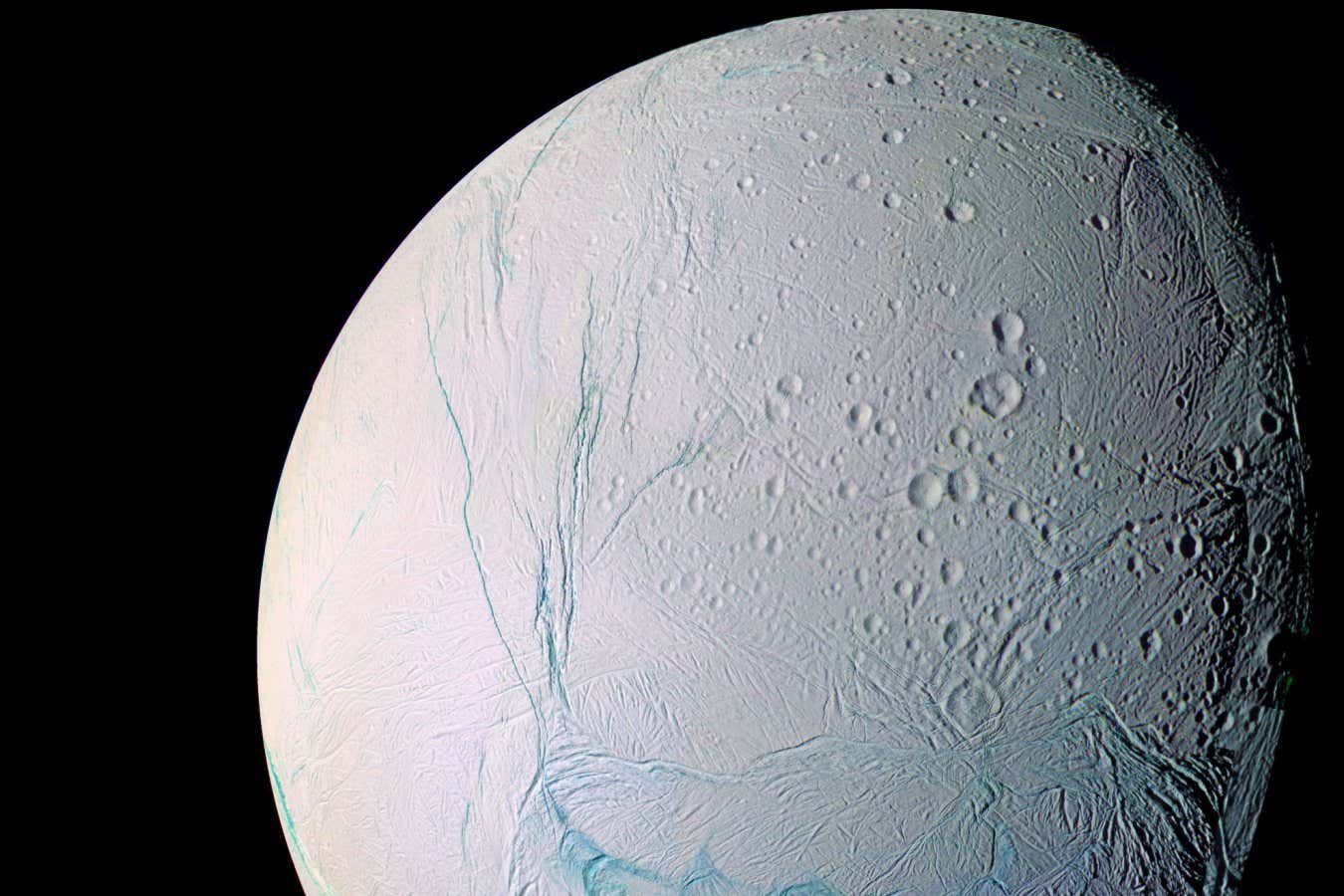
Enceladus, a moon of Saturn, is a prime target in the hunt for life elsewhere in our solar system
NASA/JPL/Space Science Institute
A new method to recognise the chemical properties of living things could help us detect alien life even if it functions differently from life on Earth.
When searching for alien life, scientists usually rely on biosignatures – substances or patterns that can reliably indicate the presence of living organisms. Astronomers can analyse the atmospheres of faraway planets to look for molecular biosignatures. But many molecules produced by living things can also arise through geological or chemical processes in the absence of life forms.
The new test, devised by Christopher Carr at the Georgia Institute of Technology and his colleagues, is based on amino acids. Amino acids are the building blocks of proteins, complex molecules that all life on Earth depends on. However, amino acids are relatively simple molecules, and they can occur in the absence of life: for example, they have been found in lunar soil and on comets and meteorites.
So, rather than simply detecting amino acids, Carr and his colleagues reasoned that measuring the reactivity of the molecules in a sample would be a more reliable indicator of living things.
In a non-living system, molecules are formed and destroyed as they react with things in their environment, like cosmic rays or other molecules, but the more reactive molecules are more likely to disappear. “If you don’t have a system in place to maintain what’s present, then the things that will tend to be destroyed would be those that are more reactive,” says Carr. Living systems, however, will preferentially keep more reactive molecules because they require them for the chemical processes that support life, leading to a unique signature.
The reactivity of a compound is determined by the arrangement of electrons in the molecule. More reactive molecules have a smaller difference in energy between the outermost electron and the next available space that would be filled by an additional electron during a reaction.
Carr and his team calculated this difference in energy for 64 amino acids, including many that aren’t used by life on Earth. Then they looked up amino acid abundances in known samples, which came from either abiotic sources, like meteorites or moon soil, or from living samples, like fungi or bacteria, and used their molecular energy calculations to map the statistical distribution of amino acid reactivities. From this, they could then assign a probability that the sample was living or non-living.
Using this method on more than 200 living and non-living samples, they found it could identify life correctly 95 per cent of the time. “The beauty of this approach is that it’s incredibly simple,” says Carr. “It’s highly explainable and it’s linked directly to physics.”
Life, if it does exist elsewhere in the universe, is likely to be based on carbon chemistry and amino acids, and function according to the same chemical reactivity rules as life on Earth, argues Carr, so this method should work for extraterrestrial life, he says. “Life inherently needs to control when, how and where molecules interact and reactions take place, so that is going to involve having structures that can regulate the flow of electrons and how things interact electrically,” says Carr.
Using the reactivity of molecules to detect life isn’t a new idea, but measuring the reactivity in a statistical distribution is, says Henderson Cleaves at Howard University in Washington DC. The method could form part of a suite of life-detecting tools on a future space mission to Mars or one of Saturn’s moons, like Enceladus, but it would require equipment that can accurately measure molecules and their abundances, which isn’t straightforward, says Cleaves.
Spend a weekend with some of the brightest minds in science, as you explore the mysteries of the universe in an exciting programme that includes an excursion to see the iconic Lovell Telescope. Topics:
Mysteries of the universe: Cheshire, England