
Close Menu
    Trending
    • Negotiations that enable Israel’s land-grabs | Israel-Palestine conflict
    • True-or-false for Round 1 of 2026 NFL Draft: Will Cowboys regret their trade?
    • Opinion | Stewart Brand, Silicon Valley’s Favorite Prophet, on Life’s Most Important Principle
    • Struggling to scale your company? Here are five things that could be holding you back
    • What happens if you’re hit by a primordial black hole?
    • When is London Marathon 2026? Start time and how to watch race for FREE
    • Pentagon Requests $54 Billion For AI War
    • Clavicular Hit With New YouTube Crackdown
    Benjamin Franklin Institute
    Friday, April 24
    • Home
    • Politics
    • Business
    • Science
    • Technology
    • Arts & Entertainment
    • International
    Benjamin Franklin Institute
    Home»Science»Möbius strip-like molecule has an entirely new and bizarre shape
    Science

    Möbius strip-like molecule has an entirely new and bizarre shape

    Team_Benjamin Franklin InstituteBy Team_Benjamin Franklin InstituteMarch 6, 2026No Comments3 Mins Read
    Share Facebook Twitter Pinterest Copy Link LinkedIn Tumblr Email VKontakte Telegram
    Share
    Facebook Twitter Pinterest Email Copy Link


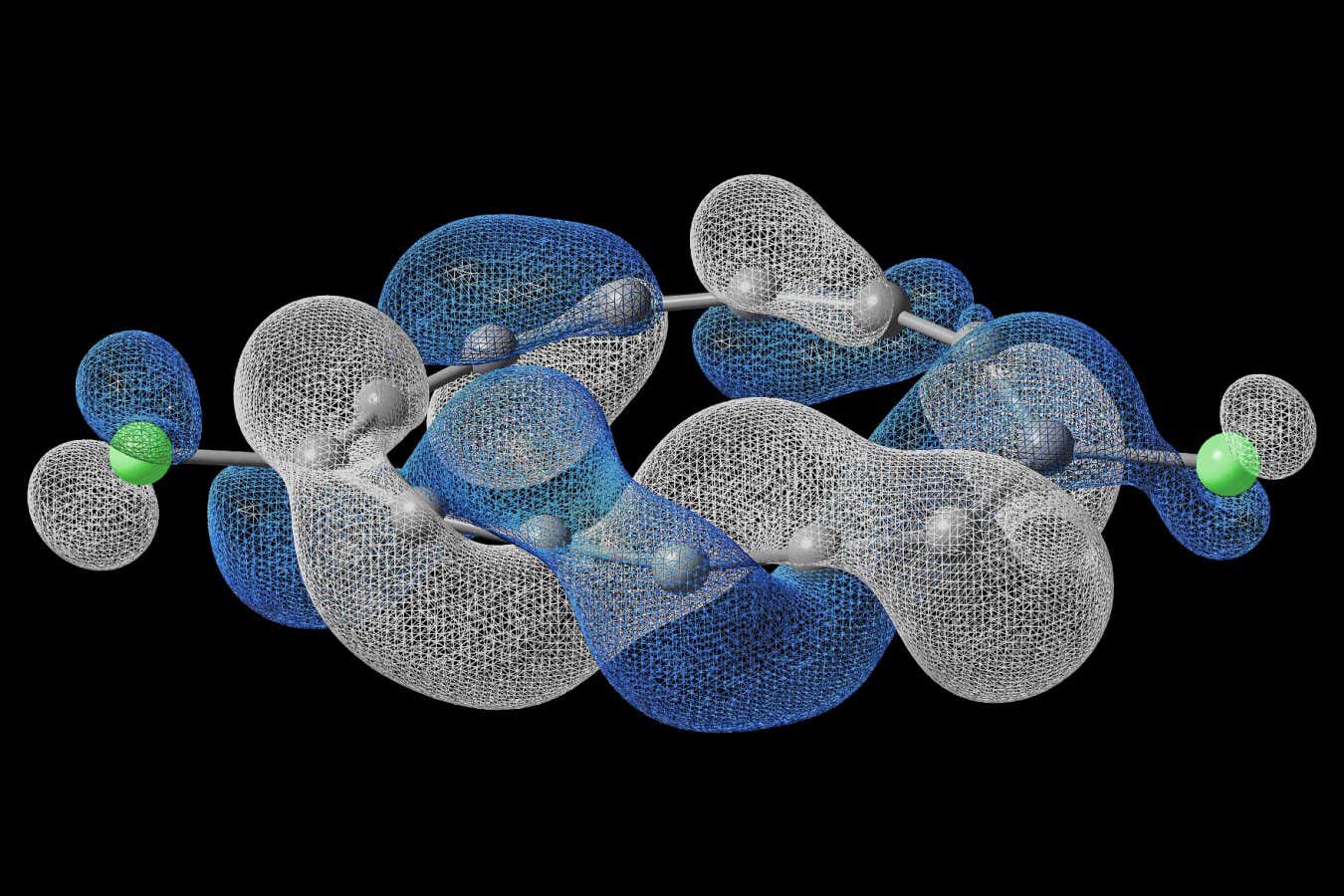
    Representation of the electrons in the “half-Möbius”-shaped molecule

    IBM Research and the University of Manchester

    Chemists have discovered a new molecular shape, and it is twice as odd as the twisty Möbius strip.

    The Möbius strip is a looped band with a twist, such that something tiny, such as an ant, would have to go around the loop twice to return to where it started on the same side of the strip.

    Igor Rončević at the University of Manchester in the UK and his colleagues now discovered a molecule with an even stranger “half-Möbius” shape. Their experiment may be the first step towards a new way to engineer useful molecules by tuning their 3D shapes, or topology.

    “This molecule is very new and very unexpected. The appeal is not just that we made a molecule with an unusual topology, but we also showed that this topology is possible, and no one really thought about it,” he says.

    To make the molecule, the researchers used 13 carbon atoms and two chlorine atoms assembled into a ring-like shape on a thin surface of gold at an extremely cold temperature. They used two specialised microscopes – an atomic force microscope and a scanning tunnelling microscope – to control the atoms and map the properties of their electrons. In this type of molecule, the electrons aren’t tightly bound to their atoms; instead, the electrons spread across specific regions around the atoms like tiny waves of matter.

    It was the interactions between these electrons that produced the never-before-seen twistiness in the molecule. If a tiny quantum creature travelled along the atoms, it would take it four circuits of the ring to return to its starting point.

    By prodding the molecule with a small electromagnetic pulse, the team was able to switch the molecule’s twist from left-handed to right-handed or to untwist it. The researchers could engineer its topology on demand, creating another way for chemists to manipulate molecules.

    To understand the new molecule and why it could even exist, the team used simulations on both a conventional computer and an IBM quantum computer. Interactions between electrons were crucial for the molecule’s novel twists, and they are difficult to exactly simulate with conventional computers. But quantum computers are already built from interacting quantum objects, so they can perform simulations at a higher level of confidence, says Rončević.

    This is an example of how quantum computers can already be useful for real-world chemistry problems, says team member Ivano Tavernelli at IBM.

    “This experiment is a remarkable achievement across a number of dimensions: organic chemistry, surface science, nanoscience and quantum chemistry,” says Gemma Solomon at the University of Copenhagen in Denmark.

    “This is a beautiful and inspiring study that brings abstract topological concepts vividly into the realm of molecular chemistry,” says Kenichiro Itami at the Japanese scientific institute RIKEN. He says the study is a technical tour de force.

    Dongho Kim at Yonsei University in South Korea, a pioneer of past work on Möbius-like molecules, says being able to switch the molecule from one shape to another is particularly interesting, as it could lead to applications in sensors. For instance, molecules could switch in a pre-programmed way when exposed to magnetic fields.

    Topics:


    Source link

    Share. Facebook Twitter Pinterest LinkedIn Tumblr Email Telegram Copy Link

    Related Posts

    Science

    What happens if you’re hit by a primordial black hole?

    April 24, 2026
    Science

    How do earthquakes end? A seismic ‘stop sign’ could help predict earthquake risk

    April 24, 2026
    Science

    ‘Kraken’ fossils show enormous, intelligent octopuses were top predators in Cretaceous seas

    April 24, 2026
    Science

    Largest ever octopus was great white shark of invertebrate predators

    April 24, 2026
    Science

    Do you need to worry about Mythos, Anthropic’s computer-hacking AI?

    April 23, 2026
    Science

    How many dachshunds would it take to get to the moon?

    April 23, 2026
    Editors Picks

    Sea turtles may be more resilient to global warming than we thought

    January 24, 2026

    Nigeria suicide bombings kill 23, wound more than 100

    March 17, 2026

    These devastating photos show the chaos of Trump’s mass deportation campaign in 2025

    December 28, 2025

    South Korea GDP falls as political turmoil hits consumption

    April 24, 2025

    Virginia offshore wind developer sues after Trump administration halts project

    December 26, 2025
    About Us
    About Us

    Welcome to Benjamin Franklin Institute, your premier destination for insightful, engaging, and diverse Political News and Opinions.

    The Benjamin Franklin Institute supports free speech, the U.S. Constitution and political candidates and organizations that promote and protect both of these important features of the American Experiment.

    We are passionate about delivering high-quality, accurate, and engaging content that resonates with our readers. Sign up for our text alerts and email newsletter to stay informed.

    Latest Posts

    Negotiations that enable Israel’s land-grabs | Israel-Palestine conflict

    April 24, 2026

    True-or-false for Round 1 of 2026 NFL Draft: Will Cowboys regret their trade?

    April 24, 2026

    Opinion | Stewart Brand, Silicon Valley’s Favorite Prophet, on Life’s Most Important Principle

    April 24, 2026

    Subscribe for Updates

    Stay informed by signing up for our free news alerts.

    Paid for by the Benjamin Franklin Institute. Not authorized by any candidate or candidate’s committee.
    • Privacy Policy
    • About us
    • Contact us

    Type above and press Enter to search. Press Esc to cancel.