

Feedback is New Scientist’s popular sideways look at the latest science and technology news. You can submit items you believe may amuse readers to Feedback by emailing feedback@newscientist.com
A shedload of bears
Following the use of golden retrievers as a unit of ice mass, Feedback has found our inbox filling up with more examples of unconventional and often unintuitive units of measurement.
Craig Downing, who self-identifies as “one of those readers that opens every issue from the back” and therefore gets top billing in this column, tells us of the Rideau canal running through his home city of Ottawa, Canada. The canal freezes every winter, becoming the world’s largest skating rink by area. However, the rink must be meticulously cleared of snow to ensure a smooth surface.
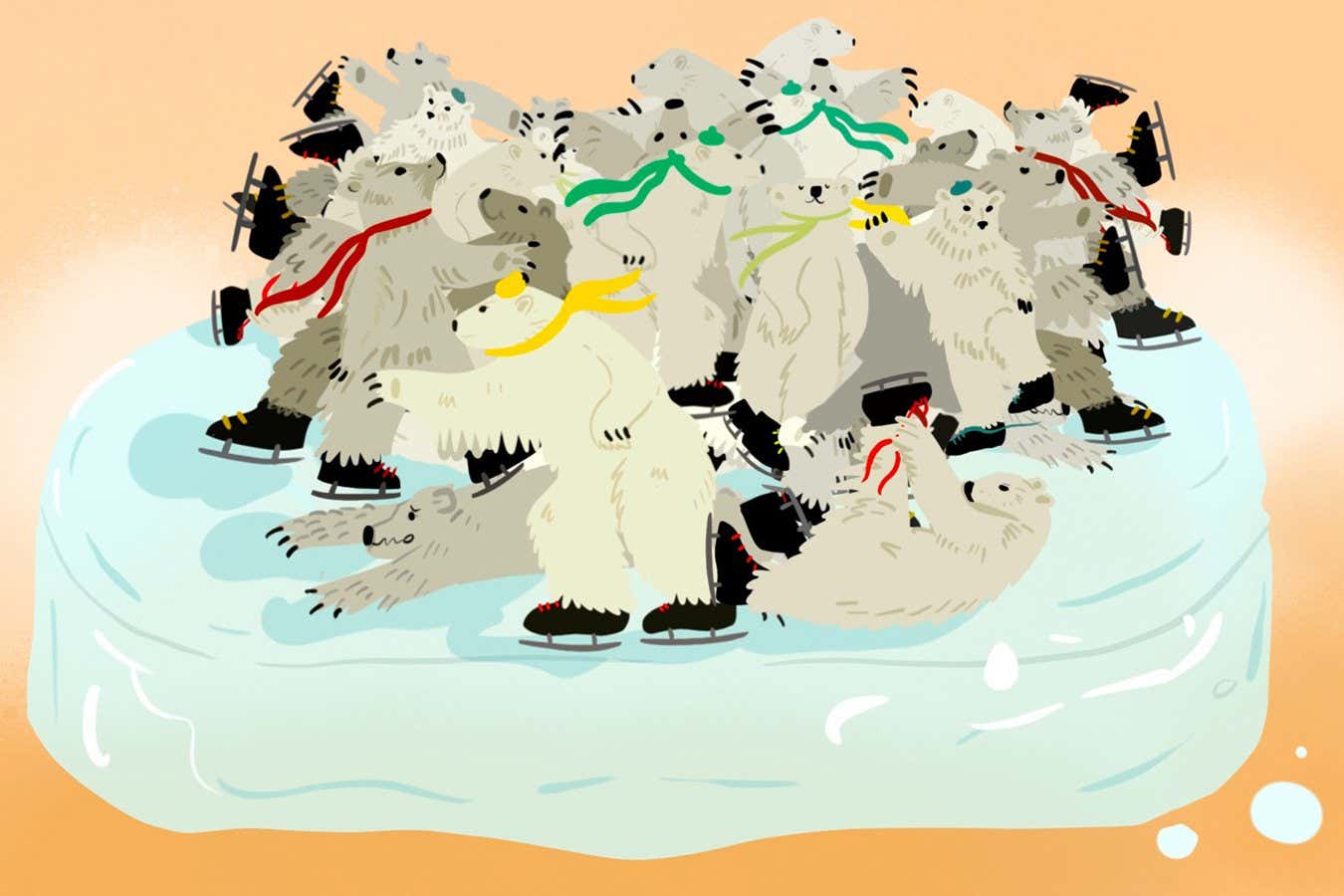
Hence the statement by the canal’s managers, the National Capital Commission, that Craig was emailed. “For every 1 cm of snowfall, our crews move 125,000 kg of snow off the Skateway. That’s equivalent to 450 polar bears!”
Craig is baffled. “I usually think of snowfall mass and volume in terms of ‘shovel loads’ or ‘driveways full up to your knees’, ” he says. It doesn’t help that there are no polar bears in or near Ottawa, so his direct experience of the world’s largest land predator is limited.
Based on the numbers given, the average polar bear must weigh 277.8 kilograms, or 612 pounds. But there is a key factor we need to account for: the bears’ sex. Ever diligent in our fact checking, Feedback wandered to the website of charity Polar Bears International, where we learned that “adult males normally weigh 350-600 kg (775-1,300 lb)” and “adult females are usually 150-290 kg (330-650 lb)”, except for the dramatic exceptions, like when “researchers in Canada estimated one male bear at 800 kg (1,700 lb)!”
Based on this, we can indeed confirm that the Rideau canal staffers are moving the equivalent of 450 polar bears – specifically, largish female ones. Measuring their output in male polar bears accounts for a mere 357 of the furry creatures, and they would have to be on the smaller side.
This lack of specification affects many of the unconventional units we see used. Steve Tees writes in to complain that “Many times I hear of a ‘shedload of xxxx’ causing tailbacks on various motorways. Will someone please define the size of the shed involved?”
Scotched
There are many sounds that drive Feedback to distraction. Fingernails on a chalkboard, of course, but also other people chewing loudly and other people brushing their teeth. Come to think of it, it’s mostly just other people.
One much-hated sound is the high-pitched screeching produced when you peel adhesive tape off a surface. This noise is about 90 per cent of the reason why Feedback avoids DIY projects.
Perhaps understanding is the key to overcoming. So, then, to the pages of Physical Review E, which has published an experiment exploring the physics of peeling Scotch tape. According to reporter Karmela Padavic-Callaghan, researchers used high-speed cameras and microphones to record a piece of tape being quickly peeled off a pane of glass. They observed “micro-cracks travelling through the tape at supersonic speeds and eventually creating a shockwave that we then hear as a high-pitched screech”.
Feedback anxiously awaits the follow-up study where they demonstrate how to peel the tape off without making the noise.
Otherwise unaffected
Feedback is a connoisseur of retracted scientific papers. Whether they have been pulled because they contain a nonsensical graphic generated by AI, or because the researchers had manipulated images, or because the studies were just implausible, we enjoy learning about them.
A strong contender for our favourite retraction of 2026 appeared in Pharmacology Research & Perspectives on 13 February. It pulled a paper that had first been published in 2022.
The study concerned ivermectin, an antiparasitic drug that has gained notoriety after being promoted as a miracle cure for, among other things, covid-19. The study suggested it might also be used to treat liver cancer, and Feedback would like to suggest that this claim was, in itself, grounds for suspicion.
The retraction announcement –which we note is “by agreement” between the authors and various other parties – is one of those that just keeps going, long after you think it should be finished.
It first notes that “the Corresponding Author was not personally involved in the submission process, did not sign the Open Access Agreement, and did not review or approve the final version of the manuscript prior to submission”. Which seems bad.
Next, we learn that the journal’s investigation “uncovered evidence of duplication of several images and figures from previously published articles”. Yup, that definitely sounds bad.
And finally, “The authors state that the conclusions of the article are otherwise unaffected.” Feedback found ourselves staring glassy-eyed into the middle distance trying to work out how the conclusions could possibly be “otherwise unaffected” when the lead author didn’t approve the final version of the manuscript and some of the images are duplicated from other papers.
Our interpretation is that the conclusions are unaffected because we aren’t taking the paper any less seriously post-retraction than we were before.
Got a story for Feedback?
You can send stories to Feedback by email at feedback@newscientist.com. Please include your home address. This week’s and past Feedbacks can be seen on our website.