

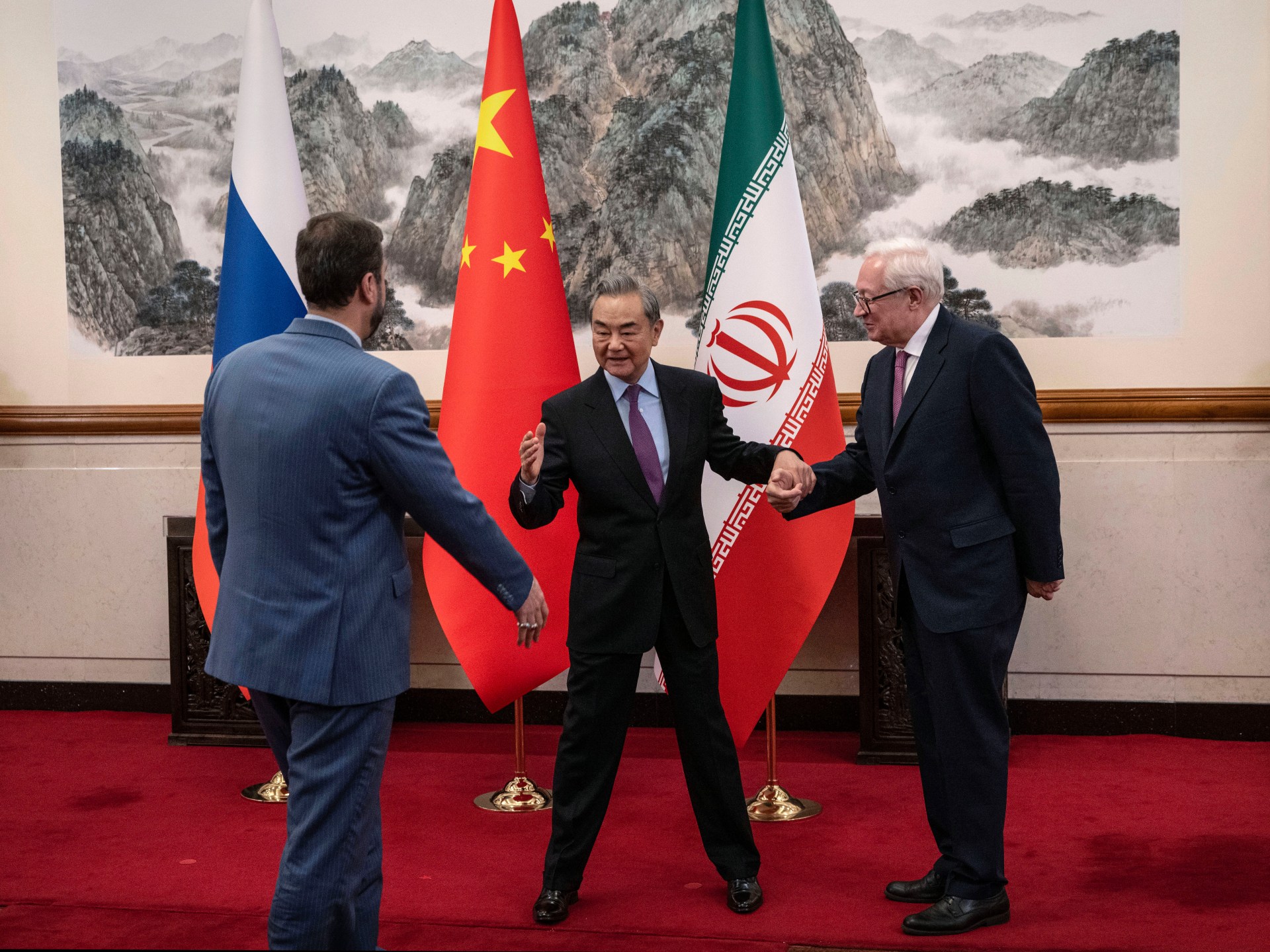
Russia and China, Tehran’s two most powerful diplomatic partners, have labelled the US-Israeli war on Iran that has killed more than 1,000 people a clear violation of international law.
President Vladimir Putin called the assassination of Iranian Supreme Leader Ali Khamenei on Saturday a “cynical violation of all norms of human morals”.
Recommended Stories
list of 4 itemsend of list
China’s Foreign Affairs Minister Wang Yi told his Israeli counterpart, Gideon Saar, that “force cannot truly solve problems” as he urged all sides to avoid further escalation.
Russia and China jointly requested an emergency meeting of the United Nations Security Council.
The reaction reflects the close relationship between Iran, Russia, and China. Moscow and Beijing have signed bilateral deals and expanded coordination through joint naval drills, projecting a united front against what they describe as a US-led international order that has long sought to isolate them.
Yet despite their sharp rhetoric, neither has indicated a willingness to intervene militarily to support Iran.
Russia-Iran: Strategic partners, not military allies
In January 2025, Russia and Iran signed a comprehensive strategic partnership treaty covering areas from trade and military cooperation to science, culture, and education.
The agreement deepened defence and intelligence coordination and supported projects such as transport corridors, linking Russia to the Gulf through Iran.
The pair carried out joint military drills in the Indian Ocean as recently as late February, the week before the US and Israel attacked Iran.
However, when the war began, Moscow was not obliged to respond as the treaty did not include a mutual defence clause, meaning it stopped short of forming a formal military alliance.
Andrey Kortunov, the former director general of the Russian International Affairs Council and a member of the Valdai Discussion Club, a Russian foreign policy think tank, told Al Jazeera via videolink from Moscow, that Russia’s 2024 mutual defence treaty with North Korea is an example of a “more binding” agreement on military support.
He said that, under that agreement, Russia would be obliged to join North Korea “in any conflict the country might get involved in”, whereas with Iran, “it just mentioned that both sides agreed to abstain from any hostile actions in case the other side is engaged in conflict”.
Kortunov said Russia is unlikely to take direct military action in support of Iran because the risks would be too high.
He added that Moscow appears to be “prioritising the United States mediation in the conflict with Ukraine”, and noted that Russia has previously taken a similar approach by criticising US actions in places like Venezuela after the US military attack and arrest of its President, Nicolas Maduro, in January.
Although the treaty clearly states that Russia is not obliged to intervene, he said some of his contacts in Tehran have expressed a “degree of frustration”, and there had been an “expectation that Russia should somehow do more than just diplomatic moves in the United Nations Security Council or in other multilateral forums”.
China–Iran ties and their limits
In 2021, China and Iran signed a 25-year cooperation agreement aimed at expanding ties in areas such as energy, while also drawing Iran into China’s Belt and Road Initiative.
Jodie Wen, a postdoctoral fellow at the Centre for International Security and Strategy (CISS) at Tsinghua University in China, who has travelled frequently to Iran, told Al Jazeera that the relationship is widely viewed in Beijing as pragmatic and stable.
“From the political side, we have regular exchange,” she said over the phone from Beijing, adding, “on the economic side, the cooperation is very deep; many enterprises have investments in Iran.”
Yet she stressed that Beijing has long drawn clear limits around the partnership, particularly regarding military involvement.
“The Chinese government always adheres to not interfering in other countries’ issues … I do not think the Chinese government would send weapons to Iran,” she said.
Instead, Beijing’s role is more likely to focus on diplomacy and crisis management.
“I think China is trying its way to talk with the US side and Gulf countries to keep calm,” she said.
That clarity about the relationship, she added, has helped build trust in Tehran.
Even so, she noted the relationship is not symmetrical.
Vessel-tracking service Kpler estimates that 87.2 percent of Iran’s annual crude oil exports go to China, underscoring how economically significant China is for Tehran, while Iran remains a relatively small partner in China’s global trade.
Dylan Loh, an associate professor in the Public Policy and Global Affairs programme at Nanyang Technological University in Singapore, told Al Jazeera that he believes China’s role regarding Iran “has evolved into a protective one, accelerating its mediation effort to prevent a regional collapse that would threaten its own regional economic and security interests”.
“I think there will be some assessment of how to lower the political risks and what sorts of options are available; truth be told, this re-think already started after [the US attack on] Venezuela,” he said.