
Close Menu
    Trending
    • Katie Holmes And Joshua Jackson Spark ‘Soul-Level’ Love Chatter
    • Singapore Airlines, Southwest Airlines partner to expand access to nearly 120 US destinations
    • Trump warns Netanyahu: ‘You’ll be on your own’ if attacks on Iran continue | US-Israel war on Iran News
    • Cristiano Ronaldo, ‘The Bosnian Diamond’ headline the World Cup 40-and-over club
    • How housing market inventory is shifting across every state
    • What is a ‘normal’ memory slowdown, and when should I worry?
    • Ariana Grande And Ethan Slater Are ‘Still Friends’ Following Split
    • US says BYD, Baidu, Alibaba and other tech giants are aiding China’s military
    Benjamin Franklin Institute
    Tuesday, June 9
    • Home
    • Politics
    • Business
    • Science
    • Technology
    • Arts & Entertainment
    • International
    Benjamin Franklin Institute
    Home»Science»The secret of how cats twist in mid-air to land on their feet
    Science

    The secret of how cats twist in mid-air to land on their feet

    Team_Benjamin Franklin InstituteBy Team_Benjamin Franklin InstituteMarch 4, 2026No Comments4 Mins Read
    Share Facebook Twitter Pinterest Copy Link LinkedIn Tumblr Email VKontakte Telegram
    Share
    Facebook Twitter Pinterest Email Copy Link


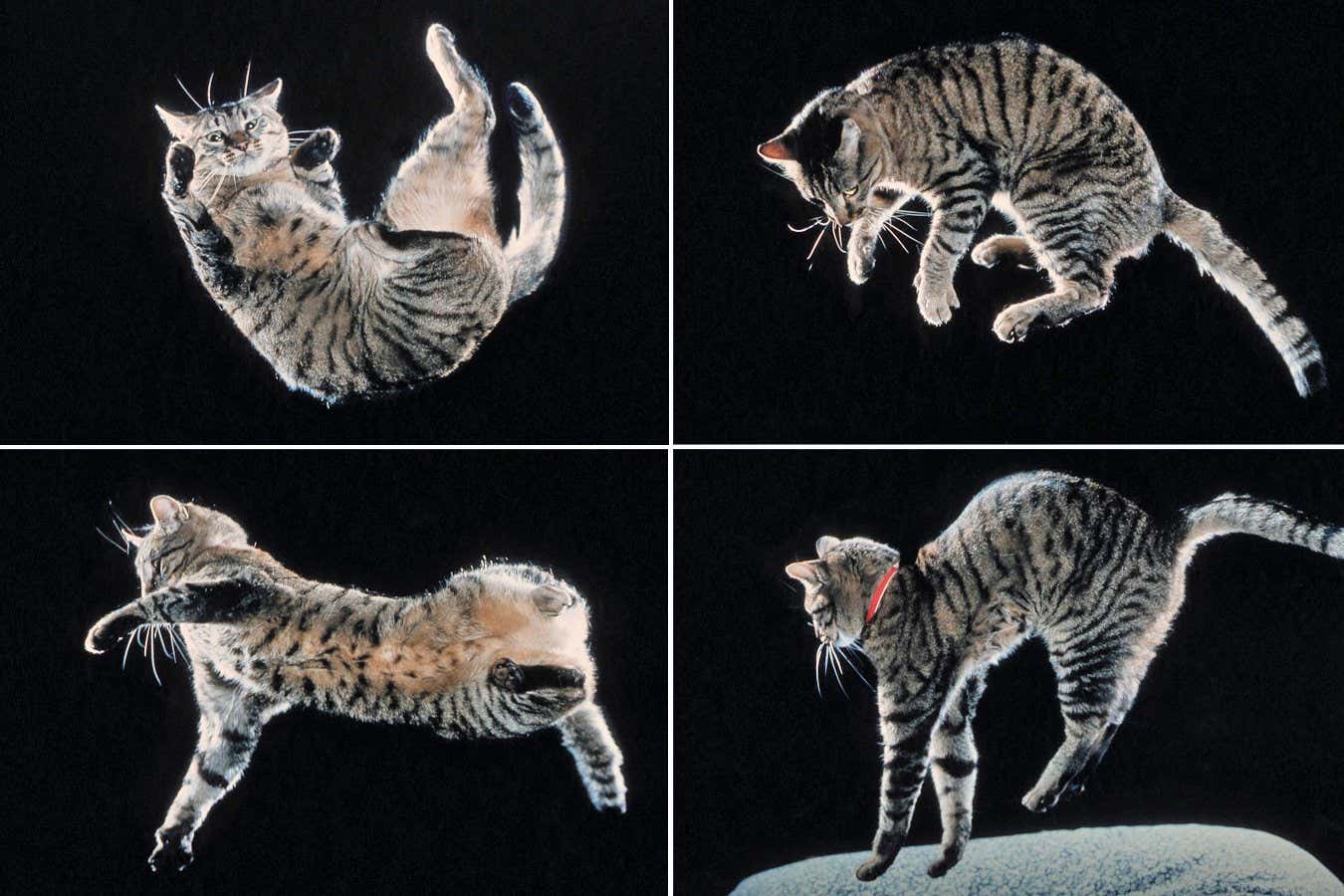
    Falling cats seem to twist the front half of their body first

    Evolve/Photoshot/ZUMAPRE​SS/Alamy

    When falling cats turn themselves the right way up before they hit the ground, they have a secret trick: a region of their spine that is exceptional at twisting.

    “We compared the flexibility of the thoracic spine and lumbar spine in cats, and we found that the thoracic spine is very flexible,” says Yasuo Higurashi at Yamaguchi University in Japan.

    Cats famously always land on their feet. If you hold a cat upside down and drop it, the animal will quickly wriggle in mid-air and land confidently on its feet.

    Quite how cats achieve this has been challenging scientists for over 100 years. Three main ideas have emerged.

    One is the propeller tail: the cat swings the tail one way, causing its body to rotate the other way. “The tail seems to be the least important, because if it doesn’t have a tail it can still turn over,” says Greg Gbur at the University of North Carolina at Charlotte, author of Falling Felines and Fundamental Physics.

    Another idea, the bend-and-twist model, proposes that the cat would bend its body almost into a right angle, then turn its front half one way and the back half the other. This means the front and rear legs both arrive at the correct position at the same time.

    Or the cat could rotate the front first and then the back in a tuck-and-turn. To do this, it would extend its rear legs while keeping its front legs scrunched up, and twist its front half. Then it would swap so the front legs were extended and the rear ones contracted, and twist its rear half. This would mean one pair of legs is correctly oriented before the other.

    To find out what cats really do, Higurashi and his colleagues performed two experiments. In the first, they examined the spines of five deceased cats and twisted them to see how much each region could rotate without breaking. They focused on the thoracic spine, from the middle of the back, and the lumbar spine, from the lower back. It turned out that the thoracic spine had a range of motion three times that of the lumbar spine.

    Second, the team took high-speed video of two adult cats being dropped from a height of 1 metre. In both cases, the cats finished rotating their fronts tens of milliseconds before their rears.

    “My general impression has been that the bend-and-twist is the most important, but this paper actually makes me reassess a bit and give a little bit more credence to the tuck-and-turn,” says Gbur. The highly flexible thoracic spine suggests to him that the front of the cat’s body might be rotating more. Furthermore, in the live experiments, “it really does look like the upper [front] part of the body is properly oriented first”.

    Gbur emphasises that the models are not mutually exclusive. “Physicists in particular love to look for simple models of how things work, whereas nature tends to look for the most effective method, which may not be simple,” he says. “Cats are complicated creatures doing complicated motions.”

    The study also threw up a strange detail. Both of the live cats rotated to the right as they fell: one did so every time, the other in six out of eight trials. Gbur says an audience member at one of his talks noticed that the cats in his videos also seemed to turn to the right. “It looks like, at least anecdotally, cats seem to have a rough preference for which way they twist,” he says. It’s not clear why; it may be that asymmetries in the placement of cats’ internal organs mean it’s easier to turn one way than the other.

    Topics:


    Source link

    Share. Facebook Twitter Pinterest LinkedIn Tumblr Email Telegram Copy Link

    Related Posts

    Science

    What is a ‘normal’ memory slowdown, and when should I worry?

    June 9, 2026
    Science

    Wildlife thrives in solar farm built on restored peatland

    June 8, 2026
    Science

    You don’t need to worry about recursive-self-improving AI – yet

    June 8, 2026
    Science

    Understanding anorexia’s grip on the brain could unlock new therapies

    June 8, 2026
    Science

    Why GLP-1 drugs might reduce cancer risk

    June 8, 2026
    Science

    Landmark pancreatic cancer treatment paves way for targeting other tricky tumors

    June 8, 2026
    Editors Picks

    Shia LaBeouf Looks Worn Down In Newly Released Mugshot

    February 22, 2026

    Market Talk – March 4, 2026

    March 4, 2026

    Erich von Daeniken, Swiss author who popularised ancient‑alien theories, dies at 90

    January 11, 2026

    Alan DeKok’s Path From Physics to Network Security

    February 16, 2026

    Aikman makes strong statement about Hurts after bombshell reports

    May 13, 2026
    About Us
    About Us

    Welcome to Benjamin Franklin Institute, your premier destination for insightful, engaging, and diverse Political News and Opinions.

    The Benjamin Franklin Institute supports free speech, the U.S. Constitution and political candidates and organizations that promote and protect both of these important features of the American Experiment.

    We are passionate about delivering high-quality, accurate, and engaging content that resonates with our readers. Sign up for our text alerts and email newsletter to stay informed.

    Latest Posts

    Katie Holmes And Joshua Jackson Spark ‘Soul-Level’ Love Chatter

    June 9, 2026

    Singapore Airlines, Southwest Airlines partner to expand access to nearly 120 US destinations

    June 9, 2026

    Trump warns Netanyahu: ‘You’ll be on your own’ if attacks on Iran continue | US-Israel war on Iran News

    June 9, 2026

    Subscribe for Updates

    Stay informed by signing up for our free news alerts.

    Paid for by the Benjamin Franklin Institute. Not authorized by any candidate or candidate’s committee.
    • Privacy Policy
    • About us
    • Contact us

    Type above and press Enter to search. Press Esc to cancel.