

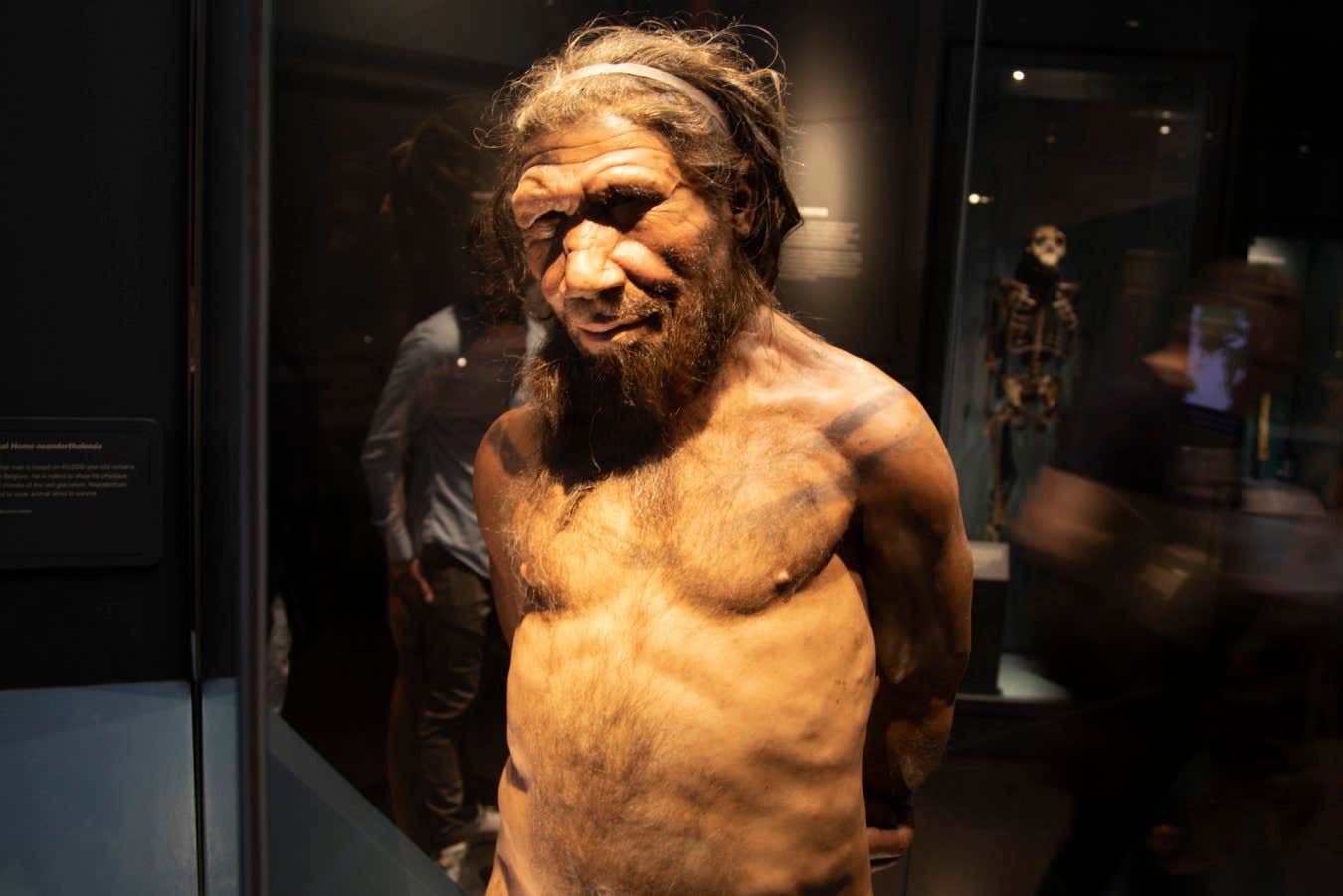
Model of a Neanderthal man at the Natural History Museum in London
Mike Kemp/In Pictures/Getty Images
When our species and Neanderthals interbred, it may have been mostly female Homo sapiens and male Neanderthals that mated. That’s the conclusion of a study of the genetic traces left in both populations by the intermixing.
It isn’t clear why this sex-biased mating pattern would have happened. It may be that male Neanderthals preferred female H. sapiens over females of their own species, or that female H. sapiens females preferred Neanderthal males, or both. There is also no way to determine whether the matings were consensual or forced.
“I think we can say very little,” says Alexander Platt at the University of Pennsylvania in Philadelphia. “The meaningful thing that we can say is that it was something that took place over generations.”
Other geneticists say the evidence is intriguing but inconclusive. “I think we need more evidence, because it’s a big claim about the behaviour,” says Arev Sümer at the Max Planck Institute for Evolutionary Anthropology in Leipzig, Germany.
We have known since 2010 that H. sapiens – sometimes referred to as modern humans – and Neanderthals interbred after some members of our species moved out of Africa into Eurasia. There seem to have been multiple periods of interbreeding: one around 50,000 to 43,000 years ago, and an earlier one that is harder to pin down, perhaps 200,000 years or more in the past. Today, all people of non-African descent carry some Neanderthal DNA.
However, researchers haven’t paid much attention to how this affected the sex chromosomes. Females typically have two X chromosomes, while males usually have one X and one Y. Platt and his colleagues Sarah Tishkoff and Daniel Harris, also at the University of Pennsylvania, focused on the human and Neanderthal X chromosomes.
“One of the things that’s been pretty abundantly clear when looking at the human X chromosome is that it’s almost entirely a Neanderthal desert,” says Harris. Compared with other chromosomes, the human X chromosome is virtually devoid of Neanderthal DNA. The team considered four possible reasons for this.
First, it could be that H. sapiens and Neanderthals were sufficiently different that their DNA didn’t work together very well. This is called hybrid incompatibility, and could cause human-Neanderthal hybrids to have difficulties with health or reproduction. However, the team found that the Neanderthal X chromosome contained more H. sapiens DNA than did the Neanderthal non-sex chromosomes – suggesting the X chromosome DNA from the two hominins was compatible.
Second, natural selection could have favoured modern human DNA. Neanderthals had quite small populations, so natural selection would have struggled to eliminate harmful mutations. In contrast, modern humans had larger populations and bad mutations would have been cleared, so modern human X chromosome DNA would have spread in the Neanderthal population. However, the team says that doesn’t make sense either, because the modern human DNA retained on the Neanderthal X chromosome is mostly in non-functional regions, where it wouldn’t do any good.
Alternatively, there could be a cultural reason. Societies differ in how the sexes move around: in some, females leave their home group to live with their sexual partners, but in others, it is the males who relocate. Modern human women moving to live with Neanderthals could produce a bias on the X chromosome, but it wouldn’t be enough to account for the strength of the bias the team found – even if every single interbreeding female was a modern human.
That, the team says, leaves only one possible explanation: a mating preference. Male Neanderthals preferred female H. sapiens over Neanderthal partners, or female H. sapiens preferred male Neanderthals over human partners – or both. “If they just like it that way, that explains everything,” says Platt.
However, other geneticists say we cannot be so confident that the alternative explanations are wrong. Sümer points out that the earlier episode of interbreeding had a drastic effect on the Neanderthal genome: their original Y chromosomes were completely replaced by H. sapiens Y chromosomes. “There should be some huge amount of modern human males involved in this mixing process,” she says.
We can’t rule out hybrid incompatibility either, says Moisès Coll Macià at the Institute of Evolutionary Biology in Barcelona, Spain. The team assumed that it would be equally intense when Neanderthal DNA entered the modern human genome and vice versa. “That might not be the case,” he says.
Coll Macià says we also need to consider yet another possibility: meiotic drive. Rogue genetic elements can cause one of a pair of chromosomes to be passed on more often than would be expected by chance. His team has found tentative evidence of this happening in modern humans outside Africa, resulting in the deletion of Neanderthal DNA from their X chromosomes.
Topics: