

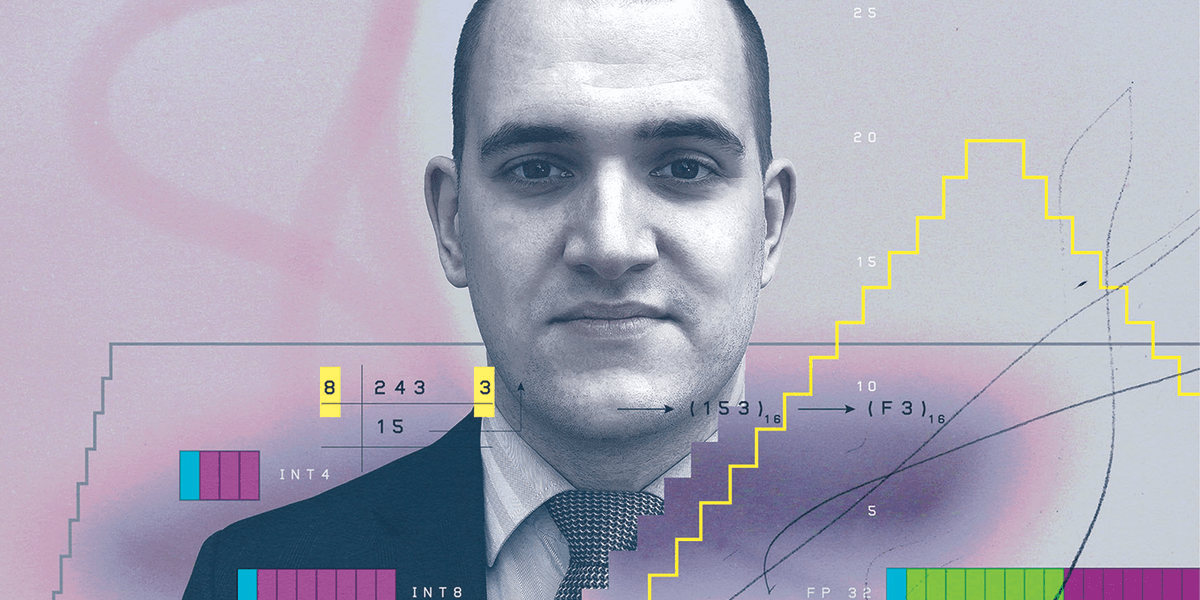
AI has driven an explosion of new number formats—the ways in which numbers are represented digitally. Engineers are looking at every possible way to save computation time and energy, including shortening the number of bits used to represent data. But what works for AI doesn’t necessarily work for scientific computing, be it for computational physics, biology, fluid dynamics, or engineering simulations. IEEE Spectrum spoke with Laslo Hunhold, who recently joined Barcelona-based Openchip as an AI engineer, about his efforts to develop a bespoke number format for scientific computing.
LASLO HUNHOLD
Laslo Hunhold is a senior AI accelerator engineer at Barcelona-based startup Openchip. He recently completed a Ph.D. in computer science from the University of Cologne, in Germany.
What makes number formats interesting to you?
Laslo Hunhold: I don’t know another example of a field that so few are interested in but has such a high impact. If you make a number format that’s 10 percent more [energy] efficient, it can translate to all applications being 10 percent more efficient, and you can save a lot of energy.
Why are there so many new number formats?
Hunhold: For decades, computer users had it really easy. They could just buy new systems every few years, and they would have performance benefits for free. But this hasn’t been the case for the last 10 years. In computers, you have a certain number of bits used to represent a single number, and for years the default was 64 bits. And for AI, companies noticed that they don’t need 64 bits for each number. So they had a strong incentive to go down to 16, 8, or even 2 bits [to save energy]. The problem is, the dominating standard for representing numbers in 64 bits is not well designed for lower bit counts. So in the AI field, they came up with new formats which are more tailored toward AI.
Why does AI need different number formats than scientific computing?
Hunhold: Scientific computing needs high dynamic range: You need very large numbers, or very small numbers, and very high accuracy in both cases. The 64-bit standard has an excessive dynamic range, and it is many more bits than you need most of the time. It’s different with AI. The numbers usually follow a specific distribution, and you don’t need as much accuracy.
What makes a number format “good”?
Hunhold: You have infinite numbers but only finite bit representations. So you need to decide how you assign numbers. The most important part is to represent numbers that you’re actually going to use. Because if you represent a number that you don’t use, you’ve wasted a representation. The simplest thing to look at is the dynamic range. The next is distribution: How do you assign your bits to certain values? Do you have a uniform distribution, or something else? There are infinite possibilities.
What motivated you to introduce the takum number format?
Hunhold: Takums are based on posits. In posits, the numbers that get used more frequently can be represented with more density. But posits don’t work for scientific computing, and this is a huge issue. They have a high density for [numbers close to one], which is great for AI, but the density falls off sharply once you look at larger or smaller values. People have been proposing dozens of number formats in the last few years, but takums are the only number format that’s actually tailored for scientific computing. I found the dynamic range of values you use in scientific computations, if you look at all the fields, and designed takums such that when you take away bits, you don’t reduce that dynamic range
This article appears in the March 2026 print issue as “Laslo Hunhold.”
From Your Site Articles
Related Articles Around the Web