

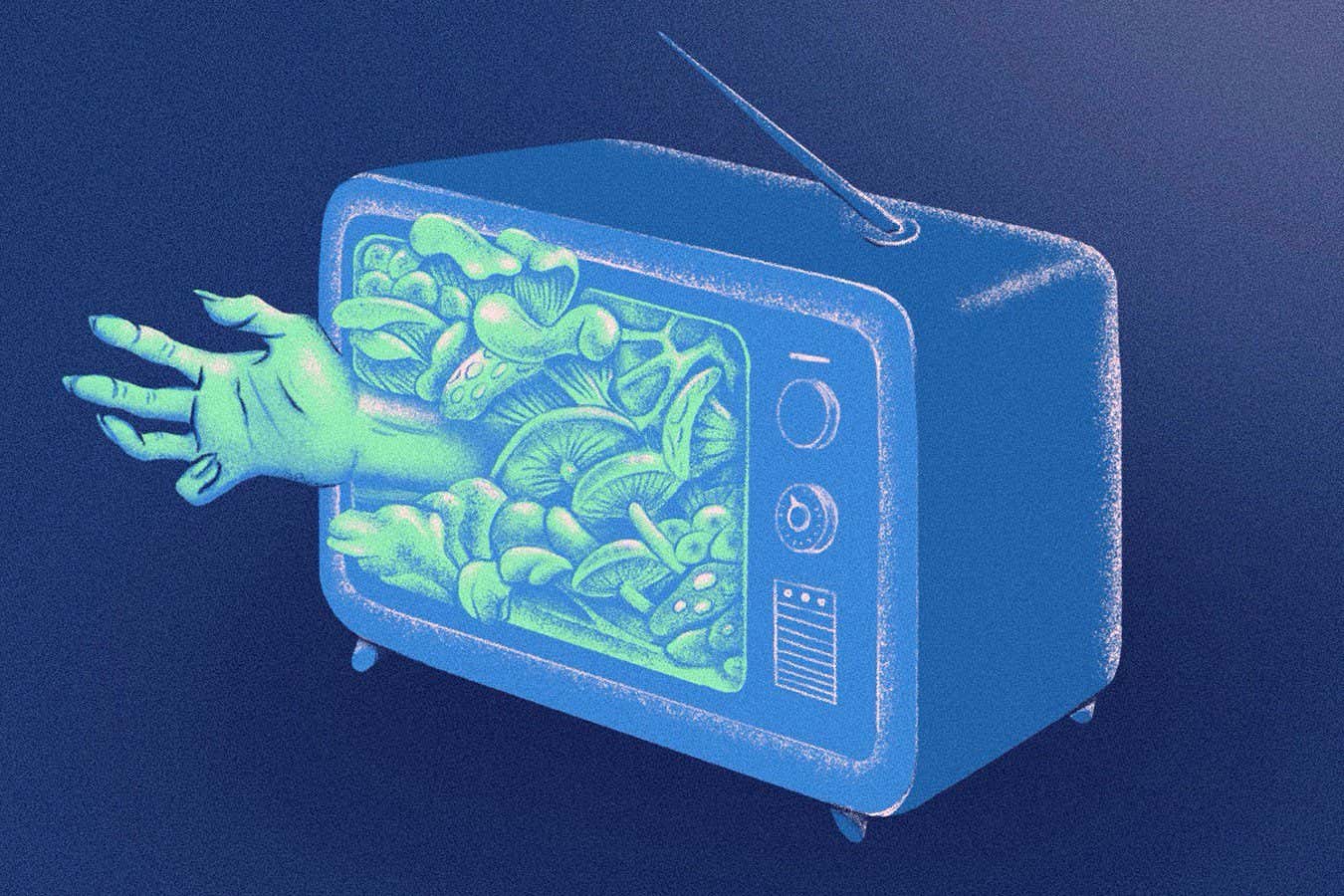
Someone inhales fungal spores. They feel strange. They might get a bit bitey. Possibly a bit dead. And then… POP! Something gruesome happens and the horror spreads.
Such is the fate of many in Cold Storage, a new film in which a trio of unlikely heroes try to save the world from apocalypse. Their enemy? A mutated Cordyceps fungus that, on account of some dastardly solar radiation, now infects warm-blooded animals rather than its usual prey. But haven’t we seen this before?
Cordyceps exist, and many of them have indeed adapted to a spectacularly cinematic form of parasitism: spores invade an unlucky invertebrate’s body; the fungus grows, consuming its host’s insides while infiltrating its nervous system and muscles; the host’s behaviour changes, perhaps seeking out platforms for optimal spore dispersal until, finally, its fungus-riddled corpse sprouts tendril-like growths, releasing hundreds of thousands of spores into the air, whereupon the whole macabre dance starts anew.
Because Cordyceps lack the ability to survive in the hothouses that are mammalian bodies, it is incredibly unlikely that any could ever transpose their attention to humans. But the nightmare persists. It fuelled The Girl With All The Gifts, unleashing a zombie apocalypse at cinemas in 2016. Last year, the second series of HBO’s The Last of Us continued using the same bioterror as an antagonist. In November, radio drama Spores found a familiar fungus transforming humans in rural Wales. And now, yet more.
This obsession with Cordyceps is misrepresenting the kingdom of fungi. At only a few hundred species, they are a vanishingly tiny part of the dizzying diversity of fungi, and while I will concede there is a UK National Collection of Pathogenic Fungi housing more than 4500 “potentially deadly fungi“, there is so much more to celebrate about fungi than to fear.
Let’s start with the superlatives. Fungi are the biggest: a single individual of Armillaria ostoyae in Malheur National Forest in Oregon is, at almost 10 square kilometres of subterranean fibre, the largest known organism on Earth. Fungi are the oldest ecosystem engineers: research last year suggested fungi transitioned to land hundreds of millions of years ahead of modern land plants, helping to build the first soils. Fungi are the most sexually flexible: the split gill mushroom (Schizophyllum commune) relies on over 23,000 “mating types” (similar to sexes) to guarantee mating success.
We could list the ways in which fungi benefit all life, from the irrepressible removal of dead organic matter that would otherwise choke the planet, to their symbiosis with 90 per cent of plants, releasing essential nutrients and keeping Earth green. Or we could consider what our own species has to thank them for: penicillin, immunosuppressants, anticoagulants and psilocybin compounds for treating depression. Sourdough! Beer!
All this from a branch on the tree of life we estimate is only 10 per cent described. Yet, what we do know about contains a universe of inspiration for the science-fiction author: ancient survivors that feed on radioactivity; decomposers that feast on plastic; predators that actively hunt their prey with microscopic lassos. If you want a real fungal apocalypse to keep you up at night, how about the devastating impact climate change will have by boosting fungal destruction of crops?
But these extraordinary creative avenues are largely ignored – and our fictional horizons are the narrower for it. The reliance on Cordyceps terror helps perpetuate the reduction of a kaleidoscope of diversity to a narrative trope. So, I beseech the writers out there: behold the mould! The kingdom of weird surrounds you and is ready to be your muse.
Nick Crumpton works at the Natural History Museum, London, and is a children’s author
Topics: