
Close Menu
    Trending
    • The end of the ‘good enough’ worker
    • Can Apple and Google stop children from sharing explicit images?
    • Amsterdam Bans Meat Ads As The War On Food Expands
    • Katie Holmes And Joshua Jackson Spark ‘Soul-Level’ Love Chatter
    • Singapore Airlines, Southwest Airlines partner to expand access to nearly 120 US destinations
    • Trump warns Netanyahu: ‘You’ll be on your own’ if attacks on Iran continue | US-Israel war on Iran News
    • Cristiano Ronaldo, ‘The Bosnian Diamond’ headline the World Cup 40-and-over club
    • How housing market inventory is shifting across every state
    Benjamin Franklin Institute
    Tuesday, June 9
    • Home
    • Politics
    • Business
    • Science
    • Technology
    • Arts & Entertainment
    • International
    Benjamin Franklin Institute
    Home»Science»We’ve spotted the strongest microwave laser in the known universe
    Science

    We’ve spotted the strongest microwave laser in the known universe

    Team_Benjamin Franklin InstituteBy Team_Benjamin Franklin InstituteFebruary 20, 2026No Comments4 Mins Read
    Share Facebook Twitter Pinterest Copy Link LinkedIn Tumblr Email VKontakte Telegram
    Share
    Facebook Twitter Pinterest Email Copy Link


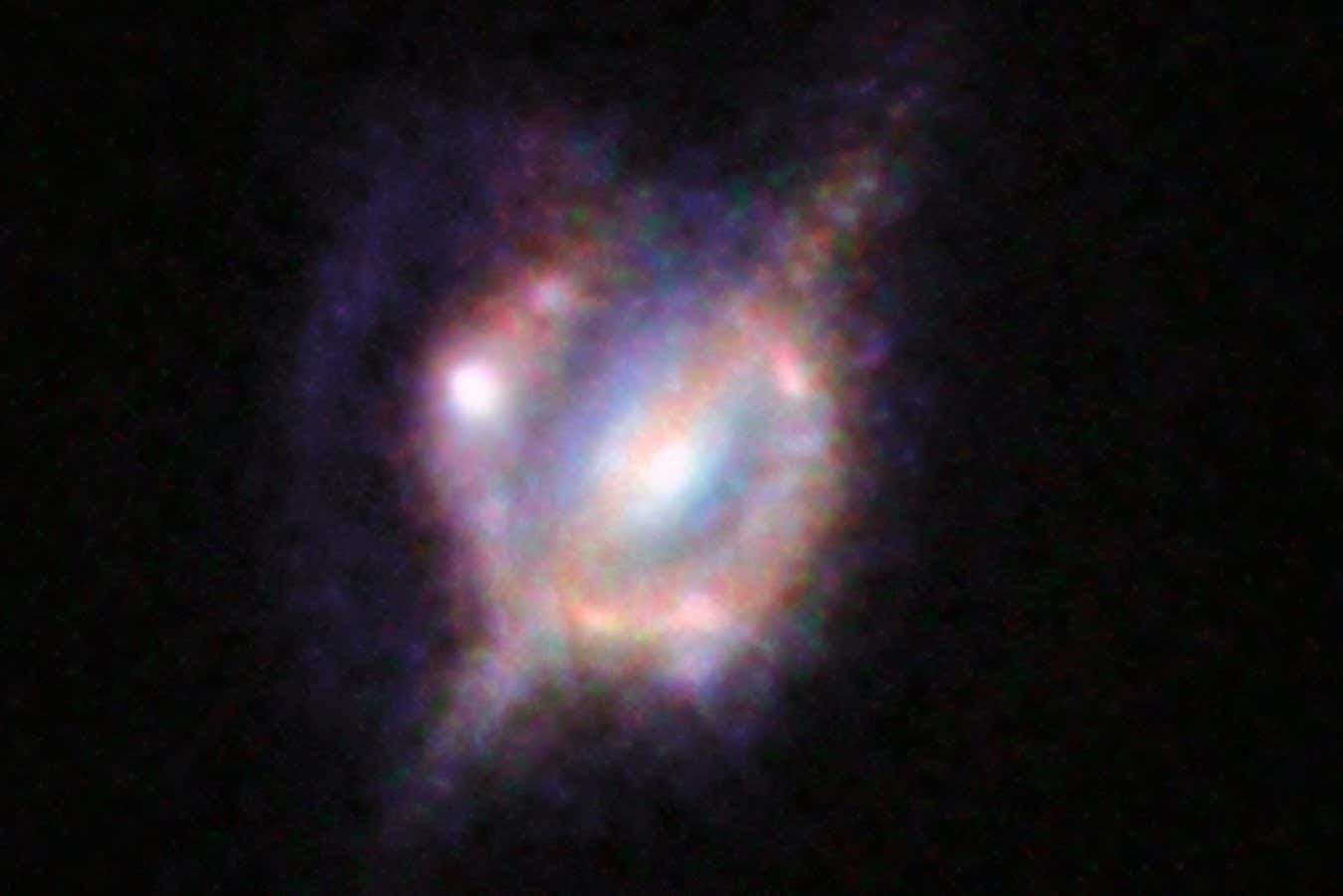
    This image combines views from the Hubble and Keck II telescopes. A galaxy in the foreground, which appears as a diagonal line, is acting as a gravitational lens. The ring shape is a smeared image of the galaxy H1429-0028 in the background

    NASA/ESA/ESO/W. M. Keck Observatory

    Astronomers have spotted a laser-like beam of microwaves produced by two galaxies smashing together, which is the brightest and most distant example of this phenomenon ever seen.

    To produce a laser, first atoms need to be stimulated into an unstable, higher-energy state. Then particles of light, or photons, fired at these atoms will cause them to relax and emit their own photons, causing a chain reaction that produces many more photons in the process. Because each atom emits identical photons, all of the light being produced is at the same frequency, forming a beam of coherent light.

    The same process can happen when galaxies smash together. Gas from both galaxies gets compressed, producing more stars and light. After travelling through clouds of dust, this light can then excite hydroxyl ions, which consist of hydrogen and oxygen atoms, into higher energy states. When these excited ions are blasted with radio waves, such as from a supermassive black hole, they can suddenly relax and produce a beam of extremely bright and focused microwave radiation, known as a maser.

    Now, Roger Deane at the University of Pretoria in South Africa and his colleagues have spotted the brightest and most distant maser so far, in a galaxy nearly 8 billion light years away called H1429-0028. The light from this galaxy is warped by a massive galaxy between it and Earth that acts as a magnifying glass, an effect called gravitational lensing.

    Deane and his colleagues were using the MeerKAT telescope in South Africa, which consists of 64 linked radio telescopes that act as one giant dish, to look for galaxies rich in molecular hydrogen, which emit light at a telltale frequency. But when they turned MeerKAT towards H1429-0028, they saw light being strongly emitted at a higher frequency, which they knew was only produced by powerful masers.

    “We had a quick look at the 1667 megahertz [frequency], just to see whether it was even detectable, and there was this booming, huge [signal]. It was immediately the record,” says Deane. “It was serendipitous.”

    The light beam from the galaxy is so bright that the maser may warrant its own category, called a gigamaser, much more powerful than the megamasers that have been observed in galaxies closer to us. “This is about 100,000 times the luminosity of a star, but in a distant galaxy, concentrated into a very, very small part of the [electromagnetic] spectrum,” says Deane.

    We should be able to detect similar masers at much greater distances when the Square Kilometre Array in South Africa, a much larger and more sensitive version of MeerKAT, is completed and comes online in the coming years, says Matt Jarvis at the University of Oxford.

    Such distant galaxy masers will be from some of the first galaxies formed in the universe and could give us precise information about how galaxies were merging far back in time, says Jarvis. “[Masers] need very precise conditions,” he says. “You need this radio continuum emission and you need this infrared emission, which you only really get from dust heated around forming stars. In order to get these very specific physical conditions to get the maser in the first place, you need merging galaxies.”

    New Scientist. Science news and long reads from expert journalists, covering developments in science, technology, health and the environment on the website and the magazine.

    The world capital of astronomy: Chile

    Experience the astronomical highlights of Chile. Visit some of the world’s most technologically advanced observatories and stargaze beneath some of the clearest skies on earth.

    Topics:


    Source link

    Share. Facebook Twitter Pinterest LinkedIn Tumblr Email Telegram Copy Link

    Related Posts

    Science

    Can Apple and Google stop children from sharing explicit images?

    June 9, 2026
    Science

    What is a ‘normal’ memory slowdown, and when should I worry?

    June 9, 2026
    Science

    Wildlife thrives in solar farm built on restored peatland

    June 8, 2026
    Science

    You don’t need to worry about recursive-self-improving AI – yet

    June 8, 2026
    Science

    Understanding anorexia’s grip on the brain could unlock new therapies

    June 8, 2026
    Science

    Why GLP-1 drugs might reduce cancer risk

    June 8, 2026
    Editors Picks

    Trump’s changing course on Strait of Hormuz strategy raises questions about US war preparation

    March 23, 2026

    Opinion | Confessions of a Former Body Positivity Influencer

    February 16, 2026

    Trump U-turn: Is Venezuelan oil really available to Cuba again? | Energy News

    February 26, 2026

    Hamas armed wing says disarmament calls are unacceptable

    April 6, 2026

    Mario Lopez ‘Completely Lost It’ At Cheerleader Suing Him For Defamation

    August 8, 2025
    About Us
    About Us

    Welcome to Benjamin Franklin Institute, your premier destination for insightful, engaging, and diverse Political News and Opinions.

    The Benjamin Franklin Institute supports free speech, the U.S. Constitution and political candidates and organizations that promote and protect both of these important features of the American Experiment.

    We are passionate about delivering high-quality, accurate, and engaging content that resonates with our readers. Sign up for our text alerts and email newsletter to stay informed.

    Latest Posts

    The end of the ‘good enough’ worker

    June 9, 2026

    Can Apple and Google stop children from sharing explicit images?

    June 9, 2026

    Amsterdam Bans Meat Ads As The War On Food Expands

    June 9, 2026

    Subscribe for Updates

    Stay informed by signing up for our free news alerts.

    Paid for by the Benjamin Franklin Institute. Not authorized by any candidate or candidate’s committee.
    • Privacy Policy
    • About us
    • Contact us

    Type above and press Enter to search. Press Esc to cancel.