

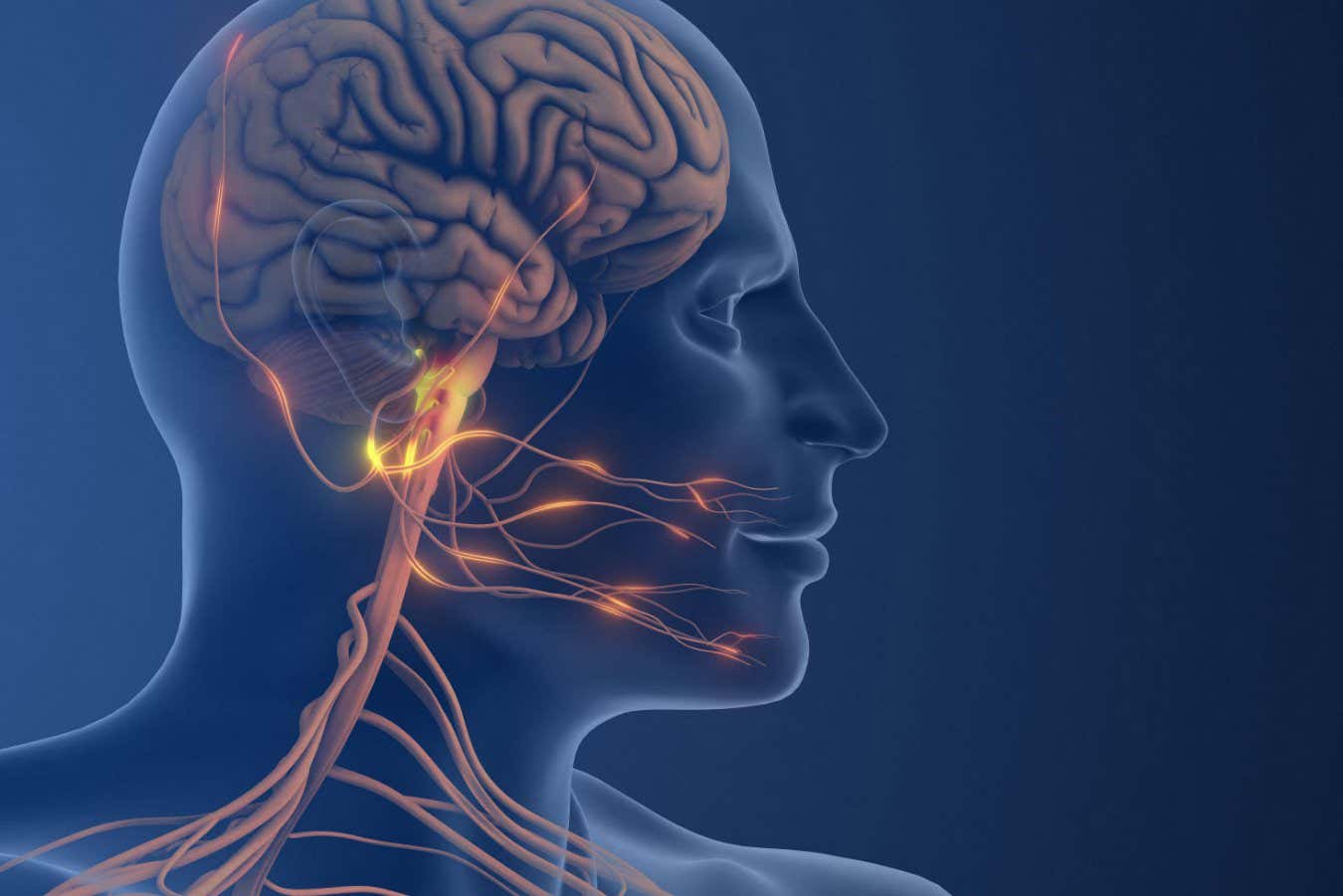
The trigeminal nerve is implicated in migraine, so it represents a target for better treatments
jitendra jadhav/Alamy
We could be on the cusp of a new wave of migraine therapies. Revisiting a neurological pathway that has long been dismissed for treating the painful condition has yielded promising results. By understanding the various mechanisms behind migraine, which affects more than 1 billion people worldwide, we could provide relief for the 1 in 3 people with the condition who don’t respond to current treatments.
Failed drug trials over the past few decades meant many dismissed this pathway as inconsequential in our quest to prevent and treat migraine. But now, a placebo-controlled study has some wondering if this may have been too hasty.
Messoud Ashina at the University of Copenhagen in Denmark and his colleagues have looked at a chemical messenger, or neuropeptide, called substance P. This is released by the trigeminal nerve, which has been implicated in migraines for decades. Substance P induces pain by dilating blood vessels, causing inflammation in the meninges (the thin membranes surrounding the brain), and by altering nervous system activity to amplify pain signalling.
Last year, the researchers showed that infusions of substance P led to headaches in 71 per cent of people who don’t get migraines, along with dilation of the superficial temporal artery, which has been linked to the condition. Now, they have found a similarly sized effect when infusing it into people who get migraines, supporting substance P’s involvement.
This comes after substance P was abandoned as a target molecule against migraine at the end of the 1990s, following five experimental drugs that showed targeting substance P had no benefit over placebo.
Ashina’s team wondered if these failures were due to those drugs acting on only one of substance P’s receptors: neurokinin-1 receptor (NK1-R). It is now known to bind to a second set of receptors, the MRGPRX2 receptors, which cause inflammation, and to act directly on sensory neurons to boost pain signals.
“After the NK1 receptor–targeted drug trials failed, there were no serious efforts to explain the failure,” says Michael Moskowitz at Harvard, who uncovered the role of the trigeminal nerve in migraine. “They probably missed blocking the wide range of substance P effects. With new knowledge comes new treatment possibilities, and based on new and existing knowledge, it seems timely and prudent to revisit strategies that target substance P.”
This should be more straightforward now that we can produce monoclonal antibodies that block molecules directly. These are already proven to work against calcitonin gene-related peptide (CGRP), the target of our most potent migraine therapies, and are under investigation for a third migraine-related neuropeptide: pituitary adenylate cyclase-activating polypeptide (PACAP).
Earlier this month, the Danish pharmaceutical company Lundbeck announced early results from a randomised controlled trial of its anti-PACAP monoclonal antibody, called bocunebart. According to the announcement, which didn’t include data, infusions of bocunebart significantly reduced monthly migraine days compared with a placebo. “It’s good news, of course, as long as we have hard data,” says Lars Edvinsson of Lund University in Sweden, who was involved in discovering the roles of PACAP and substance P in migraine. Lundbeck says it plans to share full data at an upcoming conference.
A shift in focus on the causes of migraine could reduce our reliance on inhibitors of CGRP. Since the first CGRP inhibitor was approved in the US in 2018, these treatments have revolutionised how we manage migraine – halving the number of migraine days per month and shortening the duration of any remaining attacks. But they don’t work for up to 40 per cent of people.
“CGRP drugs work very well for some people, but they don’t work for everybody,” says Peter Goadsby at King’s College Hospital in London, who discovered the role of CGRP in migraine in the 1990s, alongside Edvinsson. “Finding the next thing that will benefit the hundreds of millions of people who are not well treated by current therapies remains an important challenge.”
We are now waiting for further evidence on the real-world effects of blocking these problematic peptides. “We should be optimistic because substance P, CGRP and PACAP all act on the meningeal vessel wall and their respective receptor systems, but do so in different ways,” says Moskowitz. Blocking several pathways in combination may be the key to reducing the number of non-responders, he suggests.
But substance P- and PACAP-targeting drugs may not have as big an impact as those that block CGRP, which is released in far greater quantities in the trigeminal nerve. “I don’t think [these targets] will replace CGRP,” says Edvinsson. “I think they are more like the sprinkles on top of the ice cream.”
Topics: