
Close Menu
    Trending
    • Emily Blunt Has Fans Seeing Red With Her ‘Terrible Advice’
    • ‘Everyone wants to come to China now’: Chinese universities draw more foreign students beyond Western countries
    • Arsenal vs Fulham: Premier League – teams, start, lineups, title race | Football News
    • Cowboys somehow got the ‘biggest steal’ of the NFL Draft
    • Chipotle’s new brand chief gave fast-food burgers buzz. Now he’s coming for fast-casual burritos
    • ‘Green’ cryptocurrency uses 18 times more energy than makers claim
    • Direct Flights Between U.S. and Venezuela Resume After 7 Years
    • Two Cases Where Simulation Fills the Gap
    Benjamin Franklin Institute
    Friday, May 1
    • Home
    • Politics
    • Business
    • Science
    • Technology
    • Arts & Entertainment
    • International
    Benjamin Franklin Institute
    Home»Science»Royal Navy returns to wind power with trial of robotic sailboats
    Science

    Royal Navy returns to wind power with trial of robotic sailboats

    Team_Benjamin Franklin InstituteBy Team_Benjamin Franklin InstituteFebruary 12, 2026No Comments3 Mins Read
    Share Facebook Twitter Pinterest Copy Link LinkedIn Tumblr Email VKontakte Telegram
    Share
    Facebook Twitter Pinterest Email Copy Link


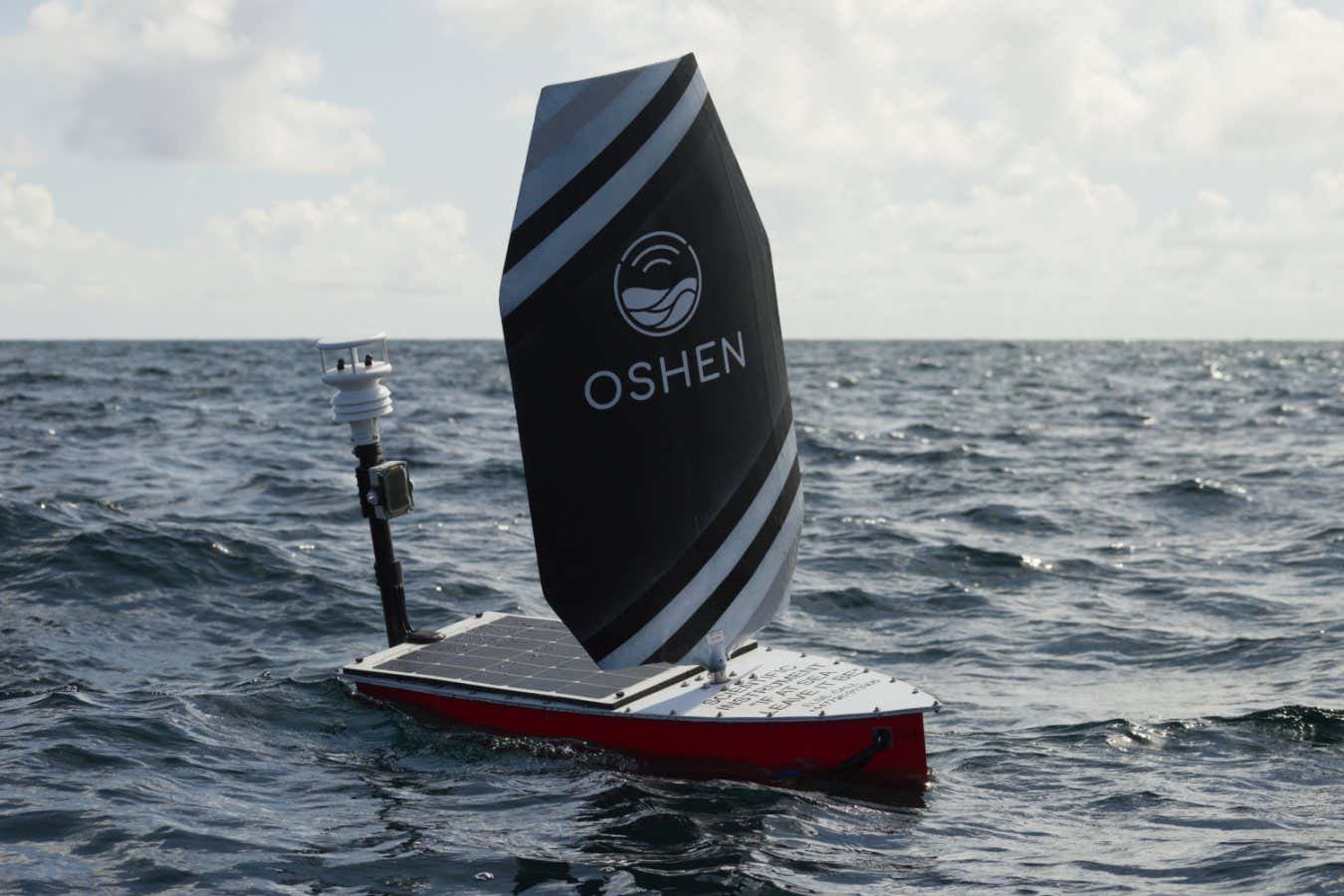
    Oshen’s robotic sailboats are powered by the wind and the sun

    Oshen

    The UK’s Royal Navy may return to the age of sail, with a new demonstration involving a flotilla of small, wind-propelled robot boats.

    Made by Oshen in Plymouth, UK, the vessels, known as C-Stars, are just 1.2 metres long and weigh around 40 kilos. Solar panels power navigation, communications and sensors, while a sail provides propulsion. Deployed as a constellation, the small vessels act as a wide-area sensor network.

    “The simplest way of describing C-Stars is as self-deploying, station-keeping ocean buoys,” says Oshen CEO Anahita Laverack.

    The boats can sail at about 2 knots, covering around 50 miles per day, or use the wind to remain in place rather than drifting. They don’t need to be fast. “Speed is not important when you are a CCTV network,” says Laverack. “The idea is to position sensors everywhere you need them.”

    In the trial announced this month, a larger robotic vessel will transport three C-Stars and drop them off in the target area. The C-Stars will then relay acoustic signals to and from an uncrewed submarine. Many more would be deployed in a live operation.

    “If you only have one, then the adversary can tell the general area of the submarine it is communicating with. If you have a hundred, the submarine could be anywhere, under any of them,” says Laverick.

    The uncrewed boats can stay at sea for six months or more and survive the worst sea states. Last year, C-Stars became the first uncrewed vessels to provide live data from inside a category 5 storm, as part of a research project involving the US National Oceanic and Atmospheric Administration.

    If the navy demonstration is successful, robot sailboats could take on a variety of roles. In addition to communication with submarines and seabed sensors, they could form picket lines to detect ships, incoming missiles, or drones trying to sneak under radar.

    C-Stars also seem ideal for submarine detection as an alternative to disposable sonar-equipped buoys, which only last a few hours. They can use their hydrophones to listen for subs or pick up reflected sonar pings from an external source such as a warship. In this scenario, the ship’s sonar effectively lights up an area, so that the C-Stars can see anything near them.

    Blair Thornton at the University of Southampton, UK, says solar- and wind-powered uncrewed vessels have gradually become accepted over the last decade, and around 100 of various types are in service. He says autonomy will be essential with a fleet of them.

    “It isn’t only the platform costs, but it is how much oversight they need for their operations,” says Thornton. “The combination of long endurance, robust operations with minimal need for human interaction can be a major advantage and allow large fleets of autonomous systems to operate.”

    The latest demonstration aims to show C-Stars can easily integrate with existing navy systems. Oshen could deliver 1000 boats with a nine-month lead time if the navy decides to place an order.

    “The next level will involve software refinements so we can see more detail and achieve better coverage of a wider area with fewer C-Stars,” says Laverack.

    Topics:


    Source link

    Share. Facebook Twitter Pinterest LinkedIn Tumblr Email Telegram Copy Link

    Related Posts

    Science

    ‘Green’ cryptocurrency uses 18 times more energy than makers claim

    April 30, 2026
    Science

    The rich but complicated legacy of genome pioneer Craig Venter

    April 30, 2026
    Science

    Doubts cast over ‘wild’ claim that magnetic control can turn on genes

    April 30, 2026
    Science

    Is an AI version of Mark Zuckerberg – or any boss – a good plan?

    April 30, 2026
    Science

    What happened after the fall of Rome? Ancient genomes offer new clues

    April 30, 2026
    Science

    A giant hailstorm just killed an emu at a Missouri zoo

    April 30, 2026
    Editors Picks

    Why AI-powered city cameras are sounding new privacy alarms

    April 6, 2026

    Gina Carano Breaks Silence On ‘Star Wars’ Costar Pedro Pascal

    April 30, 2026

    Prince Harry sued by charity he set up in Africa to honour late mother Princess Diana

    April 10, 2026

    IEEE Young Professionals Tackle Skills Gap in Tech

    March 17, 2026

    Should Israel be banned from international competitions? | TV Shows

    September 29, 2025
    About Us
    About Us

    Welcome to Benjamin Franklin Institute, your premier destination for insightful, engaging, and diverse Political News and Opinions.

    The Benjamin Franklin Institute supports free speech, the U.S. Constitution and political candidates and organizations that promote and protect both of these important features of the American Experiment.

    We are passionate about delivering high-quality, accurate, and engaging content that resonates with our readers. Sign up for our text alerts and email newsletter to stay informed.

    Latest Posts

    Emily Blunt Has Fans Seeing Red With Her ‘Terrible Advice’

    May 1, 2026

    ‘Everyone wants to come to China now’: Chinese universities draw more foreign students beyond Western countries

    May 1, 2026

    Arsenal vs Fulham: Premier League – teams, start, lineups, title race | Football News

    May 1, 2026

    Subscribe for Updates

    Stay informed by signing up for our free news alerts.

    Paid for by the Benjamin Franklin Institute. Not authorized by any candidate or candidate’s committee.
    • Privacy Policy
    • About us
    • Contact us

    Type above and press Enter to search. Press Esc to cancel.