

Unlock the Editor’s Digest for free
Roula Khalaf, Editor of the FT, selects her favourite stories in this weekly newsletter.
The writer is a former European commissioner (1995-2004) and prime minister of Italy (2011-13)
The EU is now surrounded by powers ruled by authoritarian leaders including, for the first time, the US. Uncomfortable as that may be, the bloc should be proud to be the only large economic and political space sticking to the rule of law and multilateralism. It should be calling on like-minded countries in Europe and across the world to join an alliance of values.
But the silence of European leaders on such an initiative meant that it fell to the Canadian prime minister, Mark Carney, to articulate the idea at the World Economic Forum in Davos. What should the EU do now, then? There is one thing that it should avoid at all costs. It would be suicidal if the union’s already limited authority were to be reduced further, as some are asking for. The first victims of such a move would be the single market and competitiveness.
As it happens, these are the two topics under discussion at Thursday’s meeting of the European Council. It’s a pity that the date of that meeting is not February 18, Ash Wednesday. For if the gathering is to achieve anything, the spirit of those around the table ought to be one of repentance, individually and collectively.
There has long been a pattern of political hypocrisy characterising interactions between the Council, the Commission, member states and business leaders. Commitments are solemnly made but the next day the ingredients of economic nationalism — short-sighted national politicians, corporate leaders seeking protection from them, and an insufficient rigour in enforcing the rules — are at work again.
Until that vicious circle of hypocrisy is brought into the light and properly addressed, excellent reports commissioned by European institutions will be doomed to have little impact. Take the two landmark reports prepared by Enrico Letta in April 2024 and Mario Draghi five months later.
European institutions and member states undertook to implement their findings swiftly. In retrospect, those were rosy days for Europe, before the return of Donald Trump to the White House with all its repercussions. In this new environment, the recommendations of Draghi and Letta should have been regarded as a bare minimum and their implementation accelerated. With tariffs hitting the EU and multilateral trade rules all but dead, more must be squeezed out of the single market in terms of competitiveness and growth.
Instead, the implementation of both reports is well behind the timeline originally set. In these circumstances, the credibility of the EU will be fatally undermined if this Council were to end in overhyped “strong commitments” rather than anything genuinely substantive.
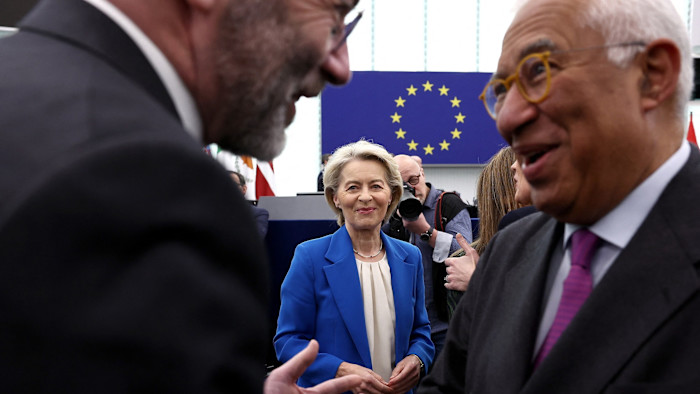
António Costa and Ursula von der Leyen, respective presidents of the European Council and Commission, should insist on an uncomfortable and realistic discussion about the responsibilities both of member states and also of their own institutions. The Council, dubbed the “cartel of nationalism” by former Italian finance minister Tommaso Padoa-Schioppa, and the Commission, still the engine of integration but too lenient with member states that infringe the rules, have a lot to contribute to more credible EU policymaking.
The two presidents should also submit new ideas put forward by member states to close scrutiny. Take the joint position adopted by Germany and Italy. While paying lip service to the single market, they are proposing actions that would exacerbate its fragmentation: a sharp deregulation drive and the relaxation of constraints on state aid.
Both governments are particularly close to business interests. This was most visible in their successful campaign to reverse EU policy on the green transition. That may have bought time for their auto industries, but it will probably enhance Chinese competitiveness in the longer term.
While it is understandable that Germany wants to relax restrictions on state aid, since it has fiscal space allowing it to spend to make its companies (artificially) more competitive, it is hard to see why Italy’s government, lacking comparable means, supports the move. It runs counter to its own national interests, as well as those of the EU.
Moreover, the so-called internal tariffs that both governments attribute to EU regulation are in fact caused by national governments not complying with bloc-wide rules meant to prevent the fragmentation of the single market, with the result that inefficient companies are sheltered behind new forms of national protection. This is a recipe for winning votes, not for improving competitiveness, which Europe so badly needs if it is to thrive in a more hostile world.