

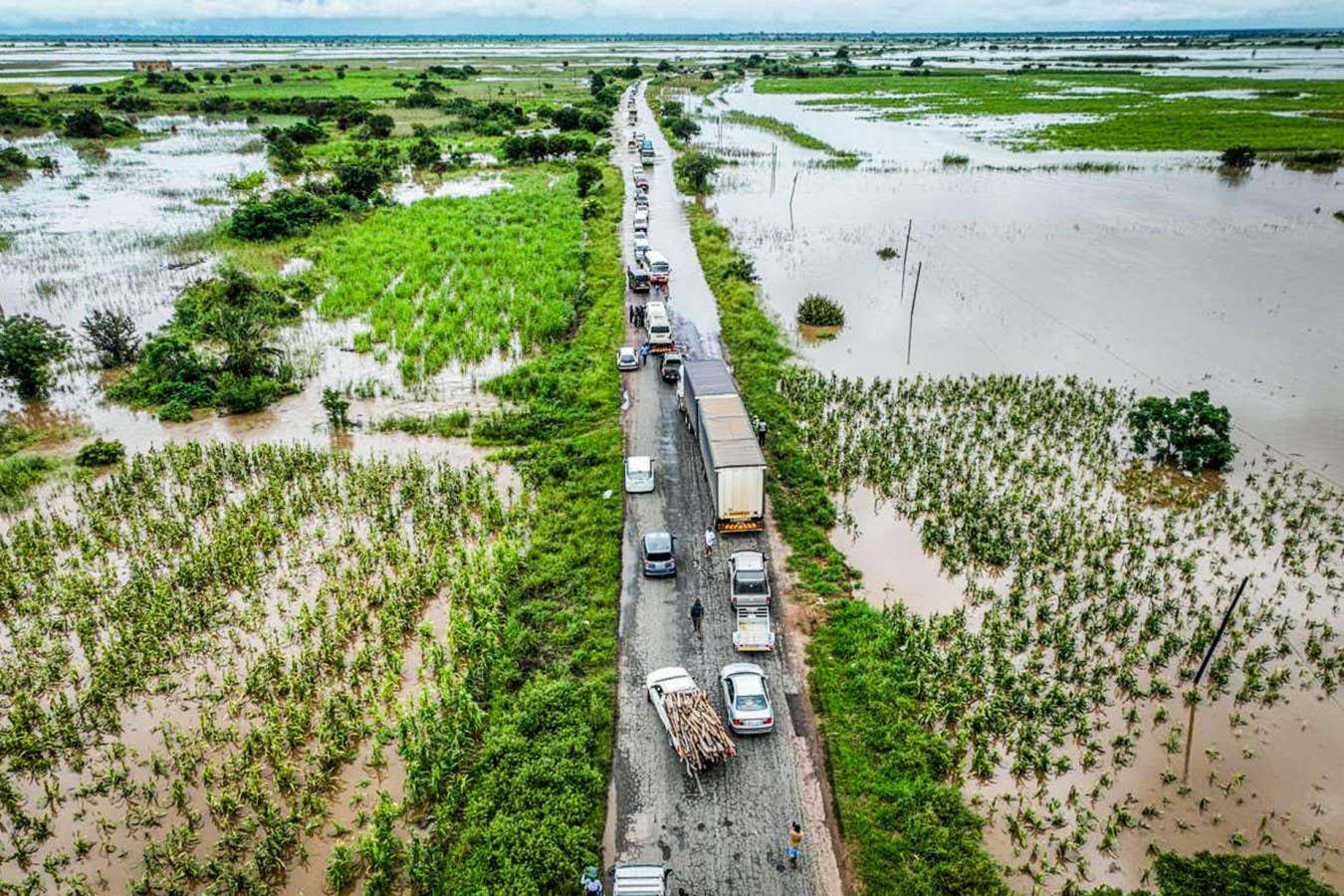
Climate change has already led to more frequent disasters, such as the recent floods in Mozambique
Associated Press/Alamy
More than a decade on from the 2015 Paris climate conference, it is hard not to feel that we have, at best, been treading water on climate action. Sure, there are plenty more electric vehicles on the road and, globally, renewables now produce more electricity than coal. But we continue to pump out more than 41 gigatonnes of carbon dioxide every year, while fossil fuel companies plan for expansion and governments row back on green measures.
There was real optimism in Paris, as countries pledged to pursue efforts to limit the global average temperature increase to 1.5°C above pre-industrial levels. Ten years on, this ambition is, to all intents and purposes, dead in the water. Such is the mechanism used for defining when our world breaches 1.5°C, however, that the year this happens is likely to be officially confirmed only in 2040 or thereabouts – a decade after it actually occurs.
The 1.5°C mark has been conflated with the threshold for dangerous climate change and, as such, has been at the heart of all aspects of climate policy. We have been warned that crossing the 1.5°C threshold hugely increases the risk of critical elements of the climate system tipping, leading to further warming and catastrophic impacts, but even this hasn’t driven the action on emissions that the science demands.
So what happened? Why did we fail? Right at the heart of the issue lies the fact that 1.5°C was treated by many not as a limit but as a target, and whereas a limit is something we try to keep below, a target is something we aim at.
The world had heated by not much more than 1°C by the time of the Paris conference, and the prevailing rate of heating was measured at about 0.18°C a decade. This gave the impression that we had plenty of time to act, and the usual suspects took advantage of this. Governments and fossil fuel corporations keen to keep kicking the climate action can down the road claimed that business as usual could continue for now, and that the time for serious measures had not yet arrived. As a consequence, burning fossil fuels continues to add 37 gigatonnes of carbon dioxide to the atmosphere every year.
As we drift past 1.5°C, there is heated debate about a new lodestar to replace it. Some have suggested using an entirely different yardstick of our progress – or lack of it – such as the rate of take-up of renewable energy. But the key metric really has to be the global temperature rise. This is the benchmark against which the climate system’s response is measured, and it can provide a comparison with ancient episodes of rapid heating that have gripped our world. It is also one that everybody understands, even if many still don’t grasp its significance.
In this regard, because every fraction of a degree is now critical, some have proposed looking to 1.6°C as the new limit, or perhaps 1.7°C. But neither of these will cut it, firstly because they will once again be regarded as targets by those gaming the system, and secondly because at the current rate of heating – 0.27°C a decade – both will be exceeded as soon as the mid-2030s. The reality is that there isn’t a snowball in hell’s chance that we will act on emissions quickly enough to stay this side of either of these marks.
The truth is that adopting a new limit that will quickly become a target would actually make the situation worse, while tying policy to this would set us up, once again, to fail. Maybe, then, we should forget limits altogether, focusing instead on some impactful means of marking the annual global average temperature rise for all to see. This would first need a methodology that allows this figure to be stipulated instantaneously, rather than having to wait 10 years. However, there is already a way of doing this developed by Richard Betts at the UK Met Office, the country’s national weather service, and his colleagues.
Then we need some pictorial means of showing this in a way that everyone can understand – perhaps an Earth Thermometer that is updated at 12-month intervals. Following the example of the Bulletin of the Atomic Scientists, who announce the time on the Doomsday Clock every January representing existential threats to civilisation, maybe a similar annual jamboree could spotlight the ratcheting-up of the global temperature on the same date every year, alongside those tipping points we are on the cusp of crossing, or have crossed already. This would provide an unequivocal benchmark of the shocking impact our activities are having on the planet’s temperature and signal the locking-in, without urgent action, of an increasingly perilous future.
Bill McGuire is professor emeritus of geophysical and climate hazards at University College London. His next book: The Fate of the World: A history and future of the climate crisis, is published by HarperNorth in May.
Topics: