

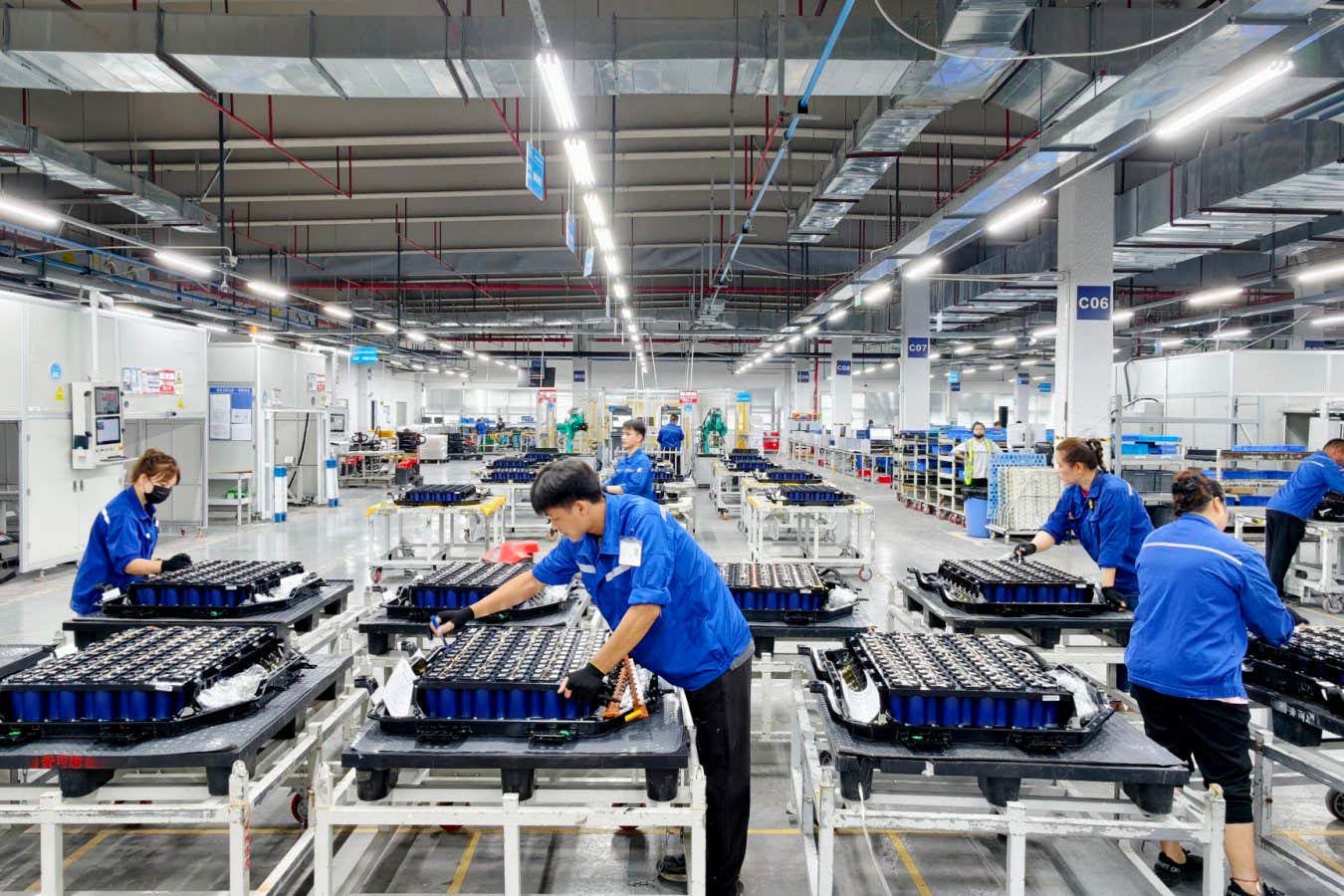
A vehicle battery factory in Guangxi, China
Costfoto/NurPhoto via Getty Images
Used electric vehicle batteries could meet two-thirds of China’s grid storage needs, charging up when renewable energy is plentiful and disbursing electricity when demand outstrips supply.
Renewable energy generation slackens when the wind doesn’t blow and the sun doesn’t shine, which can lead to a shortage at times of peak demand, like mornings and evenings and the winter months. Gas and coal plants typically fill that gap. But countries like China, the US, the UK and Australia are building huge amounts of grid storage based on batteries that can save renewable energy for later use.
As EVs become more common, batteries from dismantled cars could be plugged into the grid to achieve a carbon-neutral power system more quickly and cheaply, argue Ruifei Ma at Tsinghua University in China and colleagues. These second-life batteries could meet 67 per cent of the Chinese grid’s storage demand by 2050, while cutting costs by 2.5 per cent, according to their study.
EV batteries degrade as they are charged and discharged over the years, and they are typically retired once they reach about 80 per cent of their original capacity. While that degradation diminishes a car’s range and acceleration, it has little impact on a grid storage system, where hundreds or thousands of batteries are being charged and discharged over many hours.
“There’s still plenty of power left in them, and used as storage, they tend not to degrade as quickly,” says Gill Lacey at Teesside University, UK.
“We shouldn’t be throwing away these materials that cost a lot of money to mine and process and turn into batteries when we’ve got 80 per cent usable capacity left in the cells,” says Rhodri Jervis at University College London. “So, there’s a lot of desire to use retired battery packs in second-life applications from a cost-saving point of view, but I think probably more importantly from a sustainability point of view.”
Previous research has come to different conclusions about whether energy storage based on used batteries would be cheaper than new lithium-ion batteries, which have been falling in price.
But used batteries are likely to become more economical as increasing numbers of EVs come off the road. More than 17 million EVs were purchased in 2024, or about 20 per cent of all car sales, and almost two-thirds of them were bought in China.
The study found that in a scenario where batteries with different chemistries are sourced across all of China and deployed until they are at 40 per cent of their original capacity, second-life grid storage starts to grow ever more rapidly after 2030, while new batteries plateau. Total capacity would reach 2 trillion watts by 2050.
In a scenario in which grid storage relies on new batteries and pumped hydro — where water pumped into a reservoir flows downhill to drive a turbine — total capacity only reaches about half of that.
While second-life battery storage is still largely untested, the US start-up Redwood Materials has built a 63-megawatt-hour project out of decade-old car batteries for a data centre in Nevada. It claims its systems cost less than $150 per kilowatt-hour and can deliver power for over 24 hours, far longer than new lithium-ion batteries can realistically offer.
But used batteries need to be screened and grouped into units of similar capacity. Alternatively, the management system must be able to bypass individual batteries. Otherwise, the whole group will have to stop charging as soon as the most degraded battery reaches its capacity.
Damaged batteries must be screened out, too, and those that make the cut must have temperature and voltage sensors for each of their hundreds of cells. If a cell overheats, it can cause a massive, inextinguishable fire.
“Clearly the risks are higher, so you need to mitigate those with your safety and isolation and balancing and all the rest of it being more robust,” says Lacey.
Topics: