

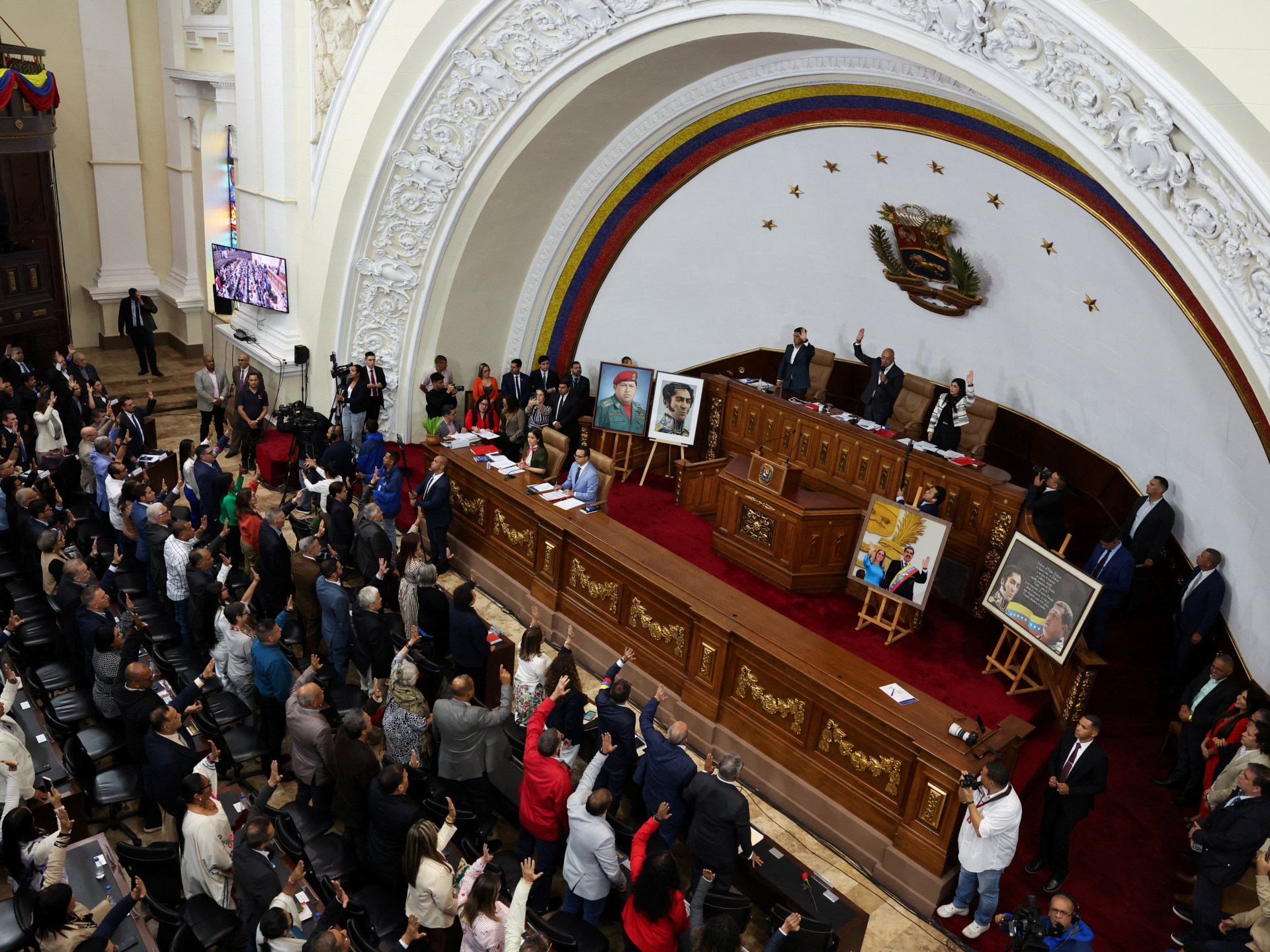
An amnesty law that would provide clemency to political prisoners in Venezuela has passed an initial vote unanimously in the National Assembly, stirring hopes among the country’s opposition.
On Thursday, members of both the governing socialist party and the opposition delivered speeches in favour of the new legislation, known as the Amnesty Law for Democratic Coexistence.
Recommended Stories
list of 3 itemsend of list
“The path of this law is going to be full of obstacles, full of bitter moments,” said Jorge Rodriguez, the head of the National Assembly.
But he added that it would be necessary to “swallow hard” in order to help the country move forward.
“We ask for forgiveness, and we also have to forgive,” Rodriguez said.
But critics nevertheless pointed out that the text of the bill has yet to be made public, and it offers no clemency for individuals accused of serious crimes, including drug trafficking, murder, corruption or human rights violations.
Instead, media reports about the legislation indicate that it focuses on charges often levelled against protesters and opposition leaders.
What does the bill say?
The bill would grant amnesty to individuals accused of crimes like treason, terrorism, rebellion, resisting authorities, instigation of illegal activities and spreading hate, if those crimes were committed in the context of political activism or protest.
Opposition leaders like Maria Corina Machado would also see bans on their candidacy for public office lifted.
In addition, the legislation specifies certain events that would qualify for amnesty, including the demonstrations that unfolded in 2007, 2014, 2017, 2019 and 2024.
That period stretches from the presidency of the late President Hugo Chavez, founder of the “Chavismo” movement, through the presidency of his handpicked successor, Nicolas Maduro.
Both Chavez and Maduro were accused of the violent suppression of dissent through arbitrary arrest, torture and extrajudicial killings.
But on January 3, the administration of United States President Donald Trump launched a military operation in Venezuela to abduct Maduro and his wife, Cilia Flores. They have since been transported to New York City, where they await trial on charges related to drug trafficking.
While members of Venezuela’s opposition have cheered the military operation as a long-overdue move, experts have argued that the US likely violated international law as well as Venezuela’s sovereignty in removing Maduro from power.

Weighing Maduro’s legacy
Images of Chavez were a common sight during Thursday’s debate at the National Assembly, which has been dominated since 2017 by members of the Chavismo movement.
That year, Venezuela’s top court dissolved the opposition-led National Assembly and briefly absorbed its powers, before re-establishing a legislature stacked with Maduro supporters.
In 2018 and again in 2024, Maduro claimed victory in contested elections that critics say were marred by fraud.
In the July 2024 vote, for instance, the government refused to release voter tallies, as was previously standard practice. The opposition, however, obtained copies of nearly 80 percent of the tallies, which contradicted the government’s claims that Maduro had won a third six-year term.
After Maduro’s abduction last month, the remnants of his government remained in power.
Within days, his vice president – Delcy Rodriguez, the sister of the National Assembly leader – was sworn in as interim president.
She used her inaugural speech to denounce the “kidnapping of two heroes who are being held hostage: President Nicolas Maduro and First Lady Cilia Flores”.
Rodriguez has nevertheless cooperated with US demands, including by supporting a bill to open Venezuela’s nationalised oil industry to foreign investment.
On the floor of the National Assembly on Thursday, her brother Jorge raised a photo of Chavez holding a crucifix while he spoke. Maduro’s son, National Assembly member Nicolas Maduro Guerra, also presented remarks.
“Venezuela cannot endure any more acts of revenge,” Maduro Guerra said as he appealed for “reconciliation”.
Venezuela’s opposition reacts
Still, opposition members in the National Assembly expressed optimism about the bill.
National Assembly representative Tomas Guanipa, for instance, called it the start of a “new, historic chapter” in Venezuelan history, one where political dissidents would no longer be “afraid to speak their minds for fear of being imprisoned”.
Nearly 7.9 million Venezuelans have left the country in recent decades, fleeing political persecution and economic instability.
But there have been lingering concerns about the human rights situation in Venezuela in the weeks following Maduro’s abduction – and whether it is safe to return home.
President Rodriguez has pledged to release political detainees and close the infamous El Helicoide prison, where reports of torture have emerged. But some experts say the number of people released does not match the number the government has reported.
The human rights group Foro Penal, for instance, has documented 383 releases since January 8.
That figure, however, is lower than the 900 political prisoners the government has claimed to have released. Foro Penal estimates 680 political prisoners remain in detention.
Opposition figures also allege that the government continues to intimidate and harass those who voice support for Maduro’s removal and other opinions that run contrary to the Chavismo movement.
Still, the head of Foro Penal, Alfredo Romero, applauded the initial passage of the amnesty law as a step forward.
“Amnesty is the framework that will ensure … that the past does not serve to halt or derail transition processes,” Romero told the news agency AFP.
A second vote is expected to be held on Tuesday next week.