

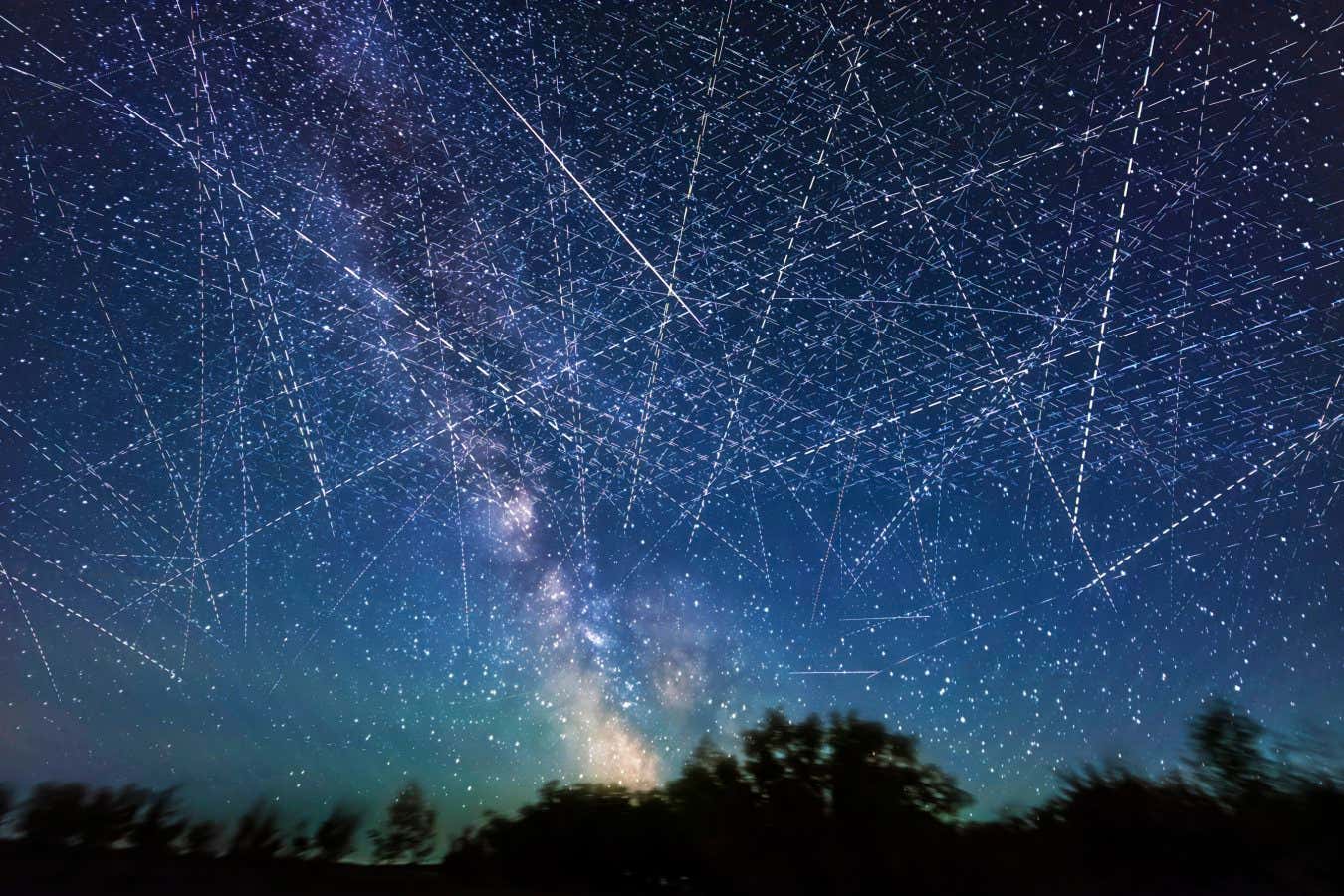
A long-exposure photograph in the northern hemisphere showing satellites in the night sky
Alan Dyer/VWPics/Universal Images Group via Getty Images
A report filed by SpaceX with the US Federal Communications Commission (FCC) in late December reveals some startling information – including that its Starlink satellites had to perform about 300,000 collision-avoidance manoeuvres in 2025.
Starlink is a mega-constellation of satellites that beams the internet to the ground. The first Starlink satellites were launched in 2019; they now number about 9400, accounting for 65 per cent of all active satellites in orbit.
The FCC requires SpaceX to publish an update every six months on Starlink’s approach to safety, given that two satellites could produce thousands of pieces of debris if they were to collide in space, potentially rendering parts of Earth’s orbit unusable or leading to a cascade of collisions.
In its latest report, filed on 31 December, SpaceX said that its Starlink satellites performed about 149,000 collision-avoidance manoeuvres from June to November 2025. Such manoeuvres are performed when two satellites are deemed to be passing too close to each other and have a reasonable risk of collision.
The industry standard is to manoeuvre when there is a 1 in 10,000 risk of collision, but SpaceX is more conservative and manoeuvres at a risk of 3 in 10 million.
In addition to the 144,000 manoeuvres previously reported by SpaceX from December 2024 to May 2025, this amounts to about 300,000 in 2025, an increase of about 50 per cent from 200,000 manoeuvres in 2024. “That’s a huge amount of manoeuvres,” says Hugh Lewis at the University of Birmingham, UK. “It’s just an incredibly high number.”
Most other satellite operators in the US and abroad don’t publish their manoeuvre figures, but a typical satellite pre-Starlink might have performed a handful of manoeuvres a year. Per SpaceX’s figures, it is performing up to 40 manoeuvres per year, per satellite.
Lewis says the company is on track to perform 1 million manoeuvres every year by 2027, with several other mega-constellations in the US and China also being deployed – meaning the number of potential collisions is going to grow. “From a physics point of view, it’s not good,” says Lewis. “We are moving ourselves towards a pretty bad scenario in orbit. It is not sustainable.”
In its latest report, SpaceX also revealed, for the first time, repeated encounters with other satellites. It singled out a Chinese satellite, called Honghu-2, as having more than 1000 close approaches with its Starlink satellites, likely because they operate in similar orbits.
“It highlights how SpaceX really owns that orbit,” says Samantha Lawler at the University of Regina in Canada, with most of its Starlink satellites operating at an altitude of between 340 and 570 kilometres. “According to the Outer Space Treaty, everybody is supposed to have access to all parts of space, but they’ve kind of occupied it.”
SpaceX also revealed details of a Starlink satellite that exploded in December, releasing dozens of pieces of debris. It said the cause was a “suspected hardware failure” and added it had “identified and removed” the components responsible from future Starlink designs.
Starlink uses an autonomous system to dodge collisions and cope with the huge number of manoeuvres required. However, SpaceX said it had one incident in which a spacecraft operated by the Japanese company Astroscale “performed an unannounced manoeuvre”, which could have raised the risk of collision with a Starlink satellite.
Astroscale disagrees with that version of events. A spokesperson said the company publicly shared the planned manoeuvre ahead of time and it was “conducted in compliance with Japanese on-orbit servicing guidelines”. SpaceX didn’t respond to a request for comment.
However, it is the overall number of manoeuvres that is the most eye-catching statistic. “They’re doing all these manoeuvres and they’re doing them perfectly,” says Lawler. “But if they make a mistake, we’re in really big trouble.”

The world capital of astronomy: Chile
Experience the astronomical highlights of Chile. Visit some of the world’s most technologically advanced observatories and stargaze beneath some of the clearest skies on earth.
Topics: