
Close Menu
    Trending
    • Katie Holmes And Joshua Jackson Spark ‘Soul-Level’ Love Chatter
    • Singapore Airlines, Southwest Airlines partner to expand access to nearly 120 US destinations
    • Trump warns Netanyahu: ‘You’ll be on your own’ if attacks on Iran continue | US-Israel war on Iran News
    • Cristiano Ronaldo, ‘The Bosnian Diamond’ headline the World Cup 40-and-over club
    • How housing market inventory is shifting across every state
    • What is a ‘normal’ memory slowdown, and when should I worry?
    • Ariana Grande And Ethan Slater Are ‘Still Friends’ Following Split
    • US says BYD, Baidu, Alibaba and other tech giants are aiding China’s military
    Benjamin Franklin Institute
    Tuesday, June 9
    • Home
    • Politics
    • Business
    • Science
    • Technology
    • Arts & Entertainment
    • International
    Benjamin Franklin Institute
    Home»Science»Star appears to have vanished in a failed supernova
    Science

    Star appears to have vanished in a failed supernova

    Team_Benjamin Franklin InstituteBy Team_Benjamin Franklin InstituteJanuary 20, 2026No Comments3 Mins Read
    Share Facebook Twitter Pinterest Copy Link LinkedIn Tumblr Email VKontakte Telegram
    Share
    Facebook Twitter Pinterest Email Copy Link


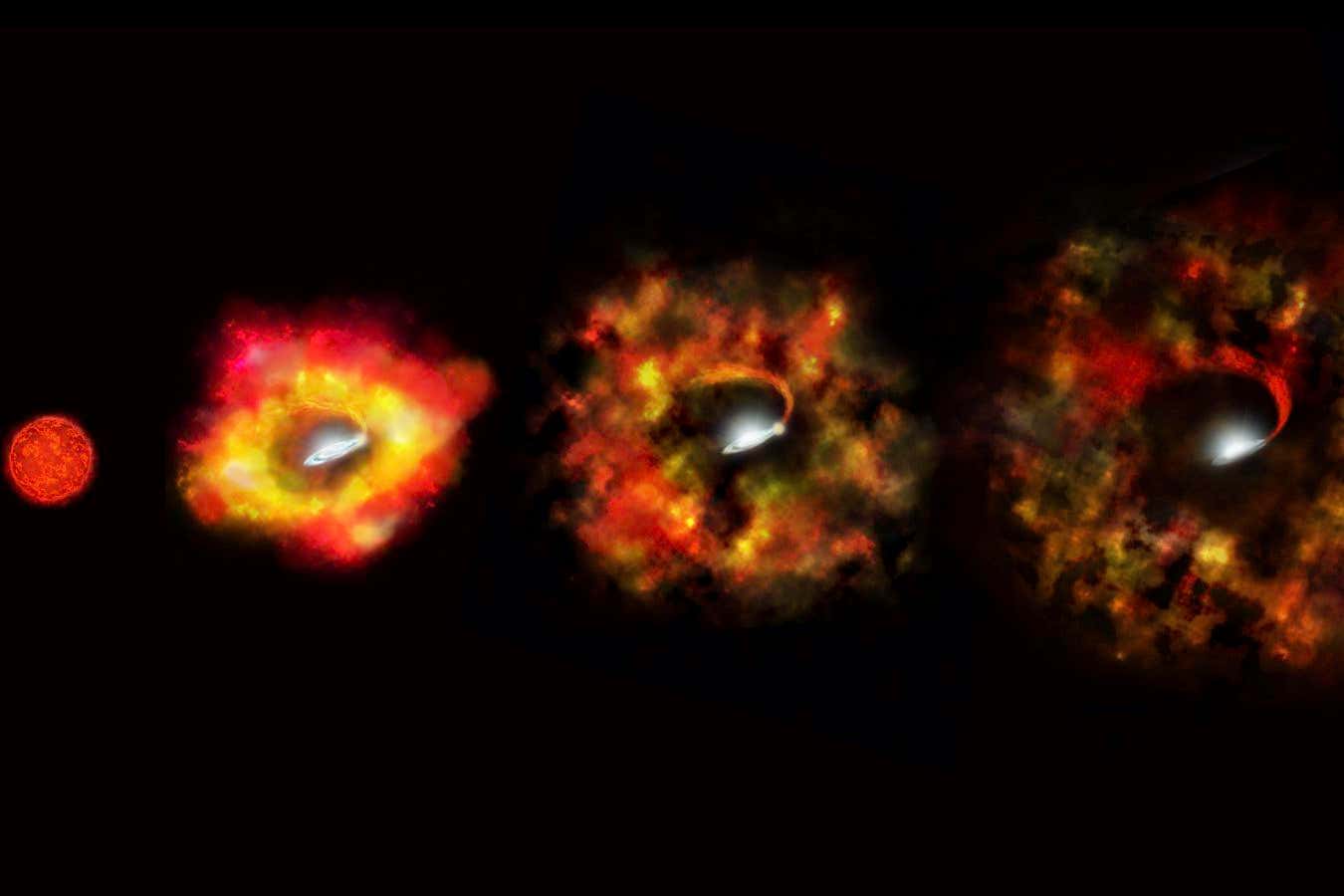
    An illustration of a failed supernova forming a black hole

    NASA, ESA, and P. Jeffries (STScI)

    A massive star in a nearby galaxy that reached the end of its life appears to have vanished rather than blown up, forming a black hole in what astronomers think is a rare way.

    The most common black holes in our galaxy begin as stars. When these stars explode in a supernova, they can leave behind a black hole. But it is thought that black holes can also form from stars that fail to go supernova, instead simply collapsing under their own mass and producing a black hole directly.

    In 2024, Kishalay De at Columbia University in New York and his colleagues observed an unusually bright star called M31-2014-DS1 in the nearby galaxy Andromeda that was around 20 times as massive as our sun. The star appeared to grow briefly brighter in 2014, before becoming dramatically dimmer between 2017 and 2020. De and his colleagues thought this pattern of brightening and then fading matched predictions for a failed supernova producing a black hole, but there was no sign of the black hole itself, such as tell-tale X-ray radiation.

    Now, De and his team have observed M31-2014-DS1 with the James Webb Space Telescope (JWST) and the Chandra X-ray Observatory, finding a faint, red object where the star once was that is only around 8 per cent as bright as the original star and is shrouded in a cocoon of dust moving rapidly outwards. This fits with what astronomers think a failed supernova making a black hole would look like. De and his team declined to comment for this story because their research hasn’t been peer-reviewed yet.

    In a separate study analysing the same JWST data, Emma Beasor at Liverpool John Moores University, UK, and her colleagues found that the case for M31-2014-DS1 undergoing a failed supernova that produced a black hole was murkier, and that the observations could just as easily be the result of two stars merging, which would also produce a small outburst followed by a dimming and lots of dust.

    “The predictions for what a failed supernova looks like overlap quite significantly with what we might expect from two stars colliding and producing loads of dust,” says Beasor.

    However, both scenarios would still be exotic phenomena, she says. “We don’t see stars that fade this significantly very often.”

    “In either explanation, this is exciting. The visible star really has gone away,” says Gerard Gilmore at the University of Cambridge. “For many years, searches for disappearing massive stars led to ambiguous results. Now, the full power of multi-wavelength time-domain astronomy is on show and making progress.”

    The only surefire way to say whether a black hole has been formed is to identify X-ray radiation, says Gilmore, which can’t currently be seen at the location of M31-2014-DS1. However, being able to study the aftermath of a dimmed star with a powerful telescope like JWST will allow us to find out what happened, he says. “We are on the verge of discovering at least one of the final fates of massive stars, an amusingly Cheshire cat way to go.”

    References: arXiv, DOI: 10.48550/arXiv.2601.0577 and DOI: 10.48550/arXiv.2601.05317

    New Scientist. Science news and long reads from expert journalists, covering developments in science, technology, health and the environment on the website and the magazine.

    The world capital of astronomy: Chile

    Experience the astronomical highlights of Chile. Visit some of the world’s most technologically advanced observatories and stargaze beneath some of the clearest skies on earth.

    Topics:


    Source link

    Share. Facebook Twitter Pinterest LinkedIn Tumblr Email Telegram Copy Link

    Related Posts

    Science

    What is a ‘normal’ memory slowdown, and when should I worry?

    June 9, 2026
    Science

    Wildlife thrives in solar farm built on restored peatland

    June 8, 2026
    Science

    You don’t need to worry about recursive-self-improving AI – yet

    June 8, 2026
    Science

    Understanding anorexia’s grip on the brain could unlock new therapies

    June 8, 2026
    Science

    Why GLP-1 drugs might reduce cancer risk

    June 8, 2026
    Science

    Landmark pancreatic cancer treatment paves way for targeting other tricky tumors

    June 8, 2026
    Editors Picks

    Ukrainians wish for peace in 2026 – and no more power cuts

    January 1, 2026

    What’s next for Live Nation? Jury reaches verdict in antitrust case over Ticketmaster fees

    April 16, 2026

    Bitcoin worth $14bn seized in US-UK crackdown on alleged scammers

    October 15, 2025

    Bianca Censori Undergoes Dramatic Hair Transformation

    February 27, 2026

    Trump claims US held direct nuclear talks with Iran | Politics News

    April 8, 2025
    About Us
    About Us

    Welcome to Benjamin Franklin Institute, your premier destination for insightful, engaging, and diverse Political News and Opinions.

    The Benjamin Franklin Institute supports free speech, the U.S. Constitution and political candidates and organizations that promote and protect both of these important features of the American Experiment.

    We are passionate about delivering high-quality, accurate, and engaging content that resonates with our readers. Sign up for our text alerts and email newsletter to stay informed.

    Latest Posts

    Katie Holmes And Joshua Jackson Spark ‘Soul-Level’ Love Chatter

    June 9, 2026

    Singapore Airlines, Southwest Airlines partner to expand access to nearly 120 US destinations

    June 9, 2026

    Trump warns Netanyahu: ‘You’ll be on your own’ if attacks on Iran continue | US-Israel war on Iran News

    June 9, 2026

    Subscribe for Updates

    Stay informed by signing up for our free news alerts.

    Paid for by the Benjamin Franklin Institute. Not authorized by any candidate or candidate’s committee.
    • Privacy Policy
    • About us
    • Contact us

    Type above and press Enter to search. Press Esc to cancel.