

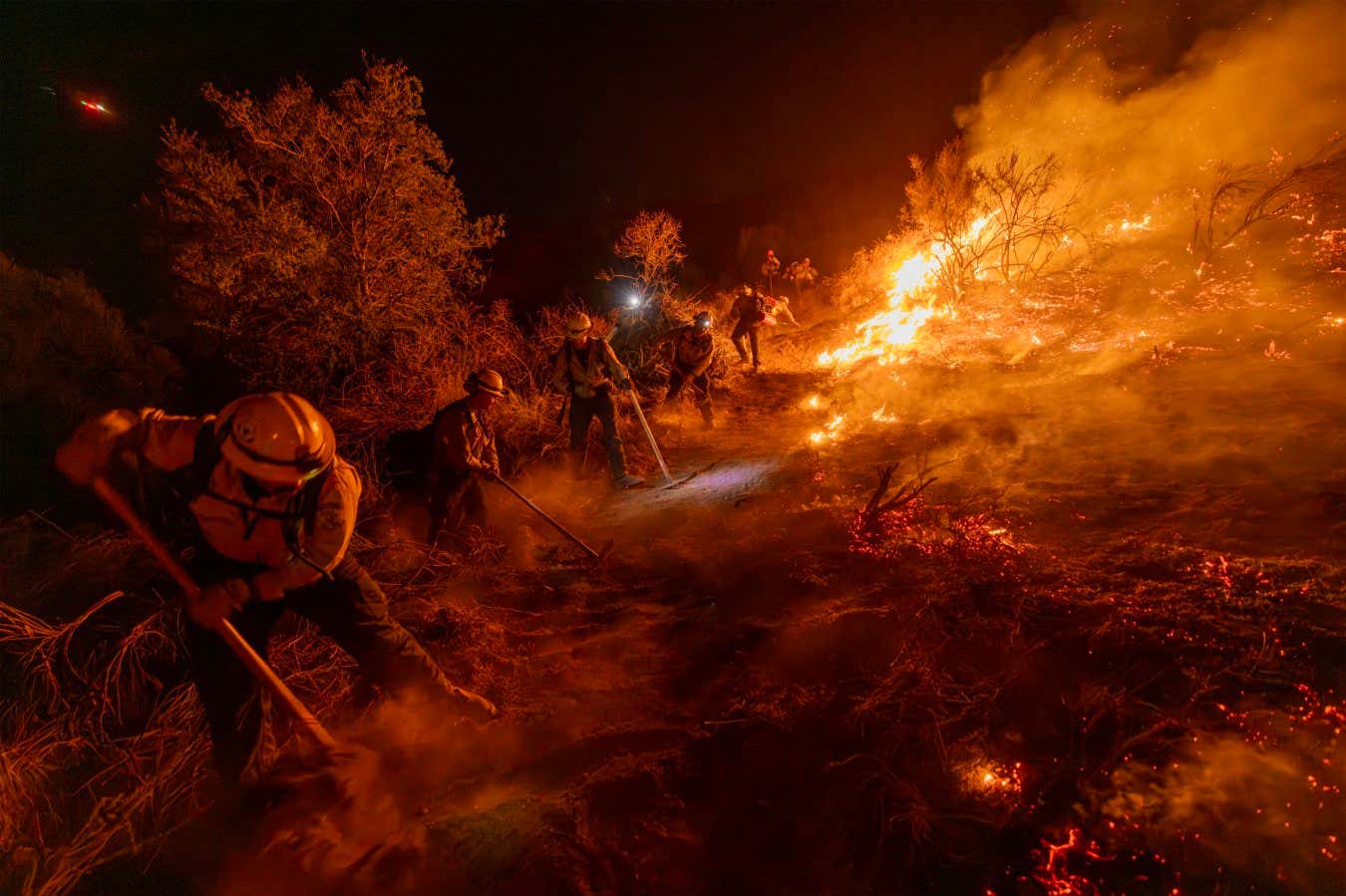
Wildfires in California in January 2025
David McNew/Getty Images
The impacts of climate change are occurring sooner than expected, but governments and businesses continue to underestimate the risks, which could add up to trillions of dollars in economic losses by 2050.
A report by climate scientists and financial experts has warned that the world may have seriously underestimated the rate of warming and faces “planetary insolvency”, where global warming begins to severely damage both the environment and economic growth.
Decision-makers typically focus on the middle-ground estimates of climate impacts. But they should be preparing for the worst-case scenarios instead, the report says, since impacts like short-term precipitation extremes in some regions are happening earlier than anticipated.
“Governments need to agree on a planetary solvency plan quickly,” says David King, former top climate adviser to the UK government who contributed to the report. “We are looking at an accelerated rate of temperature rise. We’re not sure if that will continue into the future but we can probably assume it’s not going to relax backwards.”
A first step towards such a plan could be to stop assuming the world economy will keep expanding, says Sandy Trust at UK investment management firm Baillie Gifford, an author of the new report. According to the Network for Greening the Financial System, the world could lose trillions of dollars a year by 2050 due to climate-related impacts. But the network says it doesn’t foresee a recession, since it expects global economic growth to outpace those damages.
“This is Titanic risk modelling, looking backwards from the deck of the Titanic in April 1912 and predicting a smooth voyage,” says Trust. “This fails the first principles of risk management, how to have a best guess about the worst case.”
The call to plan for the worst comes as a report by the European Union climate body Copernicus finds 2025 was the third warmest year on record after 2023 and 2024, with an average temperature of 1.47°C above pre-industrial levels. Because 2024 was 1.6°C higher, for the first time, the three-year average was more than 1.5°C above pre-industrial temperatures.
That’s another step towards the 20-30 year average needed to fail the Paris Agreement goal of keeping warming below the 1.5°C threshold. When the agreement was signed a decade ago, 1.5°C was predicted by 2045. But if the trend over the past 30 years continues, we will now breach that long-term threshold by 2030, according to Copernicus.
The rate of warming has been quickening. Many scientists attribute that to the decline in sulphur-containing air pollution from coal power and shipping. As the skies have cleared, more of the sun’s heat has been reaching Earth’s surface, “unmasking” about 0.5°C of warming.
But the biggest reason we could surpass 1.5°C sooner than expected is because emissions have continued to increase each year, says Samantha Burgess at Copernicus. Fossil fuel emissions set yet another record in 2025.
“Emissions haven’t come down as fast as people believed they would,” says Burgess.
Every tenth of a degree of warming will result in more frequent and intense extreme weather. Already, the Los Angeles wildfires in January 2025 – potentially the costliest natural disaster in US history – were twice as likely and 25 times larger due to climate change. Hurricane Melissa, the strongest storm to make landfall around the Atlantic Ocean, was associated with wind speeds at least 16 kilometres per hour faster than would be expected without climate change.
“Because this is a global average, the reality is that when we have 1.5 degrees of warming at a global level, that means that heatwaves are often 3 or 4 or even 10 degrees warmer than they otherwise would have been,” says Burgess. “Children today will be exposed to more heat hazards, more climate hazards than we were or our parents were.”
The greatest warming is at the poles due to feedback loops like the loss of reflective snow and ice, which allows more of the sun’s heat to be absorbed. Last year was the warmest year on record for Antarctica due to a rare stratospheric heating event. Combined sea ice extent in the Arctic and Antarctica reached a record low.
But in a positive sign, global emissions are not rising as quickly as they once were, and China’s emissions have flatlined.
“Because of this flattening of emissions of CO2, then we would expect warming to continue but without acceleration, just continue at the same rate,” says Timothy Osborn at the University of East Anglia, UK.
Cracking down on methane leaks from infrastructure like gas pipelines and old coal mines could be a quick short-term fix, says King. Cutting methane emissions by 30 per cent this decade could reduce warming at least 0.2°C by 2050.
“We need all the slow fixes as well, but this is a critical part of the pathway,” says King. “Because, frankly, the overshoot above 1.5°C is a major challenge to humanity.”
Topics: