

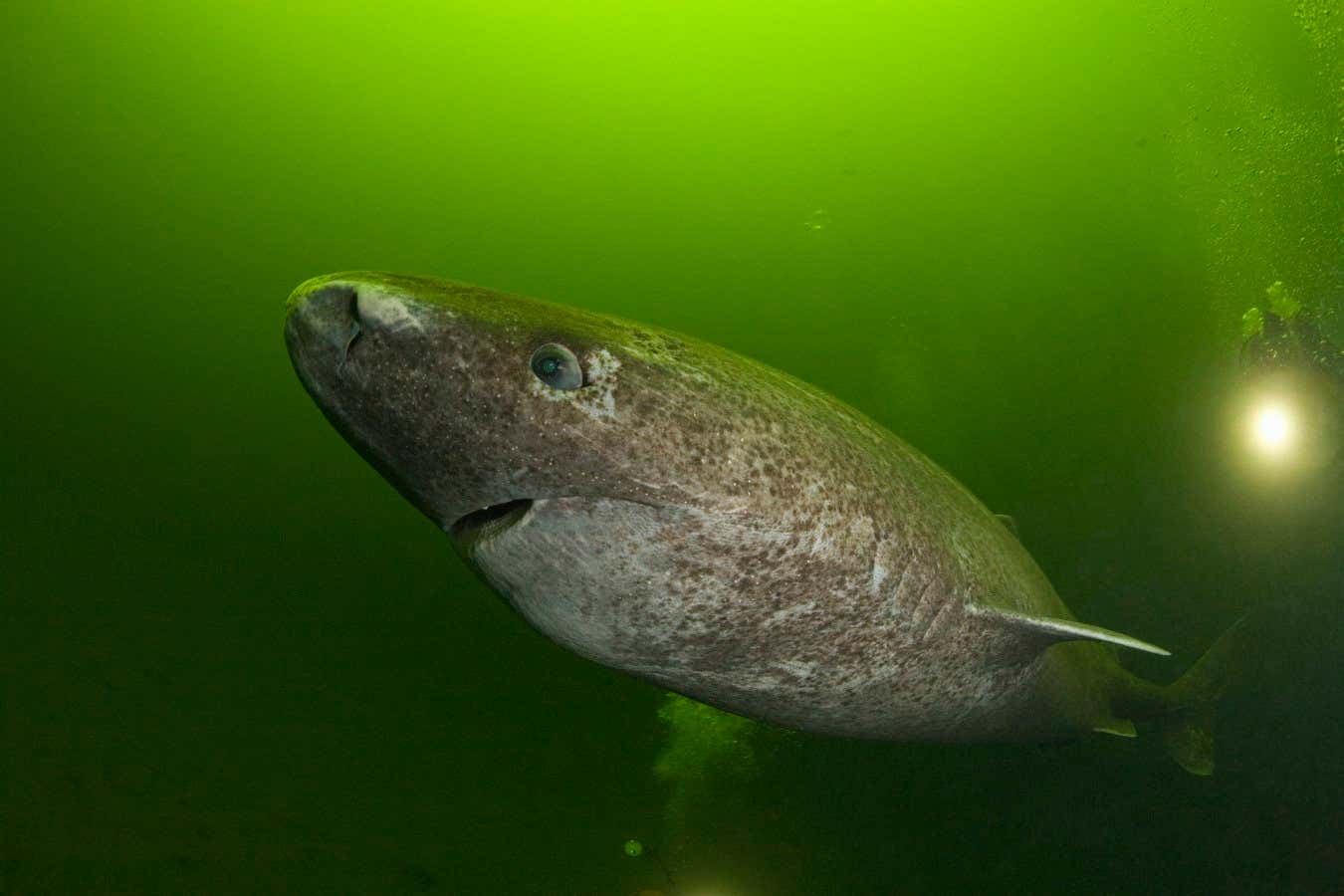
Despite their longevity, Greenland sharks can have poor heart health
Doug Perrine/naturepl.com
Greenland sharks are thought to live between 250 and 500 years – but their hearts show signs of severe age-related disease even when the sharks are just 150 years old.
Some parts of the shark’s body, such as the eyes, seem impervious to ageing and to cancer, which might have suggested the marine predator’s heart is also protected from age-related decline. But an analysis has revealed that Greenland sharks (Somniosus microcephalus) actually show signs of serious heart disease – and yet there is no apparent loss of function or reduction in the species’ lifespan.
Alessandro Cellerino, at Scuola Normale Superiore in Pisa, Italy, a member of the team that conducted the research, says he found the results of the analysis of six Greenland sharks – four females and two males, all over 3 metres long – “truly astonishing”.
Based on their length, the team estimates that all six specimens were between 100 and 150 years of age. The team ran a range of microscopy tests on the animals’ hearts, including high-resolution fluorescence and electron microscopy.
“We discovered that the Greenland shark heart is highly fibrotic, and full of the ageing markers lipofuscin and nitrotyrosine,” says Cellerino.
In a human, a high level of fibrosis, or scarring of the heart tissue, is a common indicator of age-related heart diseases and potential heart failure.
However, says Cellerino, “massive accumulation” of lipofuscin linked to mitochondrial damage and the other ageing markers appears to be non-detrimental and “does not impair the lifespan of the Greenland shark”.
The presence of high levels of nitrotyrosine, another heart disease indicator signifying inflammation and oxidative stress, suggests that the Greenland shark may have evolved strategies to tolerate chronic oxidative damage “rather than simply minimising it”.
“The first time I had a look through the microscope, I assumed what I was seeing was a technical artefact or an experimental error,” he says.
For comparison, the researchers also studied another deep-sea fish, the velvet belly lanternshark (Etmopterus spinax), which has an estimated lifespan of up to 11 years, as well as the turquoise killifish (Nothobranchius furzeri), which is an extremely short-lived species, with a lifespan of just a few months, and lives in seasonal pools on the African savannah.
Elena Chiavacci, also from Scuola Normale Superiore, says Greenland sharks possess a highly fibrotic heart, whereas the other two species show no fibrosis at all.
“Regarding nitrotyrosine, the Greenland shark exhibits a massive accumulation, whereas the lantern shark shows none,” Chiavacci says.
Despite its extremely short lifespan, the killifish also shows some of the same nitrotyrosine ageing markers as the Greenland shark, she says.
Cellerino says the Greenland shark has extraordinary resilience against ageing, particularly cardiac ageing. “The fact that there exists a creature on this planet whose heart can coexist with the ageing process without apparent decline is remarkable,” he says. “Together, these findings highlight the exceptional resilience of the Greenland shark heart and underscore its potential to inform future strategies for promoting healthy ageing.”
Joao Pedro Magalhaes at the University of Birmingham in the UK says the study highlights that scientists don’t truly understand molecular and cellular mechanisms of ageing, or even which ageing molecular changes are detrimental and which ones are beneficial.
Another conclusion is that researchers need to diversify the animals used to study ageing and longevity, says Magalhaes.
“Most scientists, myself included, employ short-lived animals like worms, mice and rats, yet clearly we have these amazing long-lived species like the Greenland shark and the bowhead whale that can live much longer than humans and hold the secrets to longevity,” he says.
Topics: