
Close Menu
    Trending
    • Tech Life – Smell the future
    • Market Talk – July 21, 2026
    • The People Who Burned Cities to Beat Trump are Back and They’re FURIOUS * The Gateway Pundit * by Promoted Post
    • MrBeast Secretly Marries Thea Booysen On Private Island
    • Canada evaluating ‘all options’ after fresh US tariffs threat
    • US judge blocks Trump bid to strip work permits from immigrants | Courts News
    • Northwestern’s new Ryan Field tour leads to incredible Chip Kelly photo
    • A High School Dropout Tackled Online Returns — Now Makes $500M
    Benjamin Franklin Institute
    Tuesday, July 21
    • Home
    • Politics
    • Business
    • Science
    • Technology
    • Arts & Entertainment
    • International
    Benjamin Franklin Institute
    Home»Science»BepiColombo mission will start to unpick Mercury’s secrets in 2026
    Science

    BepiColombo mission will start to unpick Mercury’s secrets in 2026

    Team_Benjamin Franklin InstituteBy Team_Benjamin Franklin InstituteJanuary 10, 2026No Comments3 Mins Read
    Share Facebook Twitter Pinterest Copy Link LinkedIn Tumblr Email VKontakte Telegram
    Share
    Facebook Twitter Pinterest Email Copy Link


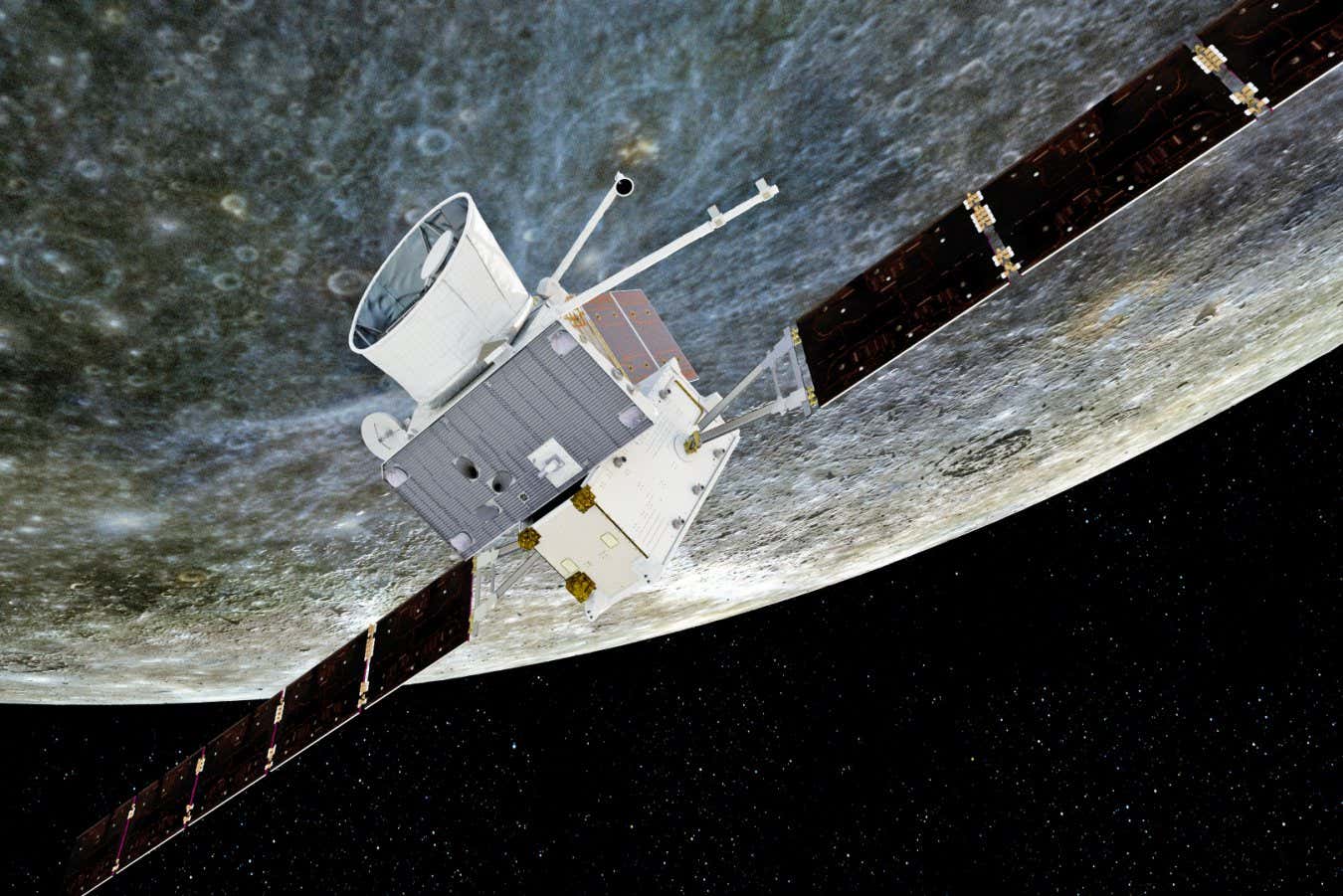
    Artist’s impression of the BepiColombo spacecraft flying by Mercury

    ESA/ATG medialab

    We will finally begin to untangle Mercury’s mysteries in 2026, as the BepiColombo spacecraft descend into orbit around the solar system’s innermost planet.

    BepiColombo consists of a pair of spacecraft from both the European Space Agency (ESA) and the Japanese Aerospace Exploration Agency (JAXA). The Mercury Planetary Orbiter (MPO) and the Mercury Magnetospheric Orbiter (Mio) are attached to a parent spacecraft, the Mercury Transfer Module (MTM).

    Since launching in 2018, the MTM has flown by Mercury six times, using the planet’s gravity to slow its descent until it can easily slot into orbit, a technique invented by the mission’s namesake, physicist Giuseppe “Bepi” Colombo.

    The mission has collected important scientific data, such as clues about the solar wind and high-resolution images of Mercury’s surface. But its most powerful instruments, such as a pair of X-ray spectrometers on ESA’s MPO, haven’t yet been used because their view has been obscured by the MTM.

    In September 2026, MPO and Mio will detach from the MTM and begin their descent into orbit, which is expected to be complete by November, letting them finally set their eyes on the planet.

    Charly Feldman at the University of Leicester, UK, worked on one of the MPO’s instruments. “There’s that anticipation of, is our instrument still working and is it going to work as we expect?” she says. “There’s nothing we can do if it’s broken. It’s been building for a very long time, so whilst it is incredibly exciting, it’s also a little bit nerve-wracking.”

    As well as imaging Mercury’s magnetic environment in far more detail than any previous mission, Mercury’s surface will also be extensively mapped and analysed, using tools like the MPO’s spectrometers. “It will be taking the first X-ray images of a surface of another planetary body,” says Feldman.

    This could help us solve mysteries such as the unexpectedly high amount of X-rays coming from the planet’s night side, facing away from the sun, which previous missions measured. It can also measure X-rays coming from the planet’s sun-facing side, which will allow scientists to work out what Mercury’s surface is made of, which can then tell us about how the planet evolved. “If you can understand how the different planets have come to be as they are, you can understand the dynamics of the whole solar system,” says Feldman.

    New Scientist. Science news and long reads from expert journalists, covering developments in science, technology, health and the environment on the website and the magazine.

    Stargazing and space science in the land of the rising sun, Japan

    Discover Japan through the lens of astronomy, from advanced research centres to skies that inspire both science and tradition. Visit world-class facilities including JAXA’s Tsukuba Space Center, Nobeyama Radio Observatory and Tanegashima Space Center, then stargaze under the pristine skies of the Japanese Alps and Yakushima Island.

    Topics:


    Source link

    Share. Facebook Twitter Pinterest LinkedIn Tumblr Email Telegram Copy Link

    Related Posts

    Science

    How a Futurama plotline led to a totally new math proof

    July 21, 2026
    Science

    Rare double supernova discovered hiding in Jellyfish Nebula

    July 21, 2026
    Science

    This tiny, forgotten organ could help us live longer, healthier

    July 21, 2026
    Science

    A single aspen clone in Utah called Pando covers 106 acres, weighs about 6,000 tonnes, and shares one root system that makes it a single organism roughly 14,000 years old, quietly dying now from mule deer eating every young shoot before it can grow

    July 21, 2026
    Science

    A bitter irony sits in the credits of The Wolf of Wall Street: prosecutors say this film about financial fraud was itself part-funded with money looted from Malaysia’s 1MDB fund — fraud, in effect, bankrolling its own movie

    July 21, 2026
    Science

    Psychology researchers know why The Odyssey transcends time

    July 21, 2026
    Editors Picks

    Opinion | One Chatbot to Rule Everything

    May 20, 2026

    Britney Spears’ Sons Raise Eyebrows After Moving Into Her Home

    April 25, 2026

    Zelenskyy says US security guarantee text ready to be finalised with Trump | Russia-Ukraine war News

    January 8, 2026

    Trump says meeting on Friday to make final decision on deal with Iran

    May 29, 2026

    Contemporary art giant David Hockney dies aged 88

    June 12, 2026
    About Us
    About Us

    Welcome to Benjamin Franklin Institute, your premier destination for insightful, engaging, and diverse Political News and Opinions.

    The Benjamin Franklin Institute supports free speech, the U.S. Constitution and political candidates and organizations that promote and protect both of these important features of the American Experiment.

    We are passionate about delivering high-quality, accurate, and engaging content that resonates with our readers. Sign up for our text alerts and email newsletter to stay informed.

    Latest Posts

    Tech Life – Smell the future

    July 21, 2026

    Market Talk – July 21, 2026

    July 21, 2026

    The People Who Burned Cities to Beat Trump are Back and They’re FURIOUS * The Gateway Pundit * by Promoted Post

    July 21, 2026

    Subscribe for Updates

    Stay informed by signing up for our free news alerts.

    Paid for by the Benjamin Franklin Institute. Not authorized by any candidate or candidate’s committee.
    • Privacy Policy
    • About us
    • Contact us

    Type above and press Enter to search. Press Esc to cancel.