
Close Menu
    Trending
    • Negotiations that enable Israel’s land-grabs | Israel-Palestine conflict
    • True-or-false for Round 1 of 2026 NFL Draft: Will Cowboys regret their trade?
    • Opinion | Stewart Brand, Silicon Valley’s Favorite Prophet, on Life’s Most Important Principle
    • Struggling to scale your company? Here are five things that could be holding you back
    • What happens if you’re hit by a primordial black hole?
    • When is London Marathon 2026? Start time and how to watch race for FREE
    • Pentagon Requests $54 Billion For AI War
    • Clavicular Hit With New YouTube Crackdown
    Benjamin Franklin Institute
    Friday, April 24
    • Home
    • Politics
    • Business
    • Science
    • Technology
    • Arts & Entertainment
    • International
    Benjamin Franklin Institute
    Home»Science»Northern Greenland ice dome melted before and could melt again
    Science

    Northern Greenland ice dome melted before and could melt again

    Team_Benjamin Franklin InstituteBy Team_Benjamin Franklin InstituteJanuary 5, 2026No Comments3 Mins Read
    Share Facebook Twitter Pinterest Copy Link LinkedIn Tumblr Email VKontakte Telegram
    Share
    Facebook Twitter Pinterest Email Copy Link


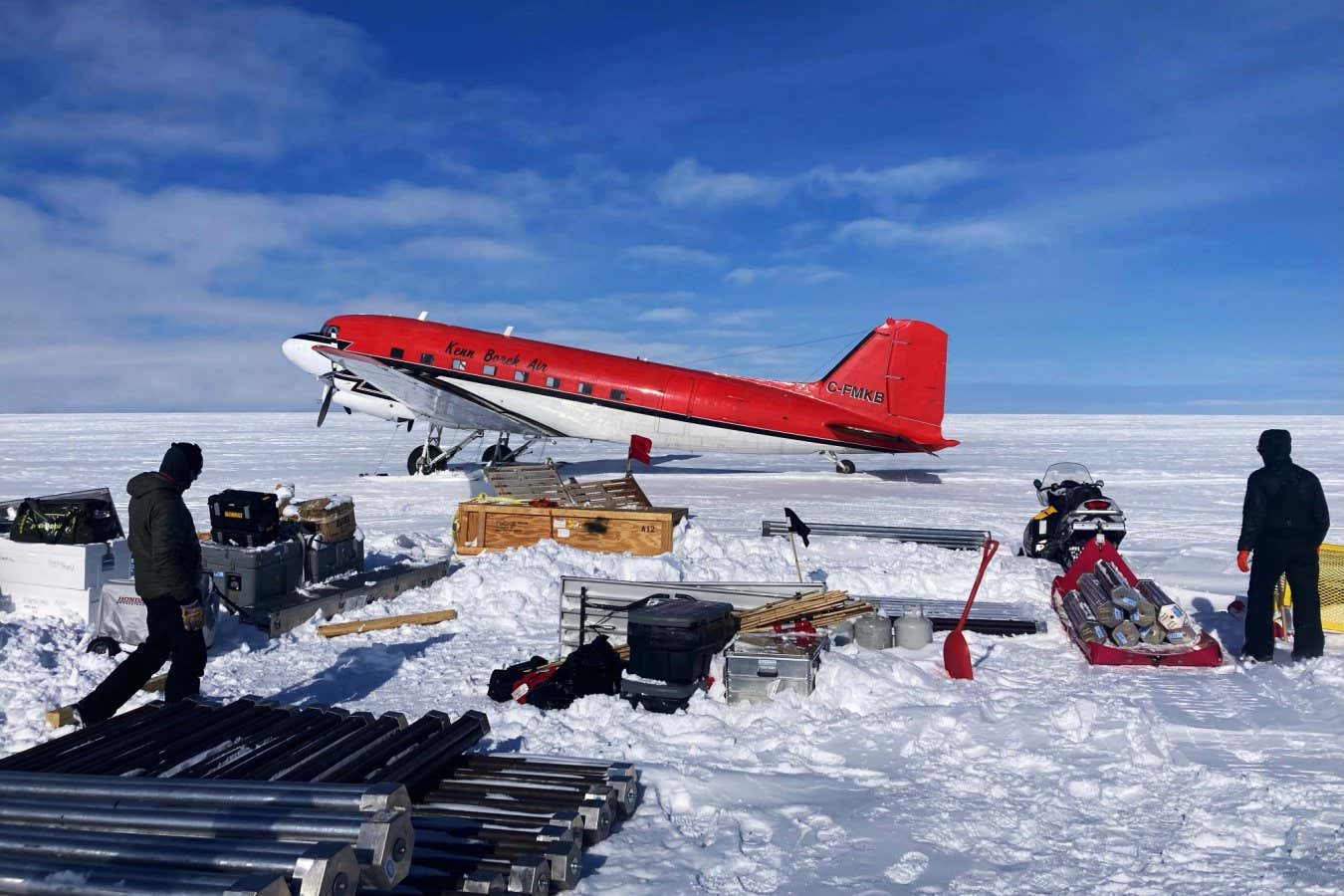
    Researchers working at the Prudhoe Dome in Greenland

    Caleb K. Walcott-George

    An ice dome in northern Greenland once melted completely at temperatures the region could experience again this century, a finding that will begin to paint a more accurate picture of how fast the melting ice sheet could raise global sea levels.

    Researchers drilled 500 metres down through the centre of the Prudhoe Dome, a bulge of ice the size of Luxembourg in the northwestern corner of Greenland, to collect a 7-metre core of sediment and bedrock. A dating technique using infrared light showed that sand at the surface of the core was bleached by the sun about 7000 years ago. That means the dome was completely melted at that time, when the planet was emerging from the last glacial maximum because of subtle shifts in its orbit around the sun.

    Summers in the area then were 3-5°C warmer than today, temperatures they could reach again by 2100 under human-made climate change.

    “This is very direct evidence that the ice sheet is as sensitive as we feared to even a relatively small amount of warming that happened in the Holocene,” says Yarrow Axford at Northwestern University in Illinois, who was not involved in the research.

    The melting of the Greenland ice sheet could unleash anywhere from tens of centimetres to 1 metre of sea level rise this century. To narrow that prediction, scientists need to better understand how fast different parts of the ice sheet will disappear.

    The Prudhoe Dome core is the first of several taken by the GreenDrill project, funded by the National Science Foundation and involving researchers at several US universities. They hope to tease information about past climates from the ground under the ice sheet, which researchers have called the least explored part of earth’s land surface.

    Sediment drilled in 1966 from under the ice at Camp Century, a United States nuclear-powered military facility that operated for eight years during the cold war, showed that northwestern Greenland was ice-free about 400,000 years ago. A bedrock core taken in 1993 from under Summit Station, a scientific research facility in the middle of Greenland, proved the entire ice sheet melted away as recently as 1.1 million years ago.

    But GreenDrill has taken this under-ice work further by sampling several points near the northern coast.

    “This question is, when have the edges of Greenland melted in the past?” says Caleb Walcott-George at the University of Kentucky, the lead author of the new study. “Because this is where … the first foot of sea level rise will come from.”

    There has been some disagreement among ice sheet models about whether northern or southern Greenland will melt sooner in the future. This study adds to growing evidence that warming after the last glacial maximum was earlier and more intense in northern Greenland, Axford says.

    A possible reason could be feedbacks like the disappearance of Arctic sea ice, which could have released more ocean heat into the atmosphere in the far north.

    By proving that Prudhoe Dome melted with 3-5°C of warming, this study will give weight to those ice sheet models that give this result, says Edward Gasson at the University of Exeter in the UK, who wasn’t involved in the research.

    “The thing that this will help is tuning surface melt models. When will we really start to lose this ice?” Gasson says.


    Topics:


    Source link

    Share. Facebook Twitter Pinterest LinkedIn Tumblr Email Telegram Copy Link

    Related Posts

    Science

    What happens if you’re hit by a primordial black hole?

    April 24, 2026
    Science

    How do earthquakes end? A seismic ‘stop sign’ could help predict earthquake risk

    April 24, 2026
    Science

    ‘Kraken’ fossils show enormous, intelligent octopuses were top predators in Cretaceous seas

    April 24, 2026
    Science

    Largest ever octopus was great white shark of invertebrate predators

    April 24, 2026
    Science

    Do you need to worry about Mythos, Anthropic’s computer-hacking AI?

    April 23, 2026
    Science

    How many dachshunds would it take to get to the moon?

    April 23, 2026
    Editors Picks

    Opinion | Israel’s ‘One-State Reality’

    April 15, 2026

    Turkey cuts interest rates for first time in 22 months with jumbo reduction

    December 27, 2024

    Opinion | In 1968, They Saw Earth From the Moon for the First Time

    April 22, 2026

    Another Forbes 30 Under 30 honoree could be headed to prison

    February 6, 2026

    Nanophotonics and AI for Molecular Sequencing and Single-Cell Phenotyping

    March 16, 2026
    About Us
    About Us

    Welcome to Benjamin Franklin Institute, your premier destination for insightful, engaging, and diverse Political News and Opinions.

    The Benjamin Franklin Institute supports free speech, the U.S. Constitution and political candidates and organizations that promote and protect both of these important features of the American Experiment.

    We are passionate about delivering high-quality, accurate, and engaging content that resonates with our readers. Sign up for our text alerts and email newsletter to stay informed.

    Latest Posts

    Negotiations that enable Israel’s land-grabs | Israel-Palestine conflict

    April 24, 2026

    True-or-false for Round 1 of 2026 NFL Draft: Will Cowboys regret their trade?

    April 24, 2026

    Opinion | Stewart Brand, Silicon Valley’s Favorite Prophet, on Life’s Most Important Principle

    April 24, 2026

    Subscribe for Updates

    Stay informed by signing up for our free news alerts.

    Paid for by the Benjamin Franklin Institute. Not authorized by any candidate or candidate’s committee.
    • Privacy Policy
    • About us
    • Contact us

    Type above and press Enter to search. Press Esc to cancel.