

Earliest Human Ancestor May Have Walked on Two Legs
A fossil belonging to an ancient hominin that lived seven million years ago bears the hallmarks of bipedalism, according to a new study

Wiliams et al., Sci. Adv. 12, eadv0130
Aside from our big brains, the trait that most distinguishes humans from other animals is our ability to walk fully upright on two legs, a style of movement without parallel in the animal kingdom. But exactly when our ancient ancestors evolved this trait was a mystery—until now. A new fossil analysis suggests that the earliest-known hominin had begun to evolve adaptations for bipedalism.
Sahelanthropus tchadensis lived in north-central Africa seven million years ago, right when the hominin lineage split off from that of our nearest animal relatives, chimpanzees and bonobos. When anthropologists discovered the first Sahelanthropus skull fragments in Chad in 2001, they immediately wondered whether it was bipedal—the hole at the base of its skull where the spinal cord would have entered seemed well positioned to carry its head, as in other bipeds. But with only a partial cranium, there wasn’t much to go on.
Researchers later realized that a femur found alongside the skull fragments belonged to the hominin, but when it was first analyzed, researchers saw no evidence for bipedalism. Those findings, published in 2020, contradicted the earlier hypothesis and raised doubts as to whether the species should be considered a hominin at all. “The field is kind of split right now on how to interpret these fossils,” says Scott Williams, a paleoanthropologist at New York University, who co-authored the new analysis but who was not involved in the 2020 study.
On supporting science journalism
If you’re enjoying this article, consider supporting our award-winning journalism by subscribing. By purchasing a subscription you are helping to ensure the future of impactful stories about the discoveries and ideas shaping our world today.
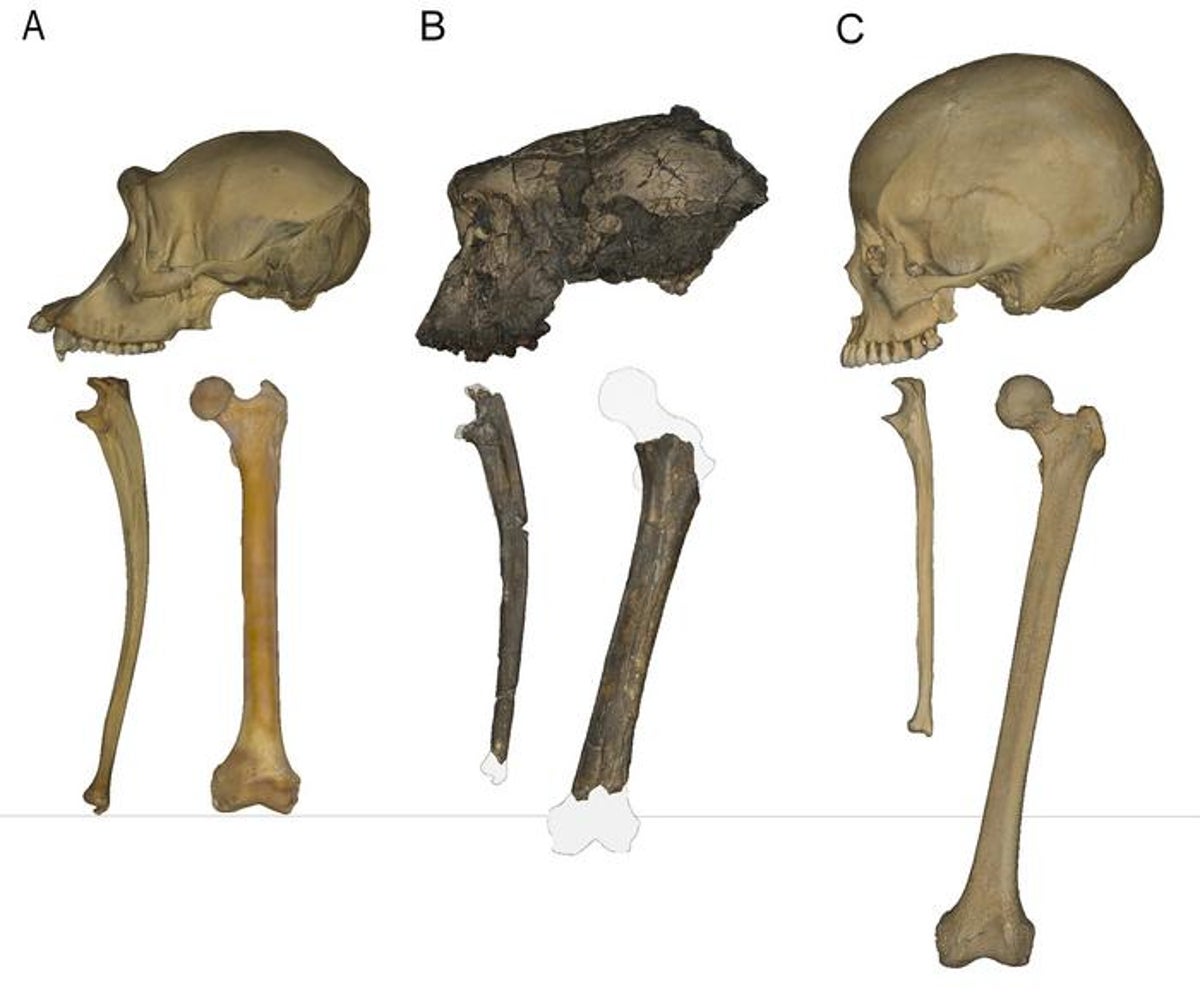
Williams and his team’s work, published today in Science Advances, reverses the narrative yet again. Using three-dimensional geometric morphometrics—a method that allows anthropologists to quantify the shapes of fossils—he and his colleagues identified rudimentary forms of several anatomical features that are critical for bipedalism in later hominins, from Australopithecus to modern humans.
Two of these features were reported in previous work: the femur is twisted inward, and there’s a small protrusion where the gluteus maximus would have attached to it. In 2022 a team led by Guillaume Daver and Franck Guy, paleoanthropologists at the University of Poitiers in France, used these features as a base to argue that Sahelanthropus was a “habitual” biped. (We, as “obligate” bipeds, have no choice but to walk upright.)
But Williams found a subtle third clue. Rubbing his thumb along the femur one day, he felt a small bump right where the iliofemoral ligament—a key stabilizer for bipedal movement—would attach to that bone in humans. “I was super excited about it,” he says. “It’s there; it’s just hard to see.” Williams informed Daver and Guy, who independently confirmed the existence of this femoral tubercle.

Wiliams et al., Sci. Adv. 12, eadv0130
Not everyone is convinced. Marine Cazenave, a paleoanthropologist at the Max Planck Institute for Evolutionary Anthropology in Leipzig, Germany, who co-authored a rebuttal last year to Daver and Guy’s 2022 paper, says the new study offers only “weak evidence” for bipedalism. Some nonbipedal primates have inward-twisted femurs, she says. As for the femoral tubercle, Cazenave says its function is poorly understood, adding that the fossil’s “badly preserved conditions” make it “impossible to know the real extent of this feature.”
In any case, Williams says, Sahelanthropus “was definitely reliant on trees.” That’s where it would have foraged, slept and sought safety. But on the ground, Williams is persuaded that it walked on two legs, using its hands to carry food. Given the sparse fossil record, it’s hard to be sure. Daver and Guy are planning to return to the original field site later this year in hopes of finding something more that others might have missed. “Closing the debate,” they said in a joint statement, “would require the discovery of new remains.”
It’s Time to Stand Up for Science
If you enjoyed this article, I’d like to ask for your support. Scientific American has served as an advocate for science and industry for 180 years, and right now may be the most critical moment in that two-century history.
I’ve been a Scientific American subscriber since I was 12 years old, and it helped shape the way I look at the world. SciAm always educates and delights me, and inspires a sense of awe for our vast, beautiful universe. I hope it does that for you, too.
If you subscribe to Scientific American, you help ensure that our coverage is centered on meaningful research and discovery; that we have the resources to report on the decisions that threaten labs across the U.S.; and that we support both budding and working scientists at a time when the value of science itself too often goes unrecognized.
In return, you get essential news, captivating podcasts, brilliant infographics, can’t-miss newsletters, must-watch videos, challenging games, and the science world’s best writing and reporting. You can even gift someone a subscription.
There has never been a more important time for us to stand up and show why science matters. I hope you’ll support us in that mission.