
Close Menu
    Trending
    • Netanyahu says he was successfully treated for prostate cancer
    • Negotiations that enable Israel’s land-grabs | Israel-Palestine conflict
    • True-or-false for Round 1 of 2026 NFL Draft: Will Cowboys regret their trade?
    • Opinion | Stewart Brand, Silicon Valley’s Favorite Prophet, on Life’s Most Important Principle
    • Struggling to scale your company? Here are five things that could be holding you back
    • What happens if you’re hit by a primordial black hole?
    • When is London Marathon 2026? Start time and how to watch race for FREE
    • Pentagon Requests $54 Billion For AI War
    Benjamin Franklin Institute
    Friday, April 24
    • Home
    • Politics
    • Business
    • Science
    • Technology
    • Arts & Entertainment
    • International
    Benjamin Franklin Institute
    Home»Science»Gargantuan black hole may be a remnant from the dawn of the universe
    Science

    Gargantuan black hole may be a remnant from the dawn of the universe

    Team_Benjamin Franklin InstituteBy Team_Benjamin Franklin InstituteJanuary 2, 2026No Comments3 Mins Read
    Share Facebook Twitter Pinterest Copy Link LinkedIn Tumblr Email VKontakte Telegram
    Share
    Facebook Twitter Pinterest Email Copy Link


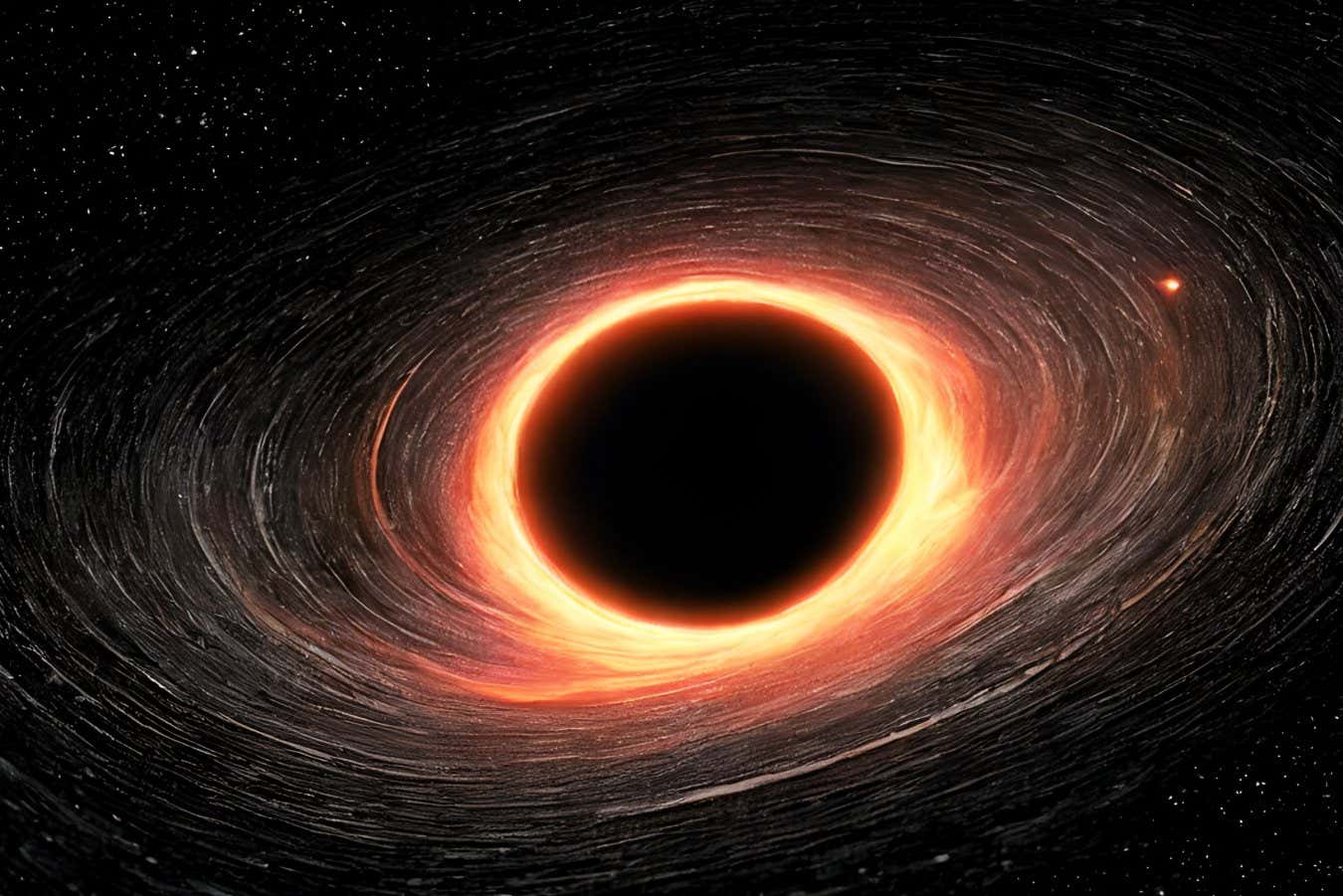
    Primordial black holes are hypothesised to have formed shortly after the big bang

    Shutterstock/Mohd. Afuza

    An unusually massive black hole in the very early universe may be a kind of exotic, star-less black hole first theorised by Stephen Hawking.

    In August, Boyuan Liu at the University of Cambridge and his colleagues spotted a strange galaxy from 13 billion years ago, called Abell 2744-QSO1, with the James Webb Space Telescope (JWST). The galaxy appeared to host an enormous black hole, around 50 million times the mass of the sun, but it was almost entirely devoid of stars.

    “This is a puzzle, because the traditional theory says that you form stars first, or together with black holes,” says Liu. Black holes are typically thought to form from very massive stars when they run out of fuel and collapse.

    Liu and his team ran some basic simulations, which showed that QSO1 could have instead started out as a primordial black hole, an exotic object first put forward by physicists Stephen Hawking and Bernard Carr in 1974. Rather than forming from a star, these objects would have coalesced out of fluctuations in the universe’s density shortly after the big bang.

    Primordial black holes should have largely evaporated and disappeared by the time we can see back to with JWST, but there is a chance that some may have survived and grown into much larger black holes, like QSO1.

    While Liu and his team’s calculations roughly matched their observations, they were simple, and didn’t take into account the complex interplay between the primordial black holes, clouds of gas and stars.

    Now, Liu and his team have run more detailed simulations of how primordial black holes would have grown in the universe’s first hundreds of millions of years. They calculated both how the gas would have swirled around a small, initial primordial black hole, and also how newly formed stars and dying stars would have interacted with it.

    Their predictions for the final mass of the black hole and the heavier elements in it match what they observed for QSO1.

    “It’s not decisive, but it’s an interesting and a kind of important possibility,” says Liu. “With these new observations that normal [black hole formation] theories struggle to reproduce, the possibility of having massive primordial black holes in the early universe becomes more permissible.”

    The simulations show that primordial black holes could actually be a viable source for QSO1, says Roberto Maiolino at the University of Cambridge, who was part of the team that originally discovered the black hole. “The fact that they manage to match the properties of QSO1, both in terms of the black hole mass, the stellar mass and the chemical enrichment, is very interesting and encouraging.”

    However, the largest supermassive black holes in standard primordial black hole simulations tend to be around 1 million solar masses, says Maiolino. “Here we are 50 times more massive,” he says. “However, it is true that these primordial black holes are expected to be strongly clustered, and so it may well be that they managed to merge to quickly become much more massive.”

    Another problem is that primordial black holes should require a blast of high-energy radiation to initially collapse and form, such as a nearby exploding star, but we don’t see any potential sources anywhere close to QSO1, says Maiolino.

    Jodrell Bank with Lovell telescope

    Mysteries of the universe: Cheshire, England

    Spend a weekend with some of the brightest minds in science, as you explore the mysteries of the universe in an exciting programme that includes an excursion to see the iconic Lovell Telescope.

    Topics:


    Source link

    Share. Facebook Twitter Pinterest LinkedIn Tumblr Email Telegram Copy Link

    Related Posts

    Science

    What happens if you’re hit by a primordial black hole?

    April 24, 2026
    Science

    How do earthquakes end? A seismic ‘stop sign’ could help predict earthquake risk

    April 24, 2026
    Science

    ‘Kraken’ fossils show enormous, intelligent octopuses were top predators in Cretaceous seas

    April 24, 2026
    Science

    Largest ever octopus was great white shark of invertebrate predators

    April 24, 2026
    Science

    Do you need to worry about Mythos, Anthropic’s computer-hacking AI?

    April 23, 2026
    Science

    How many dachshunds would it take to get to the moon?

    April 23, 2026
    Editors Picks

    New photos of Mike Vrabel and Dianna Russini emerge

    April 24, 2026

    Injured Cummins set to miss Australia’s ICC Champions Trophy bid | Cricket News

    February 5, 2025

    Pinning extreme weather on climate change: Best ideas of the century

    January 25, 2026

    Bernie Sanders Enjoys Luxury Private Jets – But Wants To Eliminate The Fossil Fuel Industry

    February 6, 2026

    Iran Waives Fees For Spanish Ships Passing Through Strait

    March 27, 2026
    About Us
    About Us

    Welcome to Benjamin Franklin Institute, your premier destination for insightful, engaging, and diverse Political News and Opinions.

    The Benjamin Franklin Institute supports free speech, the U.S. Constitution and political candidates and organizations that promote and protect both of these important features of the American Experiment.

    We are passionate about delivering high-quality, accurate, and engaging content that resonates with our readers. Sign up for our text alerts and email newsletter to stay informed.

    Latest Posts

    Netanyahu says he was successfully treated for prostate cancer

    April 24, 2026

    Negotiations that enable Israel’s land-grabs | Israel-Palestine conflict

    April 24, 2026

    True-or-false for Round 1 of 2026 NFL Draft: Will Cowboys regret their trade?

    April 24, 2026

    Subscribe for Updates

    Stay informed by signing up for our free news alerts.

    Paid for by the Benjamin Franklin Institute. Not authorized by any candidate or candidate’s committee.
    • Privacy Policy
    • About us
    • Contact us

    Type above and press Enter to search. Press Esc to cancel.