

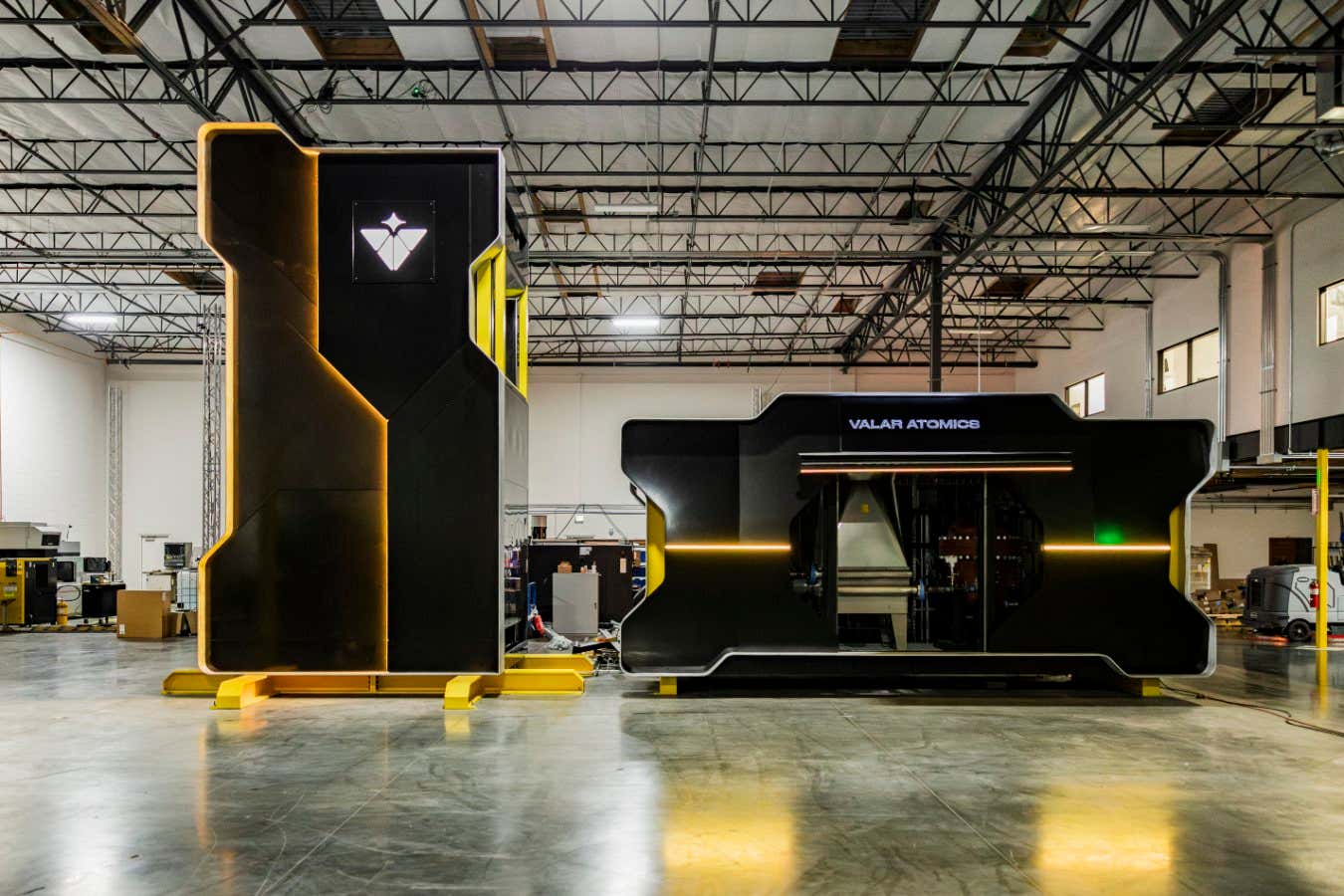
Valar Atomics’ Ward 250 reactor under construction
Daria Nagovitz/Valar Atomics
Despite providing nearly a fifth of US electricity generation, nuclear power in the country has stagnated for decades. Regulatory hurdles, public scepticism and cheaper energy sources led to plant closures, moratoriums and a lack of funding for novel nuclear technologies. But spiking electricity demand – driven largely by data centres – is spurring a nuclear revival, and the Department of Energy appears to be making up for lost time. Its Reactor Pilot Program is fast-tracking the testing of advanced reactor designs, with the first major milestone set for mid-2026.
The programme is part of a DOE strategy aiming to quadruple the sector’s output by 2050. Eleven companies developing advanced nuclear reactor technologies were selected to participate, and the goal is for at least three of them to reach criticality – a state where a nuclear fission reaction becomes stable and self-sustaining – by 4 July 2026.
“It is deliberately a very ambitious deadline,” says Leslie Dewan, a nuclear engineer specialising in advanced reactor technologies. “One of the purposes of this pilot is to really flesh out which concepts are executable under real-world constraints.”
The reactor designs being developed range from molten salt and high-temperature gas reactors to fast reactors, sodium-cooled designs and pressurised water systems. One of the companies that is thought to be furthest along is California-based Valar Atomics, which is developing a high-temperature gas reactor (HTGR) called the Ward 250.
HTGRs run on tiny particles of uranium coated in layers of carbon and ceramic. The coatings turn each particle into a self-contained fuel unit that won’t melt even at extremely high temperatures, providing a built-in safety shield that prevents radioactive leakage.
Fuel particles are loaded into graphite blocks, which form the reactor’s core and have channels for helium gas to flow through. The fuel’s fission reaction heats the helium, and that heat boils water to create steam, which turns a generator to produce electricity. The helium then flows back to the reactor to be reheated.
Valar broke ground on the Ward 250 in September, making it the second company to start construction (the first was Texas-based Aalo Atomics, which broke ground in August). Valar was the first to achieve cold criticality, a self-sustaining fission reaction with no heat output. This was done at a government test facility under tightly controlled conditions, and while it validates core physics and provides useful data, says Dewan, “it’s not the same thing as having their own integrated test reactor built and operated at power”.
Molten salt reactors, Texas-based Natura Resources’ design of choice, work in a very different way, but are also thought to be inherently safe. Uranium is mixed into molten salt, which heats up with the fuel’s fission reaction. Pumps move the liquid salt through a heat exchanger, where it transfers heat to another loop that makes steam or drives a turbine. If the salt overheats, it expands and melts an emergency “freeze plug” that drains the fuel into a safe tank, where it can’t sustain a chain reaction.
“Molten salt reactors operate at atmospheric pressure, so any type of accident would be confined to the site itself,” says Dewan. “Even if it loses all electric power, even if there aren’t any operators on site, it would be able to coast to a safe stop.”
Although Natura hasn’t broken ground yet, it secured a construction permit from the Nuclear Regulatory Commission to build a 1-megawatt research reactor, and recently acquired Shepherd Power, also based in Texas, whose supply chain and regulatory knowledge will help move Natura’s technology toward deployment. The company “has had a very positive and collaborative relationship with the NRC”, says Dewan, but “molten salt is corrosive and at high temperatures it’s radioactive, so the material challenges are not to be underestimated”.
Given that the criticality deadline is only about six months away, Valar, Natura and the other nine companies in the pilot programme will need to work at an unprecedented pace if they are to meet it. However, it is just one of many hurdles that companies will need to clear.
“The real proving points will be things like: can you take the reactor up to power and down again in a controlled way; can you operate at design temperature for thousands of hours; can you demonstrate that the materials and fuel are behaving as expected; and can you do all of that reliably enough that the NRC and future customers will trust the design?” says Dewan. “I view this 2026 date as the start of the interesting data-gathering period, by no means the finish line.”
Topics: