
Close Menu
    Trending
    • Struggling to scale your company? Here are five things that could be holding you back
    • What happens if you’re hit by a primordial black hole?
    • When is London Marathon 2026? Start time and how to watch race for FREE
    • Pentagon Requests $54 Billion For AI War
    • Clavicular Hit With New YouTube Crackdown
    • Beijing’s new supply chain rules deepen concerns for US firms in China
    • India denounces ‘hellhole’ remark shared by Trump | Donald Trump News
    • New photos of Mike Vrabel and Dianna Russini emerge
    Benjamin Franklin Institute
    Friday, April 24
    • Home
    • Politics
    • Business
    • Science
    • Technology
    • Arts & Entertainment
    • International
    Benjamin Franklin Institute
    Home»Science»Three supermassive black holes have been spotted merging into one
    Science

    Three supermassive black holes have been spotted merging into one

    Team_Benjamin Franklin InstituteBy Team_Benjamin Franklin InstituteDecember 31, 2025No Comments3 Mins Read
    Share Facebook Twitter Pinterest Copy Link LinkedIn Tumblr Email VKontakte Telegram
    Share
    Facebook Twitter Pinterest Email Copy Link


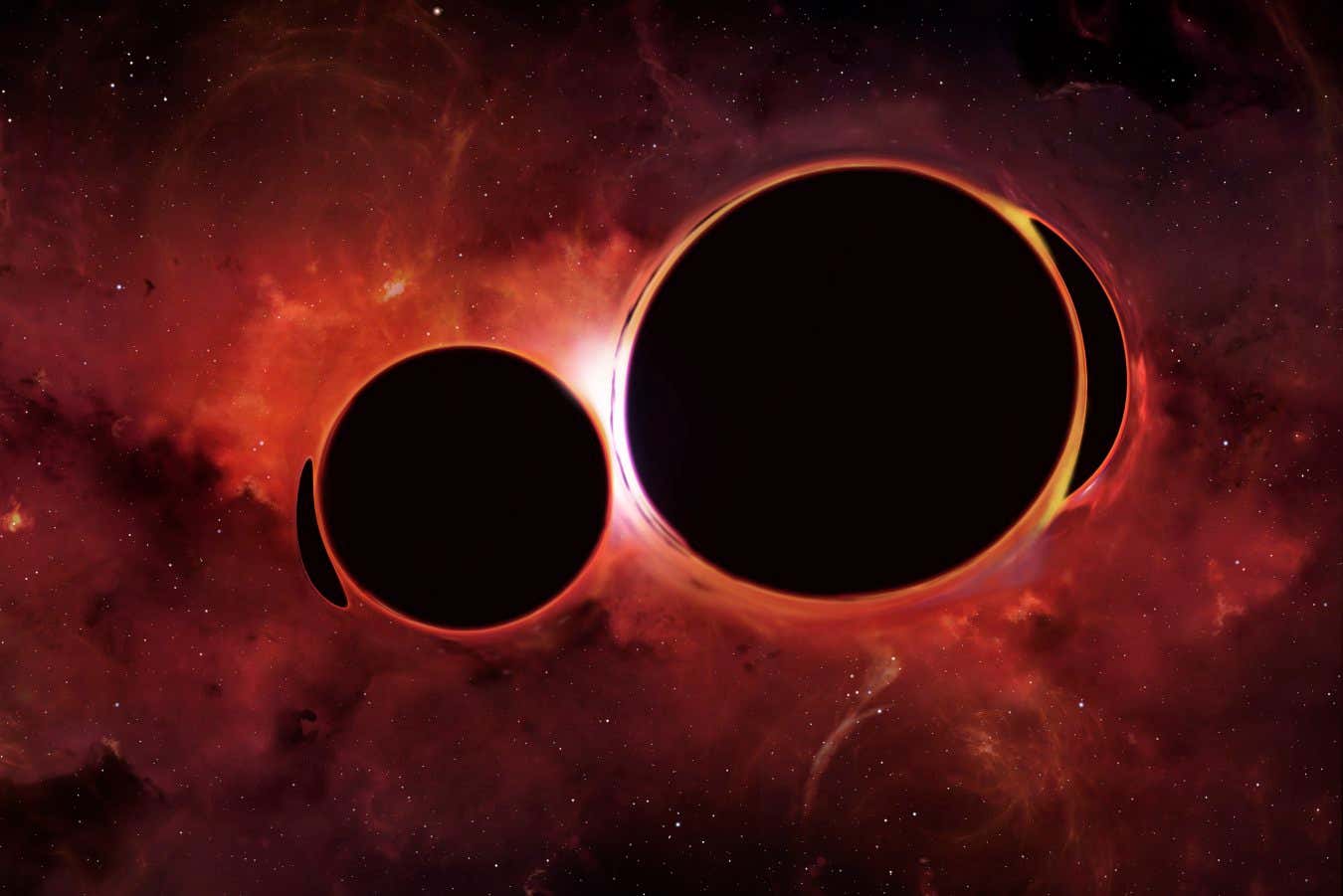
    Supermassive black holes occasionally devour or merge with other black holes

    MARK GARLICK/SCIENCE PHOTO LIBRARY

    Three galaxies with supermassive black holes at their centres appear to be in the process of merging into a single, giant galaxy, a process that astronomers have rarely seen.

    To grow to such enormous sizes, astronomers think supermassive black holes must occasionally devour or merge with other massive black holes during collisions between galaxies. This process is difficult to spot, both because these mergers are short-lived compared with the lifetime of the black hole and because the black holes can only be easily seen if they are giving off light from actively feeding on material, which is also rare. As a result, astronomers have only caught around 150 pairs of galactic black holes in the act of merging.

    Now, Emma Schwartzman at the US Naval Research Laboratory in Washington DC and her colleagues have found a group of three supermassive black holes, all actively feeding, that appear to be combining into a single system. “The more galaxies involved, the rarer the system gets,” says Schwartzman.

    Each of the supermassive black holes is emitting low-frequency radiation in the form of radio waves, which can pass through dust that blocks other light. This allowed Schwartzman and her team to observe them with two radio observatories, the Very Long Baseline Array in Hawaii and the Very Large Array in New Mexico, then rule out that the light was coming from another source, like bright galaxies full of stars.

    “What’s really interesting is that all three of these [black holes] emit in the radio regime, which we’ve never seen before,” says Schwartzman. “There’s no guarantee that any [black hole] would emit in the radio regime.”

    There are already visible signs that the galaxies have begun interacting with each other, says Isabella Lamperti at the University of Florence, Italy, but they are at a relatively early stage of interaction, given that two of the galaxies are still separated by around 70,000 light years and the third is 300,000 light years away.

    But relative to their total lifetime of billions of years, we are witnessing the end of the story. “It’s like catching the final moments of a galaxy-merging soap opera,” says Emma Kun at Ruhr University Bochum in Germany.

    Simulating how three active supermassive black holes merge is extremely difficult, she says, but observing this system will allow physicists to better understand what happens in more complex mergers. “This is the first step of finding some physics about the system,” says Kun.

    Jodrell Bank with Lovell telescope

    Mysteries of the universe: Cheshire, England

    Spend a weekend with some of the brightest minds in science, as you explore the mysteries of the universe in an exciting programme that includes an excursion to see the iconic Lovell Telescope.

    Topics:


    Source link

    Share. Facebook Twitter Pinterest LinkedIn Tumblr Email Telegram Copy Link

    Related Posts

    Science

    What happens if you’re hit by a primordial black hole?

    April 24, 2026
    Science

    How do earthquakes end? A seismic ‘stop sign’ could help predict earthquake risk

    April 24, 2026
    Science

    ‘Kraken’ fossils show enormous, intelligent octopuses were top predators in Cretaceous seas

    April 24, 2026
    Science

    Largest ever octopus was great white shark of invertebrate predators

    April 24, 2026
    Science

    Do you need to worry about Mythos, Anthropic’s computer-hacking AI?

    April 23, 2026
    Science

    How many dachshunds would it take to get to the moon?

    April 23, 2026
    Editors Picks

    Ryan Gosling Makes Rare Bedroom Confession About His Love Life

    March 22, 2026

    Workers are using AI to learn on the job, even though 65% worry about accuracy

    April 21, 2026

    American Eagle is back with Syd and not sorry about it

    April 18, 2026

    Lori Loughlin Shows Her Ex What He’s Missing With Youthful New Look

    March 18, 2026

    The real reason Silicon Valley’s architecture is so boring

    March 14, 2026
    About Us
    About Us

    Welcome to Benjamin Franklin Institute, your premier destination for insightful, engaging, and diverse Political News and Opinions.

    The Benjamin Franklin Institute supports free speech, the U.S. Constitution and political candidates and organizations that promote and protect both of these important features of the American Experiment.

    We are passionate about delivering high-quality, accurate, and engaging content that resonates with our readers. Sign up for our text alerts and email newsletter to stay informed.

    Latest Posts

    Struggling to scale your company? Here are five things that could be holding you back

    April 24, 2026

    What happens if you’re hit by a primordial black hole?

    April 24, 2026

    When is London Marathon 2026? Start time and how to watch race for FREE

    April 24, 2026

    Subscribe for Updates

    Stay informed by signing up for our free news alerts.

    Paid for by the Benjamin Franklin Institute. Not authorized by any candidate or candidate’s committee.
    • Privacy Policy
    • About us
    • Contact us

    Type above and press Enter to search. Press Esc to cancel.