
Close Menu
    Trending
    • ‘The Ultimatum’ Star Blake Robertson Shares Relationship Update
    • US missiles hit Iran as path towards de-escalation uncertain
    • UN rights chief Turk wins second term despite US and Israeli opposition | United Nations News
    • LeBron’s decision might force Jalen Brunson to do the unthinkable
    • 8 Unique Side Hustle Ideas for Summer 2026 and Beyond
    • NHTSA considers new car door safety rules after fatal Tesla crashes
    • PlayStation Network outage resolved after thousands of gamers unable to play
    • Market Talk – July 24, 2026
    Benjamin Franklin Institute
    Saturday, July 25
    • Home
    • Politics
    • Business
    • Science
    • Technology
    • Arts & Entertainment
    • International
    Benjamin Franklin Institute
    Home»Science»The world’s first fully 3D-printed microscope went big in 2025
    Science

    The world’s first fully 3D-printed microscope went big in 2025

    Team_Benjamin Franklin InstituteBy Team_Benjamin Franklin InstituteDecember 31, 2025No Comments3 Mins Read
    Share Facebook Twitter Pinterest Copy Link LinkedIn Tumblr Email VKontakte Telegram
    Share
    Facebook Twitter Pinterest Email Copy Link


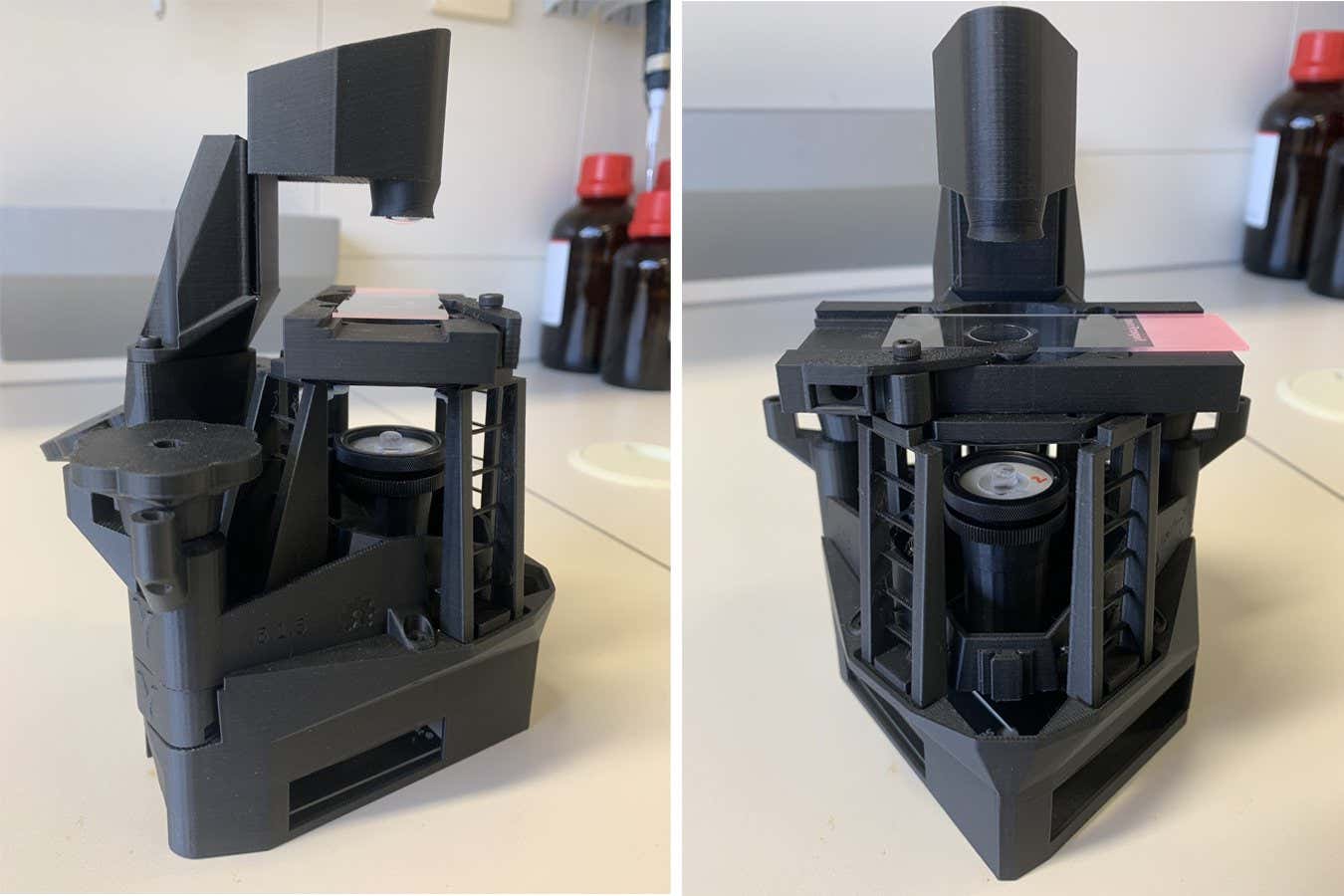
    The 3D-printed microscope

    Dr Liam M. Rooney/University of Strathclyde

    At the beginning of 2025, a preprint of a paper about a new microscope caused an awful lot of excitement among researchers. It was the world’s first fully 3D-printed microscope, made in only a few hours and for a fraction of the typical cost.

    Liam Rooney at the University of Glasgow in the UK, who worked on the project, says that after New Scientist reported on the microscope, people reached out from all over the world, from biomedical researchers to community groups and even film-makers. “Community reception was incredible,” he says. The work has now also been published in the Journal of Microscopy.

    For the body of the microscope, his team used a design from OpenFlexure, which is a resource for 3D-printing scientific instruments that anyone can access. They also used a store-bought camera and a light source, while the control for all the microscope’s parts came from a Raspberry Pi computer.

    The real breakthrough, however, was that the team 3D-printed the microscope’s lens out of clear plastic – this is what made their microscope both more affordable and more accessible than more conventional devices. While such microscopes can cost thousands, creating the new one cost less than £50.

    “We must have printed about a thousand more lenses of different shapes since January,” says team member Gail McConnell at the University of Strathclyde in the UK.

    She says several companies that make commercial products that require lenses reached out about the team’s work, as cheap and lightweight 3D-printed lenses are not at all common in large-scale manufacturing. She and her colleagues tested the microscope by examining a blood sample and a thin section of a mouse kidney, which established that it could be useful in medicine and biology studies.

    But the team says their goal with the work was to democratise access to microscopes, and those dreams are coming true. They are now collaborating with a laboratory at the Kwame Nkrumah University of Science and Technology in Ghana to make microscopy more available to researchers and students in West Africa, and they have received grants from the UK Institute for Technical Skills and Strategy, says Rooney. They are also participating in programmes that upskill and empower students who face barriers to accessing education.

    Additionally, the researchers have incorporated the new microscope into the Strathclyde Optical Microscopy Course, which is designed for researchers at all levels of experience and, according to Rooney, a unique educational opportunity within the UK. “This is really changing how we teach,” he says.

    And there is scope for the 3D-printed microscope to become even better. The researchers have been working on improving its resolution without making it more costly, and they have already worked out how to increase its contrast by up to 67 per cent.

    McConnell says that because the microscope was designed to be created with consumer electronics and accessible 3D printers, the limitations on how much it could do in the future, and how well, really lie with the limitations of current 3D-printing technology.

    “As these printers get better, we will get better too: this is the bottleneck. The bottleneck is not imagination,” she says. “We are getting emails constantly from people asking us to print something new.”

    Topics:

    • 3D printing/
    • 2025 news review


    Source link

    Share. Facebook Twitter Pinterest LinkedIn Tumblr Email Telegram Copy Link

    Related Posts

    Science

    NHTSA considers new car door safety rules after fatal Tesla crashes

    July 24, 2026
    Science

    Fungus made fashion—researchers turn living organisms into textiles

    July 24, 2026
    Science

    How a 99-year-old mathematician unraveled a century-old braid mystery

    July 24, 2026
    Science

    Is it possible to regain a sense of smell? These scientists are working on it

    July 24, 2026
    Science

    Why don’t insects live in the ocean?

    July 24, 2026
    Science

    Why environmental groups are suing over SpaceX’s land swap deal

    July 24, 2026
    Editors Picks

    Are stores open on Juneteenth? Holiday hours for Walmart, Costco, stock markets, banks, and more

    June 19, 2026

    Egypt signs renewable energy deals worth US$1.8 billion

    January 11, 2026

    Germany Covers Mouth At World Cup After Armband Ban

    December 10, 2025

    Why are the steel beams inside a Manhattan skyscraper buckling? Experts explain

    July 8, 2026

    Opinion | America Needs to Build More Housing

    May 18, 2026
    About Us
    About Us

    Welcome to Benjamin Franklin Institute, your premier destination for insightful, engaging, and diverse Political News and Opinions.

    The Benjamin Franklin Institute supports free speech, the U.S. Constitution and political candidates and organizations that promote and protect both of these important features of the American Experiment.

    We are passionate about delivering high-quality, accurate, and engaging content that resonates with our readers. Sign up for our text alerts and email newsletter to stay informed.

    Latest Posts

    ‘The Ultimatum’ Star Blake Robertson Shares Relationship Update

    July 25, 2026

    US missiles hit Iran as path towards de-escalation uncertain

    July 25, 2026

    UN rights chief Turk wins second term despite US and Israeli opposition | United Nations News

    July 25, 2026

    Subscribe for Updates

    Stay informed by signing up for our free news alerts.

    Paid for by the Benjamin Franklin Institute. Not authorized by any candidate or candidate’s committee.
    • Privacy Policy
    • About us
    • Contact us

    Type above and press Enter to search. Press Esc to cancel.