

Aaron Schwartz/Sipa USA via Reuters Connect
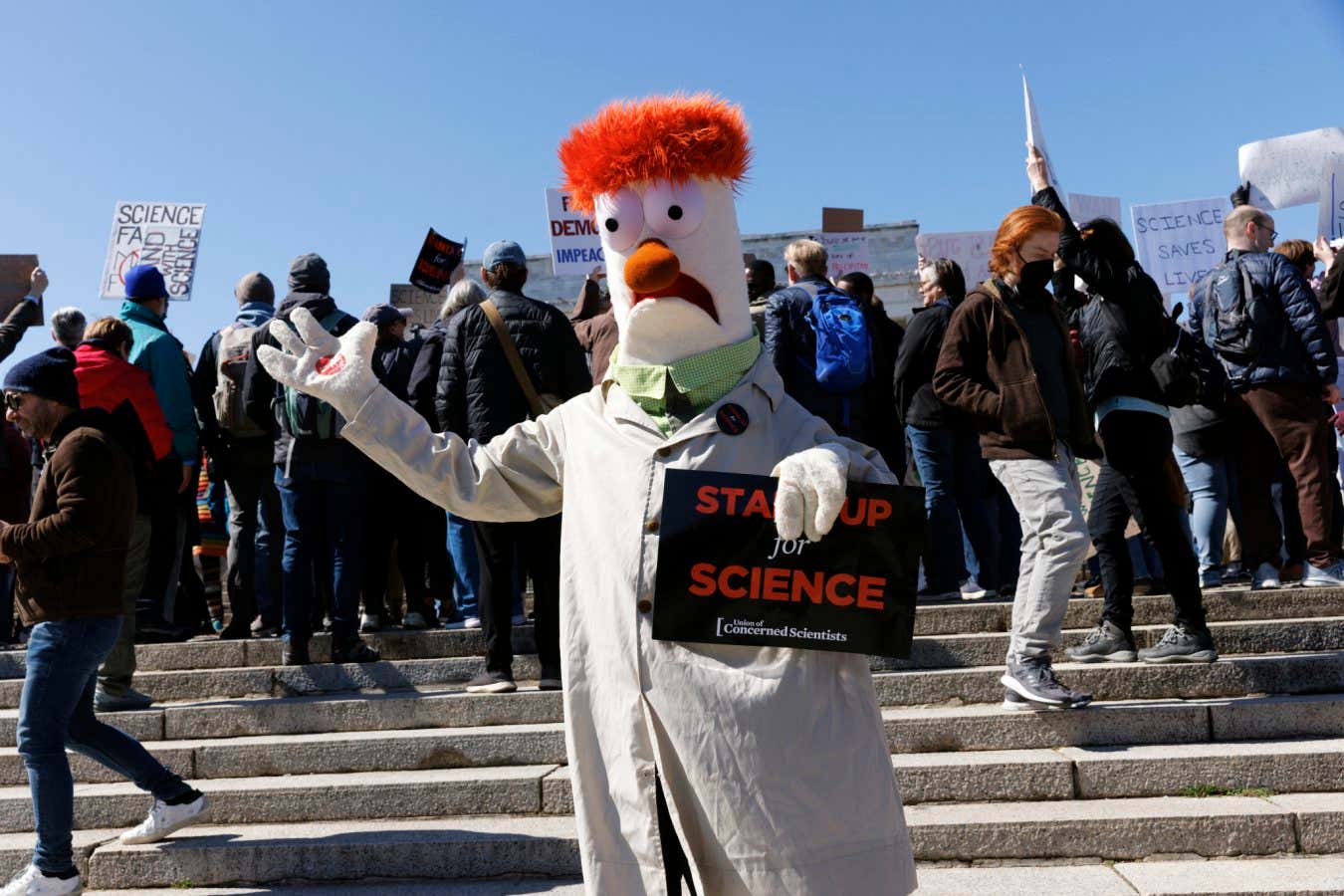
From vaccine sceptics at the heart of the US government to the continued global paralysis when it comes to climate action, science has been under siege in 2025. Those who believe in rationality and evidence must continue to fight back against the encroaching darkness – as we hope you agree New Scientist is doing – but also seek out the whimsy and wonder that comes from exploring the universe and everything in it.
Before we break out the party hats for the delightful celebration of science contained in our double holiday issue, it is worth reflecting on the threats we science-minded folk are facing. Wherever you turn, there are shocking examples of science being misused and abused this past year.
The gutting of US science under President Donald Trump cannot be ignored, even if you don’t live in the US (see, Donald Trump and Elon Musk put science on the chopping block in 2025). For decades, the nation has been one of the biggest funders of science in the world, to the great benefit of both the US itself and everyone else. That all changed this year. By taking an axe to US science (or, in the case of Elon Musk, a chainsaw), countless discoveries will go unmade, drugs untested and technologies undeveloped, leaving us all the poorer.
Of course, governments aren’t the only source of funding, but two stories from this year demonstrate the danger of leaving science at the whim of commercial interests. Regular readers of New Scientist will be familiar with Colossal Biosciences, a US company that claims to be in the business of “de-extinction” (see, De-extinction was big news in 2025 – but didn’t live up to the hype). Its most notable, or perhaps notorious, output this year were three genetically modified grey wolves named Romulus, Remus and Khaleesi.
“
While it may take time to see results, science is here to serve, save and delight us all
“
Colossal claimed that these were the first living dire wolves since the species went extinct 10,000 years ago, a claim widely trumpeted by the world’s media despite the protestations of independent scientists. In the battle of truth versus spectacle, spectacle seemed to take the upper hand.
A similar tale played out in November with the broadcast of the UK documentary Hitler’s DNA: Blueprint of a dictator. There is no disputing that the scientists involved in the series have successfully identified and sequenced the Nazi dictator’s genome, but the sensationalist interpretation of those results, such as claims that he may have had schizophrenia or been autistic, leaves much to be desired. While the documentary and its accompanying lurid headlines have come and gone, we still await the publication of a scientific paper detailing the work, allowing for a true assessment of the researchers’ claims.
One area where we are definitely not waiting for the science is in the realm of climate action. Indeed, science and public policy have been perfectly aligned for the past decade, since nations signed the Paris Agreement pledging to keep global warming below 1.5°C. The one small problem is that we haven’t actually done that.
The Paris Agreement had a “ratchet” mechanism designed to ensure we stay on track by asking countries to make new pledges on climate action every five years. Around 95 per cent of nations failed to do so by the deadline in February this year, and only about 60 per cent managed it in time for the COP30 climate summit, held in November in Belém, Brazil.
The backsliding didn’t stop there. In our end-of-year leader for 2024, we called on the Brazilian president Luiz Inácio Lula da Silva “to take to the stage and publicly admit the failure of the COP process to date, flanked by unsmiling world leaders with a clear plan to do better”. Instead, countries couldn’t even agree to include the phrase “fossil fuels” in the final COP30 text.
OK, OK, that’s enough doom and gloom – it is the holidays, after all, so let’s have some fun. Another major story of 2025 was the 100-year anniversary of quantum mechanics, which we covered extensively, including in an April special issue. To cap the year off, we have the news that a thought experiment dreamed up by Albert Einstein and Niels Bohr has finally been realised (see, Quantum experiment settles a century-old row between Einstein and Bohr). It shows that, yes, quantum mechanics really is that weird.
Other good-news stories from 2025 included the continued success of GLP-1 drugs in treating a range of conditions, not just aiding weight loss (see, The potential of GLP-1 drugs to transform medicine exploded in 2025), and – perhaps most whimsically of all – the people who saw a brand-new colour (see, People saw a new colour for the first time in 2025).
Elsewhere in this issue, you will find an incredible smorgasbord to stuff your mind along with your stomach this holiday season. For a new twist on Charles Dickens, see, How 3 imaginary physics demons tore up the laws of nature for the story of three demons that have been haunting physicists. As you catch your breath from a busy year, consider a new approach to meditation for the time-poor (see, Too busy to meditate? Microdosing mindfulness has big health benefits). To learn about what may be the best job in science, visit the Touch and Tickle lab see, What the evolution of tickling tells us about being human. And finally, why not wash it all down with the world’s oldest beer (see, Did ancient humans start farming so they could drink more beer??)
As we turn to 2026 and the global challenges ahead, let us remember just how powerful and wonderful science can be. Despite the sceptics and the naysayers, there is no better way of making sense of the world, and making the world a better place, than scientific inquiry and the application of knowledge it brings. While it may take time to see results – like the hundred-year gap between Einstein and Bohr’s debate and the resulting experiment – science is here to serve, save and delight us all.
Here’s to better luck – or at least a more beneficial draw from a random probability distribution – next year.