

“AI is not going to take your job. The person who uses AI is going to take your job.”
This is an idea that has become a refrain for, among others, Nvidia CEO Jensen Huang, who has publicly made the prediction several times since October 2023. Meanwhile, other AI developers and stalwarts say the technology will eliminate countless entry-level jobs. These predictions have come at the same time as reports of layoffs at companies including IBM and Amazon, causing anxiety for tech workers—especially those starting their careers, whose responsibilities are often more easily automated.
Early reports have borne out some of these anxieties in employment data. For example, entry-level hiring at the 15 biggest tech firms fell 25 percent from 2023 to 2024, according to a report from SignalFire last May. Still, it’s unclear what the long-term effects will be, or whether hiring cuts are actually a result of AI. For instance, while Meta laid off 600 employees from its AI division in October (and continued hiring other AI researchers), OpenAI began hiring junior software engineers.
In 2026, all new graduates may face a tougher job market in the United States. Employers’ rating of the job market for college graduates is now at its most pessimistic since 2020, according to data from the National Association of Colleges and Employers (NACE) Job Outlook 2026 survey. However, 49 percent of respondents still consider the job market “good” or “very good.”
So, what does the rise of generative AI mean for early-career engineers?
“This is a tectonic shift,” says Hugo Malan, president of the science, engineering, technology and telecom reporting unit within the staffing agency Kelly Services. AI agents aren’t poised to replace workers one-to-one, though. Instead, there will be a realignment of which jobs are needed, and what those roles look like.
How Jobs Are Changing
When publicly available AI tools first arrived, Malan says the expectation was that jobs like call-center roles would be most vulnerable. “But what nobody predicted was that the biggest impact by far would be on programmers,” a trend he attributes to the relatively solitary and highly structured nature of the work. He notes that, while other economic conditions also factor into the job market, the pace of programmer employment decline has accelerated since generative AI came on the scene. In the United States, overall programmer employment fell a dramatic 27.5 percent between 2023 and 2025, according to data from the U.S. Bureau of Labor and Statistics. But employment for software developers—a distinct, more design-oriented position in the government data—only fell 0.3 percent in the same period.
At the same time, some positions, such as information security analyst and AI engineer are actually growing, Malan says. “There’s been this pretty dramatic readjustment of the job landscape, even with as narrow a field as IT. Within IT, some jobs have exploded, like InfoSec analysts have grown in double digits, whereas programmers declined double digits” over the past few years, he says. (Eventually, Malan says he expects generative AI to affect all intellectual work.)
Job responsibilities also appear to be changing. For recent graduates pursuing roles labeled as software-engineering jobs, “they’re not necessarily just coding,” says Jamie Grant, senior associate director for the engineering team at the University of Pennsylvania’s career services. “There tends to be so much higher-order thinking and knowledge of the software-development life cycle,” as well as a need to work with other parties, such as understanding user and client demands, she says.
Using AI to Your Advantage
In her work advising Penn students, Grant hears concerns about AI’s effects on the job market from many engineering students and their parents. But during conversations with them, she says she tries to maintain an ethos of “we can make this work for us, not against us.”
According to a report from the Stanford Digital Economy Lab, jobs involving tasks that could be automated with AI appear to be more susceptible to early-career employment dips than those where AI augments an employee’s ability to perform their job. The NACE data supports this: Sixty-one percent of employers say they are not replacing entry-level jobs with AI, while 41 percent are discussing or planning to augment these jobs with AI within the next five years.
Over the past few years, computer-programmer employment in the United States has dropped sharply—but overall employment in the computing industry hasn’t seen the same decline.
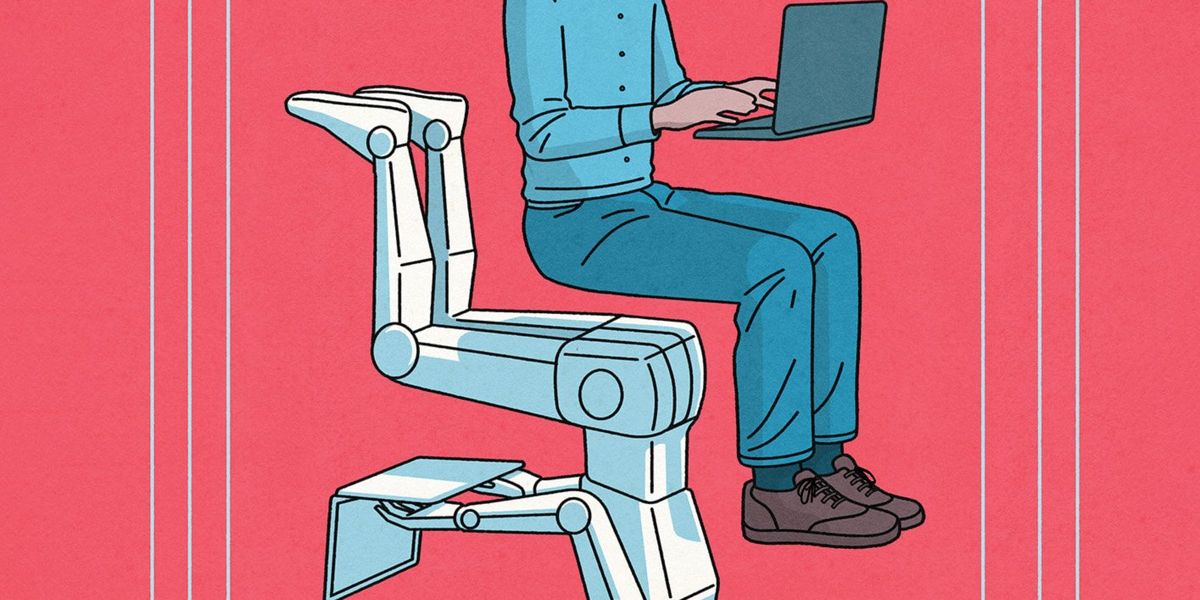
“Think about an exoskeleton that you could wear that allows you to lift 1,000 pounds,” Grant says. “AI should be, just as the people at Stanford say, an augmentation to your work, to your higher-order critical-thinking skills.” That being said, she advises students to be cautious of the risks, such as sharing sensitive or proprietary information with a chatbot.
At this point, Grant thinks proficiency with AI tools is an unwritten expectation of many employers. But students and early-career workers should also recognize where AI can’t help. “AI can’t necessarily be with you in that moment of negotiation or of client-relationship development,” she says. “You still need to be able to perform at your highest level of capabilities.” And foundational skills like problem solving and communication are consistently prioritized by employers.
How Education Needs to Change
With AI tools performing more of the “grunt work” that has served as a training ground for early-career workers, expectations for recent graduates are high. In the past, junior engineers have cultivated proficiency while doing simpler, more task-oriented work. “But if all of those are going to get taken over, you need to slot in at a higher level almost from day one,” Malan says. This leaves recent graduates in a difficult spot.
To help students prepare, the education system will likely need to change, for instance by encouraging students to become proficient using AI and take on more hands-on, experiential learning.
Today’s employers are looking for demonstrated skills, says Grant. “If you’re just going to class and doing projects and maybe getting a great GPA, that’s amazing. But you also need to be applying what you’re learning,” she says. Industry experience and demonstrated proficiencies are among the top factors considered by employers surveyed in NACE’s Job Outlook 2026.
One solution may even lie in entirely different educational models, like apprenticeship. “Often, students in a more traditional computer-software degree program get a lot of theoretical knowledge,” but they may not have much experience building software on a team, says Mike Roberts, founder and CEO of the nonprofit Creating Coding Careers. Recent graduates may not be ready to ship code on day one—but AI can. Apprenticeship allows students to learn on the job in a structured program, and helps “to much more effectively close the experience gap,” Roberts says.
Training the next generation of humans might also better serve the long-term interests of employers, he says. In today’s software engineering, many companies tend to be short-sighted in their hiring, thinking more of the next quarter than four or five years down the line. But “if you don’t train new early entrants into the market, you will eventually have no more people becoming mid-levels,” says Roberts. “It’s very myopic.”
Also, AI can help ramp up new employees faster than ever. “I find it an exciting time, because it’s never been faster to build high-quality software,” Roberts says. “But it’s weird that folks are not seeing the virtue of continuing to invest in humans.”
From Your Site Articles
Related Articles Around the Web