

Chris BaraniukTechnology Reporter
 Getty Images
I’m peering into a large vat containing a perfectly clear liquid – a special kind of flame retardant for wood products.
“You can drink it. I have,” says Stephen McCann, general & technical manager at Halt, a wood treatment company in Belfast. “I wouldn’t recommend it,” he adds, however. It’s very salty, apparently.
But this liquid, containing a substance called Burnblock, has been shown to prevent fire taking hold of wood in tests.
In a video the firm has shared online, two small model houses are blasted with a blow torch. One, treated with a different product, is engulfed in flames to such an extent that it collapses. The Burnblock-treated model gets heavily charred in one corner but remains otherwise unharmed.
What is Burnblock exactly? No-one will say. Neither Mr McCann nor Hroar Bay-Smidt, chief executive of Burnblock itself, a Danish firm, will confirm the ingredients. However, documentation on Burnblock’s website from the Danish Technological Institute states the flame retardant ingredient is “a natural component in the body” and that the mixture also contains citric acid and “a natural component in some berries”.
Flame retardants, chemicals added to products to try and slow down how they burn, have been around in various forms for centuries.
But many of the flame retardants developed in the 20th Century are highly toxic. “There hasn’t been a lot of investment in replacements so now all of a sudden people are scrambling to find them,” says Alex Morgan, a chemist and flame retardant expert at the University of Dayton Research Institute in the US.
When you try to set fire to wood treated with Burnblock, the material forms a protective layer of char, explains Mr Bay-Smidt. “It also releases some water,” he adds. “That helps absorb the heat and slows the fire’s spread.” And, it prevents oxygen feeding the flames. You can add Burnblock to other building materials, he says, including dried seagrass.
Halt, which has been operating in Belfast for nearly four years, has supplied Burnblock-treated wood products to hundreds of locations around the UK and Ireland. From restaurants to hotels and even HS2. For the latter, Halt provided treated hoardings used to fence off construction areas in tunnels.
“It could be quite difficult to get out of the tunnel so they need as much time as possible to evacuate [in the event of a fire],” says Mr McCann. I ask whether any of the buildings or facilities constructed with wood treated by Halt have ever been affected by a fire to date – “No” is the answer.


In one of Halt’s buildings they have a huge machine called an autoclave, consisting mainly of two large horizontal tubes. The top one is a tank containing the treatment fluid that I saw earlier. When the tube below it is loaded with pieces of wood, it first exposes them to a vacuum, to open up the wood’s pores, says Mr McCann.
Then, pressure appropriate to the species of wood in question is applied, along with the treatment fluid.
“What that pressure is doing is, it’s forcing the fire retardant into the very core of the timber,” says Mr McCann.
After this, the wood goes into a large kiln where it is dried in a process that can last anywhere from 10 days to six weeks. It’s carefully managed – drying that happens too quickly or too slowly can warp the wood.
“Timber is an amazing material,” says Richard Hull, professor emeritus and fire retardants expert at the University of Lancashire. He refers to wood’s ability to take up treatment fluids within its pores. “You can ultimately change the chemistry of its burning behaviour,” he says.
Hull is often sceptical of new flame retardants, however. He points out that some ideas have come and gone. “There was a lot of work done on clay nanocomposites in the early 2000s,” he says. “Now, 20-25 years later, essentially 99% of that has fizzled out.”
 University of Dayton Research Institute
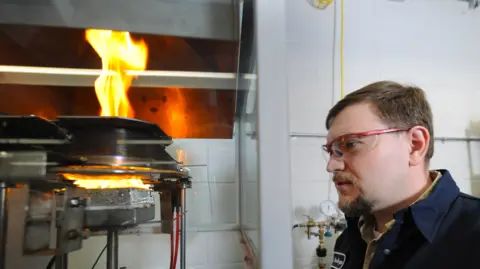
While timber tends to burn at a fixed rate, making plastic flame resistant is another story because plastics tend to burn at an accelerating rate, he explains.
Dr Morgan adds that he calls polyethylene, a type of plastic commonly used in construction, “solid gasoline” because of its similar chemical structure and capacity to burn rapidly.
In Australia, First Graphene says it has found a way to slow the spread of fire in plastics by adding graphene – tiny flakes of carbon atoms arranged in honeycomb lattices. Michael Bell, managing director and chief executive, says the firm’s solution, PureGRAPH, has already been added to products including protective footwear and conveyor belts used in the mining industry.
First Graphene says it works by forming a protective gas barrier, preventing the release of volatile compounds prior to ignition, and also a char layer should ignition occur. But graphene is a notoriously enigmatic material and the company says there may be other mechanisms at work, which are not yet fully understood.
Could graphene affect people’s health following a fire? A spokeswoman says, “There’s no data suggesting that graphene poses any health hazards. The industry continues to test and evaluate these aspects.”
In the UK, Vector Homes is preparing to sell a licence for PureGRAPH to makers of plastic pellets that could be used to make construction materials such as fascia boards.
Experiments suggest that the graphene does reduce the plastic’s ability to burn. “It hits the highest ratings in those tests,” says Liam Britnell, co-founder and chief technology officer.
Buildings aren’t just at risk from fires that start inside them, though. “There’s an increase in wildfires,” says Dr Morgan. That’s why Eric Appel at Stanford University, and colleagues have been working on gel-like fire retardants that could be sprayed onto a home hours before a wildfire reaches it, to limit the damage.
Prof Appel hopes to test the substance on mini structures, or mock-built homes, soon.
Lab work revealed that, upon exposure to a flame, one of the gels he was working on bubbled up to form a porous aerogel structure within it that is highly protective against fire.
“As soon as I saw that it did that, it was like, ‘Oh my gosh – that would be perfect for this’,” recalls Prof Appel.