
Close Menu
    Trending
    • May 2026 Live Webinar Series
    • Damson Idris Says Messi Made Him Quit Soccer
    • Netanyahu says he was successfully treated for prostate cancer
    • Negotiations that enable Israel’s land-grabs | Israel-Palestine conflict
    • True-or-false for Round 1 of 2026 NFL Draft: Will Cowboys regret their trade?
    • Opinion | Stewart Brand, Silicon Valley’s Favorite Prophet, on Life’s Most Important Principle
    • Struggling to scale your company? Here are five things that could be holding you back
    • What happens if you’re hit by a primordial black hole?
    Benjamin Franklin Institute
    Friday, April 24
    • Home
    • Politics
    • Business
    • Science
    • Technology
    • Arts & Entertainment
    • International
    Benjamin Franklin Institute
    Home»Science»Saturn’s rings form a giant dusty doughnut encircling the planet
    Science

    Saturn’s rings form a giant dusty doughnut encircling the planet

    Team_Benjamin Franklin InstituteBy Team_Benjamin Franklin InstituteDecember 25, 2025No Comments3 Mins Read
    Share Facebook Twitter Pinterest Copy Link LinkedIn Tumblr Email VKontakte Telegram
    Share
    Facebook Twitter Pinterest Email Copy Link


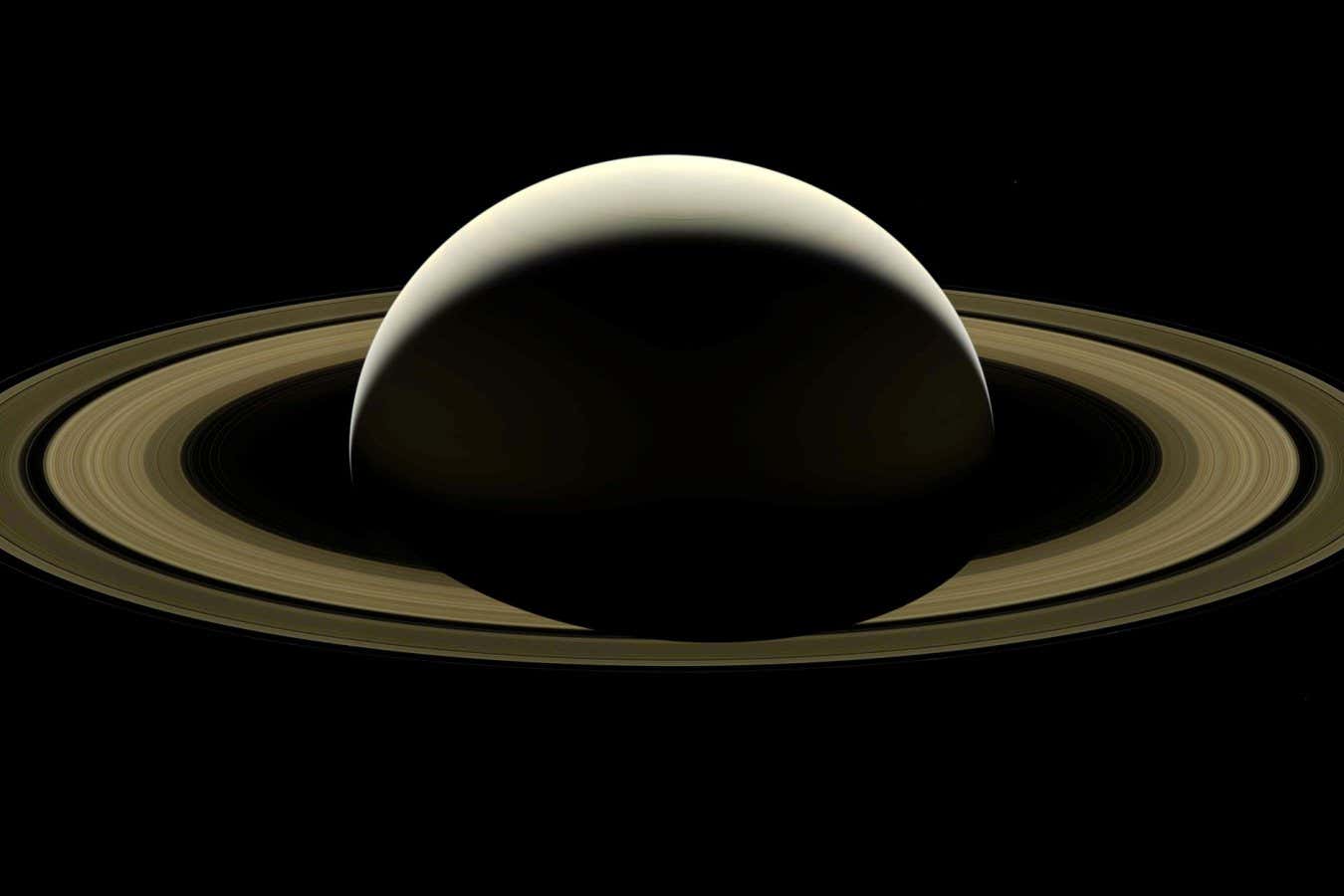
    Saturn and its rings, captured by the Cassini spacecraft

    NASA/JPL-Caltech/Space Science Institute

    Specks of dust from Saturn’s rings appear to float much farther above and below the planet than scientists thought possible, suggesting the rings are more like a giant dusty doughnut.

    The main structure of Saturn’s rings is extremely thin, extending outwards for tens of thousands of kilometres but only vertically for around 10 metres, which creates the planet’s striking appearance when viewed from Earth. There is some variation in this shape, however, such as the puffier outer E ring fed by Saturn’s moon Enceladus, which spurts out ice from its underwater ocean.

    Now, Frank Postberg at the Free University of Berlin and his colleagues have analysed data NASA’s Cassini spacecraft during 20 orbits in 2017, the mission’s final year, when it took extremely steep paths through the rings, starting from distances up to three times Saturn’s radius above the planet and sweeping to the same distances below.

    Cassini’s spectrometer, the Cosmic Dust Analyzer, found hundreds of tiny rocky particles near the top of Cassini’s trajectory that had a similar chemical make-up to grains found in the main ring, which are low in iron. “It’s a really distinct spectral type we never see anywhere else in the Saturnian system,” says Postberg.

    “There’s much more stuff close to the ring plane, but it still is surprising that we see these ring particles that high, both above and below the ring plane,” he says.

    To get so high, more than 100,000 kilometres from the main ring, Postberg and his team calculated that particles would need velocities of more than 25 kilometres per second to escape Saturn’s gravity and magnetic forces.

    It is unclear what process might give them those speeds, says Postberg. The most straightforward explanation is that tiny meteorites smash into the rings and send particles flying, but this wouldn’t produce fast enough shrapnel.

    However, micrometeorites colliding with Saturn’s rings could generate temperatures hot enough to vaporise rock, according to a recent study which suggested that Saturn’s rings are far older than previously thought. Postberg and his colleagues suggest this vaporised rock can shoot out of the rings at far higher velocities than shrapnel and later condense at distances far from the planet.

    To find dust so far from the main ring is surprising, says Frank Spahn at the University of Potsdam, Germany, who wasn’t part of the study. This is because the particles in Saturn’s main ring are small, making them collide infrequently, and sticky, so collisions tend to be more like snowballs hitting each other than billiard balls, he says.

    Micrometeorite collisions happen all over the solar system, so the same thing could also be happening on other ringed planets, such as Uranus. “If you have high velocity impacts onto icy rings, then this process could be universal. You would expect similar dust halos above and below other rings,” says Postberg.

    New Scientist. Science news and long reads from expert journalists, covering developments in science, technology, health and the environment on the website and the magazine.

    The world capital of astronomy: Chile

    Experience the astronomical highlights of Chile. Visit some of the world’s most technologically advanced observatories and stargaze beneath some of the clearest skies on earth.

    Topics:


    Source link

    Share. Facebook Twitter Pinterest LinkedIn Tumblr Email Telegram Copy Link

    Related Posts

    Science

    What happens if you’re hit by a primordial black hole?

    April 24, 2026
    Science

    How do earthquakes end? A seismic ‘stop sign’ could help predict earthquake risk

    April 24, 2026
    Science

    ‘Kraken’ fossils show enormous, intelligent octopuses were top predators in Cretaceous seas

    April 24, 2026
    Science

    Largest ever octopus was great white shark of invertebrate predators

    April 24, 2026
    Science

    Do you need to worry about Mythos, Anthropic’s computer-hacking AI?

    April 23, 2026
    Science

    How many dachshunds would it take to get to the moon?

    April 23, 2026
    Editors Picks

    Coco Gauff claps back at hairstyle critics: ‘I won’t apologize’

    April 11, 2026

    Chile’s President Kast tosses out dozens of environmental protections | Environment News

    March 18, 2026

    Boycotting India at T20 World Cup to support Bangladesh: Pakistan PM Sharif | Cricket News

    February 5, 2026

    Trump defends block on foreign students at Harvard

    May 25, 2025

    Sending Children To War — History Repeats In Iran

    April 1, 2026
    About Us
    About Us

    Welcome to Benjamin Franklin Institute, your premier destination for insightful, engaging, and diverse Political News and Opinions.

    The Benjamin Franklin Institute supports free speech, the U.S. Constitution and political candidates and organizations that promote and protect both of these important features of the American Experiment.

    We are passionate about delivering high-quality, accurate, and engaging content that resonates with our readers. Sign up for our text alerts and email newsletter to stay informed.

    Latest Posts

    May 2026 Live Webinar Series

    April 24, 2026

    Damson Idris Says Messi Made Him Quit Soccer

    April 24, 2026

    Netanyahu says he was successfully treated for prostate cancer

    April 24, 2026

    Subscribe for Updates

    Stay informed by signing up for our free news alerts.

    Paid for by the Benjamin Franklin Institute. Not authorized by any candidate or candidate’s committee.
    • Privacy Policy
    • About us
    • Contact us

    Type above and press Enter to search. Press Esc to cancel.