

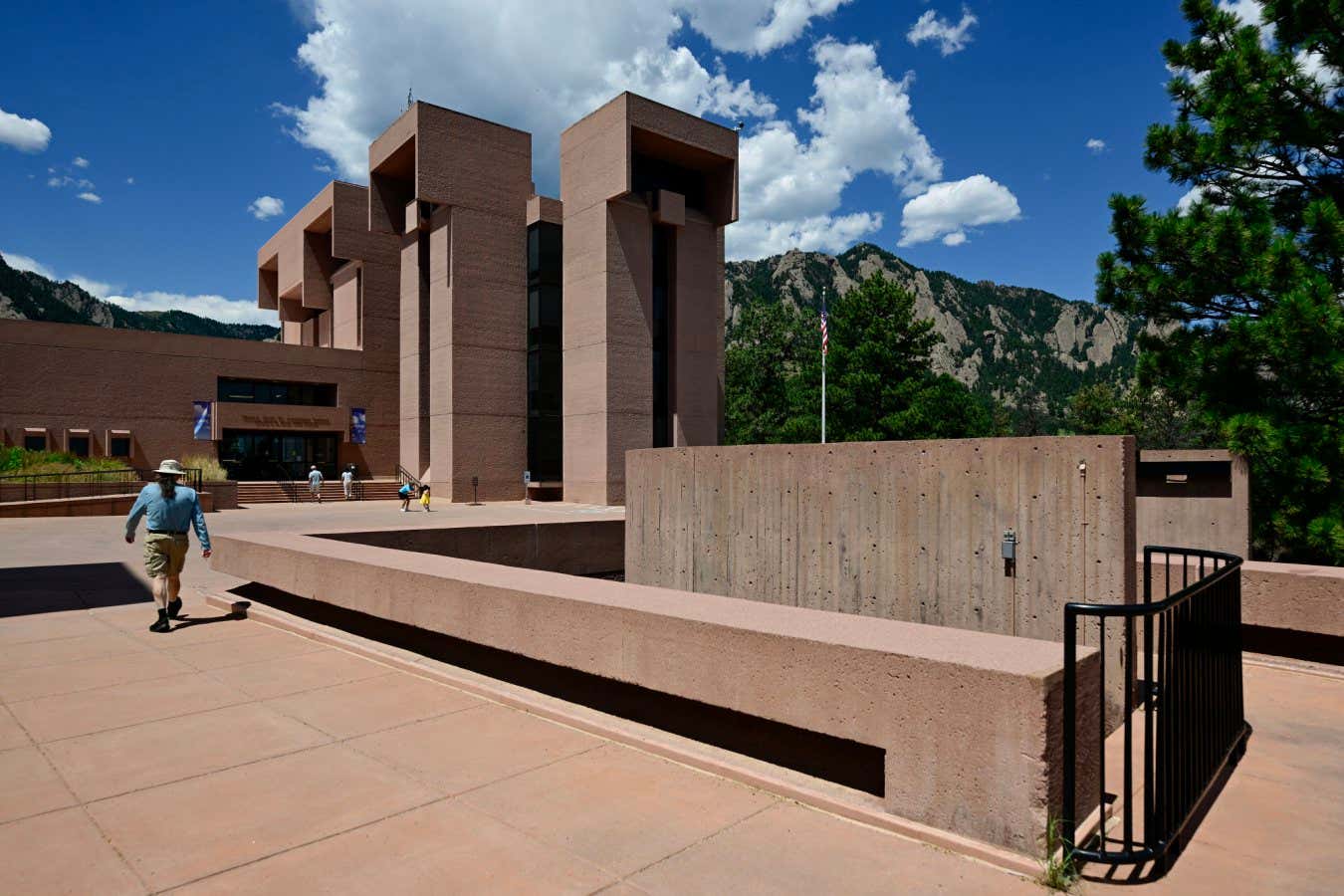
The National Center for Atmospheric Research in Boulder, Colorado
Matthew Jonas/MediaNews Group/Boulder Daily Camera via Getty Images
The Trump administration’s decision to close a world-leading research centre for atmospheric science is a blow to weather forecasting and climate modelling that could leave humanity more exposed to the impacts of global warming.
In a statement to USA Today, White House official Russ Vought said the National Center for Atmospheric Research (NCAR) is a source of “climate alarmism” and will be broken up. “Green new scam research” will be eliminated, while “vital functions” like weather modelling and supercomputing will be moved elsewhere, the White House said.
NCAR’s models underpin the reports of the United Nations’ Intergovernmental Panel on Climate Change, which countries rely on for decisions about how to reduce carbon emissions and adapt to extreme weather.
“Shutting it down would lead to greater uncertainty about what our climate future might be and leave us less able to prepare effectively,” says Michael Meredith at the British Antarctic Survey. “It’s hard to see this as anything other than shooting the messenger.”
NCAR was started in 1960 to facilitate atmospheric science too large-scale for individual universities. Its 830 employees are involved in research “from the ocean floor to the Sun’s core”, according to its unofficial motto, with programmes to monitor everything from flooding and wildfires to space weather.
At its hilltop laboratory in the Colorado Rockies, NCAR invented the GPS dropsonde, a sensor-laden device that is dropped into hurricanes, revolutionising our understanding of tropical storms. Its researchers developed wind-shear warning systems for airports that have prevented countless crashes.
But perhaps its greatest contribution has been providing data, modelling and supercomputing to other researchers. Weather Underground, which in the 1990s was one of the first to offer local forecasts online, wouldn’t have existed without software and weather data from NCAR, according to its founder, meteorologist Jeff Masters.
NCAR develops and administers the Weather Research and Forecasting Model, which is widely used for both day-to-day forecasting and the study of regional climates. It also collaborates with the US National Oceanic and Atmospheric Administration to advance weather modelling, especially for predicting severe storms.
If this work is disrupted, it could halt improvements to forecasts on weather apps and television news, at a time when extreme weather is getting more frequent. Shutting down NCAR is like if, “on the eve of world war two, we decided to stop funding R&D into weapons”, says Masters.
“If we don’t know what’s coming at us, it’s going to be more expensive and it’s going to kill more people,” he says.
NCAR administers the Community Earth System Model (CESM), the first global climate model designed for universities. CESM has supported a huge variety of research, from estimates of current global carbon emissions to future changes to ocean currents, heatwave frequency and glacier and sea ice melt.
“It’s probably the most-used model in the world,” says Richard Rood at the University of Michigan.
NCAR holds biannual meetings with users to decide how to improve the model, which can be run on its servers or downloaded and operated locally. Its closure is likely to end the further development of CESM, as well as maintenance to fix bugs.
Colin Carlson at Yale University was one of many scientists who posted on social media about NCAR’s importance. He is using its climate models to estimate how much cholera and yellow fever vaccine will be needed as the climate changes and when dengue will become endemic in Florida. “We need NCAR to do our jobs,” Carlson said on Bluesky.
NCAR also flies a C-130 cargo plane and a Gulfstream business jet modified to conduct research up to the edge of the stratosphere, and it helps run a King Air propeller plane outfitted to study cloud physics.
In 2009-2011, the Gulfstream jet hopped from the North Pole to the South Pole several times, climbing between 150 and 9000 metres, to complete the first comprehensive survey of CO2 and other gases in the atmosphere. It also took measurements of the sun’s corona during the 2017 solar eclipse.
Its aircraft help monitor air pollution and calibrate satellite instruments, according to Rood.
Its research on aerosols would be vital to understanding the effects of geoengineering, he adds. Schemes like spreading aerosols to block sunlight have been proposed to avoid abrupt changes in the climate.
“Getting rid of climate research like this would really have us flying blind, more blindly, into decisions about geoengineering, as well as tipping points,” says Rood.
Topics: