
Close Menu
    Trending
    • Katie Holmes And Joshua Jackson Spark ‘Soul-Level’ Love Chatter
    • Singapore Airlines, Southwest Airlines partner to expand access to nearly 120 US destinations
    • Trump warns Netanyahu: ‘You’ll be on your own’ if attacks on Iran continue | US-Israel war on Iran News
    • Cristiano Ronaldo, ‘The Bosnian Diamond’ headline the World Cup 40-and-over club
    • How housing market inventory is shifting across every state
    • What is a ‘normal’ memory slowdown, and when should I worry?
    • Ariana Grande And Ethan Slater Are ‘Still Friends’ Following Split
    • US says BYD, Baidu, Alibaba and other tech giants are aiding China’s military
    Benjamin Franklin Institute
    Tuesday, June 9
    • Home
    • Politics
    • Business
    • Science
    • Technology
    • Arts & Entertainment
    • International
    Benjamin Franklin Institute
    Home»Science»Mars may once have had a much larger moon
    Science

    Mars may once have had a much larger moon

    Team_Benjamin Franklin InstituteBy Team_Benjamin Franklin InstituteDecember 12, 2025No Comments4 Mins Read
    Share Facebook Twitter Pinterest Copy Link LinkedIn Tumblr Email VKontakte Telegram
    Share
    Facebook Twitter Pinterest Email Copy Link


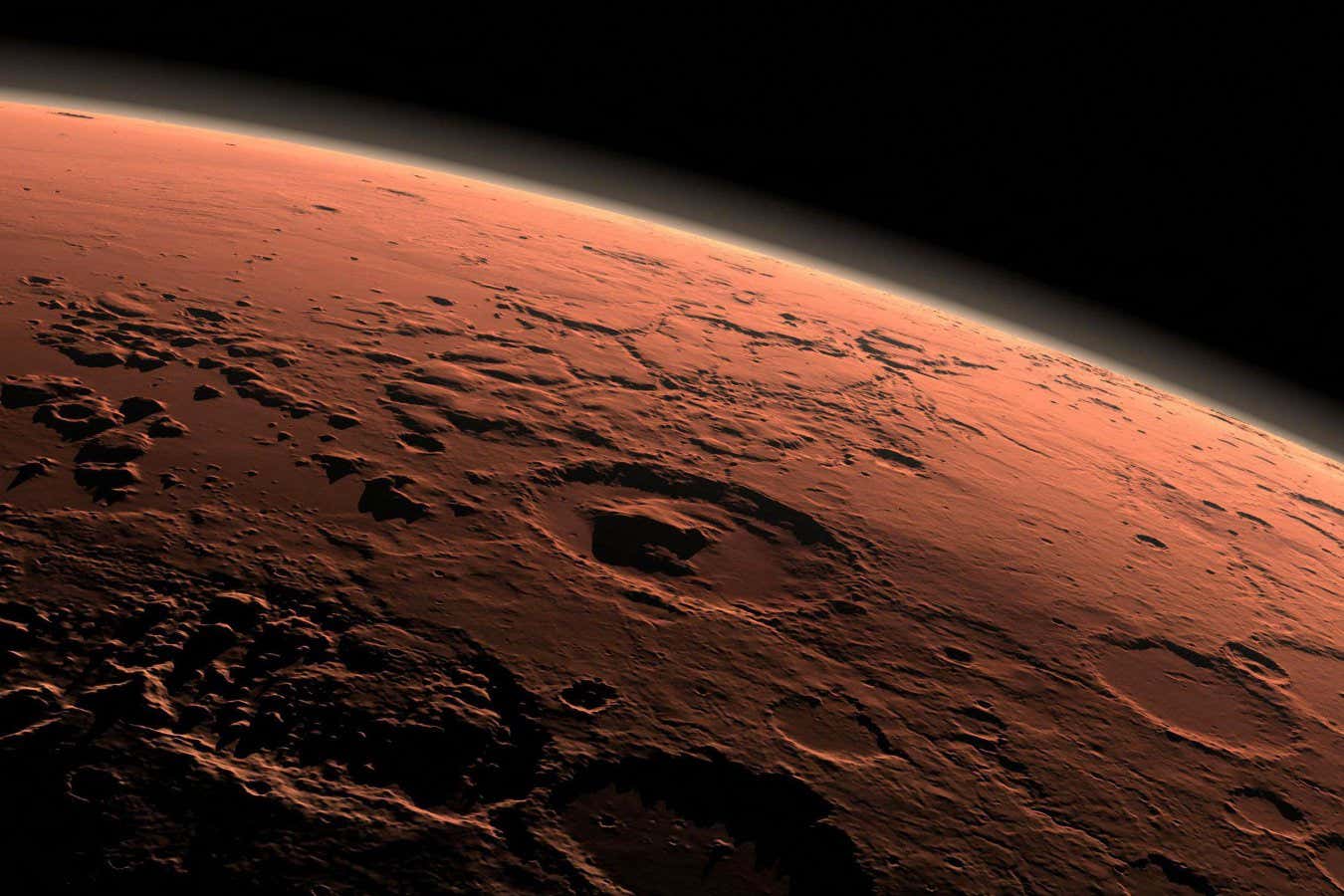
    The Gale crater on Mars

    ZUMA Press, Inc./Alamy

    A Mars crater may have once contained water that sloshed back and forth as a tide came and went. If that is true, it follows that Mars must have had a moon that was massive enough to exert a gravitational pull on the planet’s seas sufficient enough to create tides. Neither of the two moons it currently possesses are big enough for the job.

    Suniti Karunatillake at Louisiana State University and his colleagues have found that traces of tidal activity seem to be preserved in thin layers within sedimentary rocks in Gale crater.

    They analysed the sediment layers to obtain the period of the tides and the properties of the moon that helped cause them. If it indeed existed, it was 15 to 18 times as massive as Phobos, the largest of the Red Planet’s two present moons. This would still make it hundreds of thousands of times less massive than Earth’s moon. Today’s two Martian moons may in fact be remnants of the larger moon.

    Karunatillake will present the team’s results at next week’s annual meeting of the American Geophysical Union in New Orleans, Louisiana.

    The rocks the researchers base their conclusions on were imaged by NASA’s Curiosity rover. They contain alternating layers of different thickness and colour. Such layers are called rhythmites, because they are a sign that material was brought in by a wind or current with a regularly varying strength. In the case of tides, the incoming tide brings sand, which is then covered with fine mud when the tide turns and the water is at a standstill.

    The Gale rhythmites contain thin, dark lines suggesting such “mud drapes”, which “show a very close similarity with Earth tidal patterns”, says team member Priyabrata Das, also at Louisiana State University.

    To strengthen the team’s hypothesis, Ranjan Sarkar at the Max Planck Institute for Solar System Research in Germany used a standard mathematical technique called a Fourier transform to analyse the pattern of layering in the Martian rocks. This identified additional periodicities in the layer thicknesses, suggesting that both the sun and a moon were once driving the tide, just like on Earth.

    With that analysis, the researchers may have confirmed an idea first raised by Rajat Mazumder at the German University of Technology in Oman. An expert on rhythmites, he suggested in 2023 that layered formations observed by NASA’s Perseverance rover in another Martian crater, Jezero, might be tidal. But those images didn’t have enough resolution to do a Fourier transform. Excited by the analysis of the Gale rhythmites, Mazumder points out that, on Earth, finding such rhythmites “is a very robust proof of tidal activity. In other words: marine conditions.”

    But not everyone is convinced. The lakes inside Jezero and Gale craters, with their diameters of 45 and 154 kilometres, respectively, were too small to have tides, says Nicolas Mangold at the Laboratory of Planetology and Geosciences in Nantes, France, who is a member of NASA’s Perseverance Mars team. “Thus, even with a larger moon in the past, I don’t think these two locations are the good ones to record tidal deposits.”

    Christopher Fedo at the University of Tennessee, who works with NASA on Curiosity’s explorations, also sees problems with the larger moon idea, and notes that tidal-like rhythmites can be formed by regularly varying river inflows into a lake.

    But Sarkar thinks there may be a way out for the tidal interpretation. “Maybe an ocean was hydrologically connected with Gale. Even subsurface porosity can connect bodies and cause tides. On Mars you have a highly fractured and cratered surface, so porosity is not a problem over there.”

    Topics:


    Source link

    Share. Facebook Twitter Pinterest LinkedIn Tumblr Email Telegram Copy Link

    Related Posts

    Science

    What is a ‘normal’ memory slowdown, and when should I worry?

    June 9, 2026
    Science

    Wildlife thrives in solar farm built on restored peatland

    June 8, 2026
    Science

    You don’t need to worry about recursive-self-improving AI – yet

    June 8, 2026
    Science

    Understanding anorexia’s grip on the brain could unlock new therapies

    June 8, 2026
    Science

    Why GLP-1 drugs might reduce cancer risk

    June 8, 2026
    Science

    Landmark pancreatic cancer treatment paves way for targeting other tricky tumors

    June 8, 2026
    Editors Picks

    A quantum computing system’s perfect randomness could keep your secrets safe

    May 28, 2026

    2025 on track to tie second-hottest year on record: EU monitor

    December 9, 2025

    Belgrade Halts Arms Exports After Russia Says Serbian Weapons Went to Ukraine

    July 2, 2025

    Assailant convicted after Barron Trump calls London police to report crime he saw on video

    January 28, 2026

    Polar bears are getting fatter in the fastest-warming place on Earth

    January 29, 2026
    About Us
    About Us

    Welcome to Benjamin Franklin Institute, your premier destination for insightful, engaging, and diverse Political News and Opinions.

    The Benjamin Franklin Institute supports free speech, the U.S. Constitution and political candidates and organizations that promote and protect both of these important features of the American Experiment.

    We are passionate about delivering high-quality, accurate, and engaging content that resonates with our readers. Sign up for our text alerts and email newsletter to stay informed.

    Latest Posts

    Katie Holmes And Joshua Jackson Spark ‘Soul-Level’ Love Chatter

    June 9, 2026

    Singapore Airlines, Southwest Airlines partner to expand access to nearly 120 US destinations

    June 9, 2026

    Trump warns Netanyahu: ‘You’ll be on your own’ if attacks on Iran continue | US-Israel war on Iran News

    June 9, 2026

    Subscribe for Updates

    Stay informed by signing up for our free news alerts.

    Paid for by the Benjamin Franklin Institute. Not authorized by any candidate or candidate’s committee.
    • Privacy Policy
    • About us
    • Contact us

    Type above and press Enter to search. Press Esc to cancel.