

Most 3D design software requires visual dragging and rotating—posing a challenge for blind and low-vision users. As a result, a range of hardware design, robotics, coding, and engineering work is inaccessible to interested programmers. A visually-impaired programmer might write great code. But because of the lack of accessible modeling software, the coder can’t model, design, and verify physical and virtual components of their system.
However, new 3D modeling tools are beginning to change this equation. A new prototype program called A11yShape aims to close the gap. There are already code-based tools that let users describe 3D models in text, such as the popular OpenSCAD software. Other recent large-language-model tools generate 3D code from natural-language prompts. But even with these, blind and low-vision programmers still depend on sighted feedback to bridge the gap between their code and its visual output.
Blind and low-vision programmers previously had to rely on a sighted person to visually check every update of a model to describe what changed. But with A11yShape, blind and low-vision programmers can independently create, inspect, and refine 3D models without relying on sighted peers.
A11yShape does this by generating accessible model descriptions, organizing the model into a semantic hierarchy, and ensuring every step works with screen readers.
The project began when Liang He, assistant professor of computer science at the University of Texas at Dallas, spoke with his low-vision classmate who was studying 3D modeling. He saw an opportunity to turn his classmate’s coding strategies, learned in a 3D modeling for blind programmers course at the University of Washington, into a streamlined tool.
“I want to design something useful and practical for the group,” he says. “Not just something I created from my imagination and applied to the group.”
Re-imagining Assistive 3D Design With OpenSCAD
A11yShape assumes the user is running OpenSCAD, the script-based 3D modeling editor. The program adds OpenSCAD features to connect each component of modeling across three application UI panels.
OpenSCAD allows users to create models entirely through typing, eliminating the need for clicking and dragging. Other common graphics-based user interfaces are difficult for blind programmers to navigate.
A11yshape introduces an AI Assistance Panel, where users can submit real-time queries to ChatGPT-4o to validate design decisions and debug existing OpenSCAD scripts.
A11yShape’s three panels synchronize code, AI descriptions, and model structure so blind programmers can discover how code changes affect designs independently.Anhong Guo, Liang He, et al.
If a user selects a piece of code or a model component, A11yShape highlights the matching part across all three panels and updates the description, so blind and low-vision users always know what they’re working on.
User Feedback Improved Accessible Interface
The research team recruited 4 participants with a range of visual impairments and programming backgrounds. The team asked the participants to design models using A11yShape and observed their workflows.
One participant, who had never modeled before, said the tool “provided [the blind and low-vision community] with a new perspective on 3D modeling, demonstrating that we can indeed create relatively simple structures.”
Participants also reported that long text descriptions still make it hard to grasp complex shapes, and several said that without eventually touching a physical model or using a tactile display, it was difficult to fully “see” the design in their mind.
To evaluate the accuracy of the AI-generated descriptions, the research team recruited 15 sighted participants. “On a 1–5 scale, the descriptions earned average scores between about 4.1 and 5 for geometric accuracy, clarity, and avoiding hallucinations, suggesting the AI is reliable enough for everyday use.”
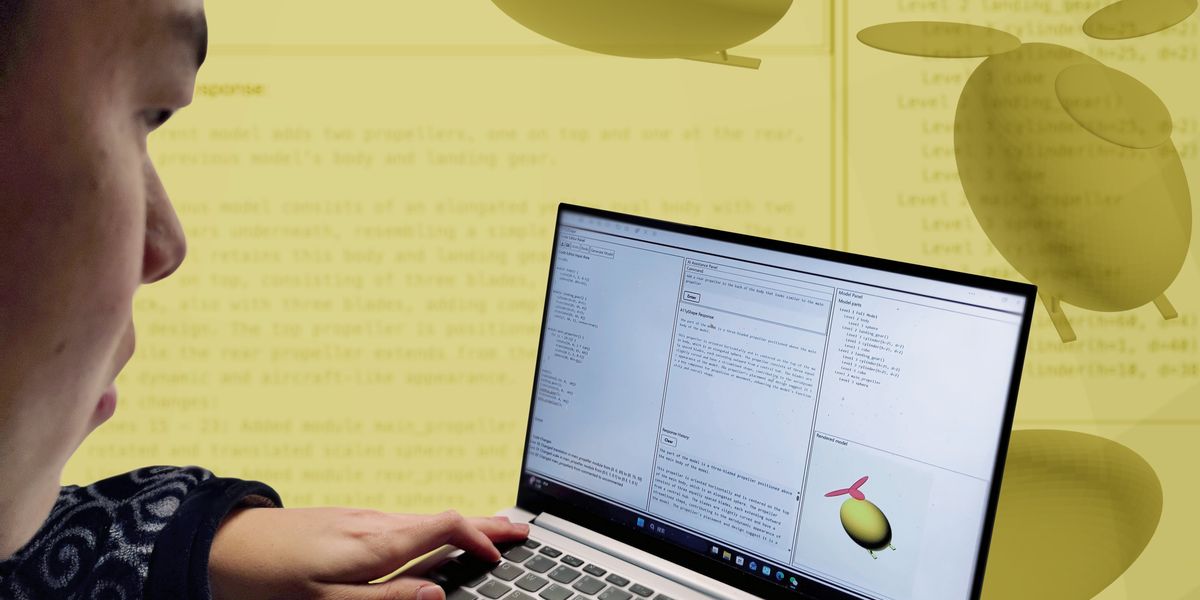
 A new assistive program for blind and low-vision programmers, A11yShape, assists visually disabled programmers in verifying the design of their models.Source: Anhong Guo, Liang He, et al.
The feedback will help to inform future iterations—which He says could integrate tactile displays, real-time 3D printing, and more concise AI-generated audio descriptions.
Beyond its applications in the professional computer programming community, He noted that A11yShape also lowers the barrier to entry for blind and low-vision computer programming learners.
“People like being able to express themselves in creative ways. . . using technology such as 3D printing to make things for utility or entertainment,” says Stephanie Ludi, director of DiscoverABILITY Lab and professor of the department of computer science and engineering at the University of North Texas. “Persons who are blind and visually impaired share that interest, with A11yShape serving as a model to support accessibility in the maker community.”
The team presented A11yshape in October at the ASSETS conference in Denver.
From Your Site Articles
Related Articles Around the Web