
Close Menu
    Trending
    • US will not tolerate Iranian control or tolls in Strait of Hormuz: Rubio
    • US Supreme Court reinstates Republican-favoured Texas electoral map | US Midterm Elections 2026 News
    • NBA announces Rookie of the Year winner between Cooper Flagg, Kon Knueppel
    • Opinion | Maybe Trump Was Never a Deal Maker
    • Spotify is morphing into a one-stop-shop. Why its latest move makes a lot of sense
    • Why the keto diet could be a revolutionary way to treat mental illness
    • Canada Announces Investment Fund to Distance Economy From the U.S.
    • Market Talk – April 27, 2026
    Benjamin Franklin Institute
    Tuesday, April 28
    • Home
    • Politics
    • Business
    • Science
    • Technology
    • Arts & Entertainment
    • International
    Benjamin Franklin Institute
    Home»Science»Failed Soviet probe will soon crash to Earth – and we don’t know where
    Science

    Failed Soviet probe will soon crash to Earth – and we don’t know where

    Team_Benjamin Franklin InstituteBy Team_Benjamin Franklin InstituteMay 9, 2025No Comments3 Mins Read
    Share Facebook Twitter Pinterest Copy Link LinkedIn Tumblr Email VKontakte Telegram
    Share
    Facebook Twitter Pinterest Email Copy Link


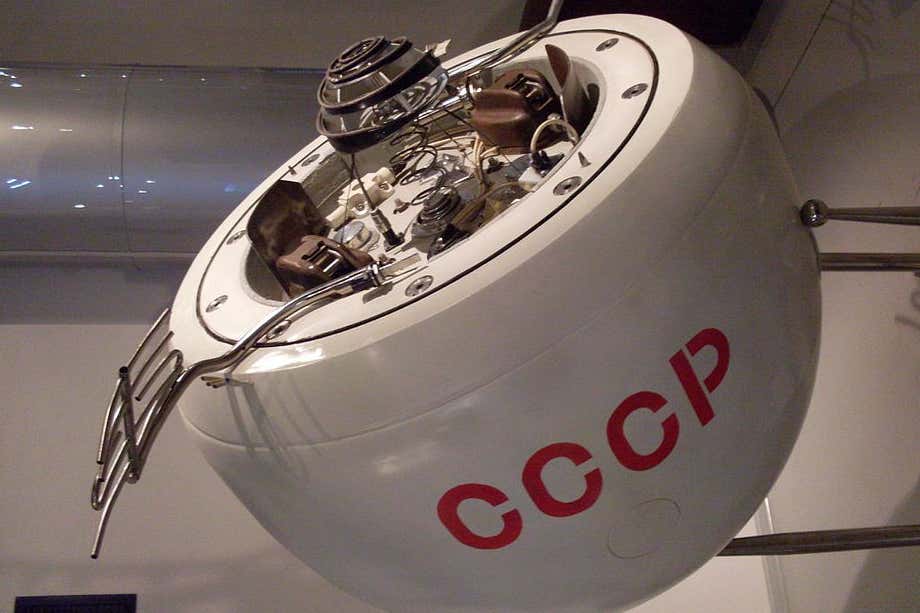
    A model of Kosmos 482, which was originally set to go to Venus

    Wikimedia Commons

    More than 50 years after its launch, a Soviet spacecraft called Kosmos 482 is about to come crashing back to Earth. It was originally intended to land on the surface of Venus, but it started to fall apart in low Earth orbit and never made it beyond there. After decades of circling our planet in an oval-shaped orbit, it’s finally about to hurtle back to the ground.

    Kosmos 482 launched in 1972, but because of secrecy during the cold war period, little is known about its structure or its exact mission. We only know it was headed for Venus because of other Soviet missions that were focused on our neighbouring world at the time and because the spacecraft appeared to attempt to launch on a trajectory there before it went to pieces. It isn’t clear what exactly caused the spacecraft failure, but three of the four fragments fell in New Zealand shortly after the launch.

    The last fragment drifted into a higher orbit, with its closest point to Earth at about 210 kilometres up and its most distant about 9800 kilometres away. Over the years, particles from the very top of Earth’s atmosphere have slowed down this piece, shrinking its path around Earth, and it has finally gotten close enough to fall. It is expected to come down on 9 or 10 May.

    The remaining bit of the spacecraft, its landing capsule, is estimated to be more than a metre wide with a mass of nearly 500 kilograms. Between its size and the likelihood that it was designed to survive a trip through Venus’s hot, dense atmosphere, it seems likely that it will survive its descent intact and hit the ground hard, at upwards of 200 kilometres per hour.

    It is impossible to predict where exactly the last piece of Kosmos 482 will smash down. Based on its current orbit, it could hit anywhere on Earth between the latitudes of 52° north and 52° south – an area that covers everywhere from the southern tip of South America to parts of Canada and Russia. Thankfully, despite that huge swathe of possible landing spots, the probability that it will hit an inhabited area is low. “It’s an infinitesimally small number,” said Marcin Pilinski at the University of Colorado Boulder in a statement. “It will very likely land in the ocean.”

    Pilinski is part of a team tracking the debris. As it continues to get closer, the possibilities for where and when it will land will narrow down. Space junk falling to Earth like this isn’t uncommon: about one orbiting object that NASA is tracking falls every day, and most either burn up in the atmosphere or hit the ocean. Kosmos 482 is just a particularly big and hardy piece of space junk.

    Topics:


    Source link

    Share. Facebook Twitter Pinterest LinkedIn Tumblr Email Telegram Copy Link

    Related Posts

    Science

    Why the keto diet could be a revolutionary way to treat mental illness

    April 27, 2026
    Science

    Coral reefs on a remote archipelago shrugged off a massive heatwave

    April 27, 2026
    Science

    Giant arctic continent launched dinosaurs to world domination

    April 27, 2026
    Science

    10,000 new planets found hidden in NASA telescope data

    April 27, 2026
    Science

    Trump wants Iran’s ‘nuclear dust.’ Here’s how the U.S. could remove the uranium

    April 27, 2026
    Science

    How geneticists uncovered a common root of two neurological diseases

    April 27, 2026
    Editors Picks

    41 popular hair extensions have toxic chemicals linked to cancer and other health risks

    February 14, 2026

    Feds Investigating Whether Comey Post Was Threat On Trump

    May 18, 2025

    Shipping in Strait of Hormuz at a standstill despite US-Iran ceasefire | Shipping News

    April 10, 2026

    Wanted: Human experts to help train AI

    January 13, 2026

    Three ways to become calmer this New Year that you haven’t tried (yet)

    January 15, 2026
    About Us
    About Us

    Welcome to Benjamin Franklin Institute, your premier destination for insightful, engaging, and diverse Political News and Opinions.

    The Benjamin Franklin Institute supports free speech, the U.S. Constitution and political candidates and organizations that promote and protect both of these important features of the American Experiment.

    We are passionate about delivering high-quality, accurate, and engaging content that resonates with our readers. Sign up for our text alerts and email newsletter to stay informed.

    Latest Posts

    US will not tolerate Iranian control or tolls in Strait of Hormuz: Rubio

    April 28, 2026

    US Supreme Court reinstates Republican-favoured Texas electoral map | US Midterm Elections 2026 News

    April 28, 2026

    NBA announces Rookie of the Year winner between Cooper Flagg, Kon Knueppel

    April 28, 2026

    Subscribe for Updates

    Stay informed by signing up for our free news alerts.

    Paid for by the Benjamin Franklin Institute. Not authorized by any candidate or candidate’s committee.
    • Privacy Policy
    • About us
    • Contact us

    Type above and press Enter to search. Press Esc to cancel.