

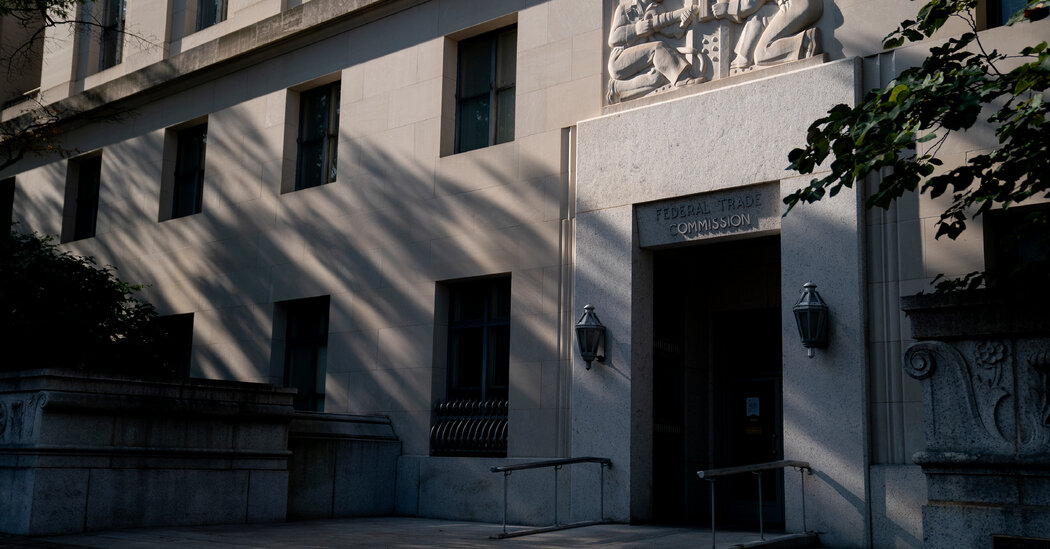
The Trump administration isn’t letting up on the tech giants.
On Monday, the Federal Trade Commission will face off with Meta in court over claims that the social media giant snuffed out nascent competitors when it bought Instagram and WhatsApp. And on April 21, the Justice Department will argue that a federal judge should force Google to sell its Chrome web browser to limit the power of its search monopoly.
Both cases, which helped set into motion a new era of antitrust scrutiny, were filed during President Trump’s first term in office. They were advanced by the Biden administration, which also filed monopoly lawsuits against Amazon, Apple and Google’s ad technology business.
Investors in Silicon Valley and on Wall Street hoped that Mr. Trump might show technology companies more deference during his second term, as he promised to deregulate industries. Some legal experts think the administration could still take a lighter hand on blocking mergers and setting proactive regulations for tech.
But so far, Mr. Trump’s appointees have promised to continue much of the scrutiny of the biggest tech companies, despite the industry’s hopes.
“I think that they may not have fully focused on how much the first Trump presidency had to do with setting in motion this re-examination of tech,” said Bill Kovacic, a former F.T.C. chairman.
Here’s what to know.
Who is in charge of antitrust enforcement now?
Mr. Trump appointed Andrew Ferguson as chair of the F.T.C., which enforces antitrust and consumer protection laws. Mr. Ferguson, a lawyer who spent much of his career working for powerful Republican senators, has said he wants to increase scrutiny of the ways that social media companies decide to take posts down. Conservatives have complained for years that platforms like Facebook and YouTube disproportionately censor right-leaning viewpoints.
“I will throw every resource the agency has at prosecuting the cases against Big Tech that we’ve got going,” Mr. Ferguson said in an appearance on the Bloomberg podcast “Odd Lots” this year.
The new leader of the Justice Department’s antitrust division, Gail Slater, a veteran tech and media lawyer, worked in the White House during Mr. Trump’s first term. She has also pledged to enforce antitrust laws aggressively.
“It’s now a bipartisan issue, and there’s a consensus around the need for robust antitrust enforcement,” Ms. Slater said at an event hosted this month by Y Combinator, the Silicon Valley start-up accelerator, which has pushed for more antitrust scrutiny of the tech giants.
Where do the major antitrust lawsuits against the tech giants stand?
Five government cases accuse tech companies of maintaining illegal monopolies, and all are moving through the courts. The companies deny the allegations.
-
The F.T.C. sued Meta in 2020, arguing that its acquisitions of Instagram in 2012 and WhatsApp in 2014 violated the law by using what regulators call a “buy or bury” strategy to eliminate its nascent rivals. The trial is expected to last into July and feature testimony from high-profile figures including Meta’s chief executive, Mark Zuckerberg.
-
The Justice Department sued Google in 2020 over claims that it had a monopoly in online search. A federal judge ruled for the government last year and will convene a roughly three-week hearing on how to address Google’s monopoly. The government has suggested that the company sell Chrome, among other measures. Google has proposed fewer restrictions and has said it plans to appeal.
-
The Justice Department accused Google in 2023 of illegally dominating the advertising technology business. A federal judge heard arguments in that case last year, and a ruling is expected soon.
-
The F.T.C. accused Amazon in a 2023 lawsuit of squeezing small merchants that use its marketplace to sell to consumers. A federal judge rejected Amazon’s attempt to dismiss the case last year. It is scheduled to go to trial next year.
-
The Justice Department sued Apple last year over claims that the company’s interwoven ecosystem of technology makes it hard for consumers to ditch their iPhones and iPads. Apple has asked a federal judge to dismiss the lawsuit.
What about tech industry mergers and acquisitions?
The Biden administration tried and failed to block numerous tech deals, including Meta’s purchase of a small virtual reality start-up, Within. The push to stop acquisitions outraged investors who back small companies that want to cash out by being acquired by a tech giant.
Mr. Trump’s appointees say they want to get out of the way of acquisitions that don’t present a competitive problem. Ms. Slater has expressed an openness to companies’ proposing settlements — such as selling off similar assets — which can help resolve concerns about deals.
In late January, the Justice Department sued to block the business software company Hewlett Packard Enterprise from buying Juniper Networks, a networking firm, for $14 billion. It was the first lawsuit to challenge a tech deal in Mr. Trump’s second term.
During the first Trump administration, the Justice Department unsuccessfully challenged AT&T’s purchase of Time Warner.
What does this mean for the artificial intelligence race?
Last year, the Justice Department and the F.T.C. agreed to divide up responsibility for investigating whether the biggest players in artificial intelligence were violating antitrust laws. The Justice Department started investigating Nvidia, while the F.T.C. took Microsoft and its partner, OpenAI.
It is unclear whether those investigations will result in lawsuits. The Trump administration has promised to clear the way for American companies to develop A.I., including rescinding a Biden-era executive order that put guardrails on the use of the technology.
The administration has solicited the industry’s input on how best to move forward with policy around the technology, an opening that companies and investors took to lobby for fewer rules.
“I think it is extremely important that we protect competition in the A.I. space, but I think it is equally important that the government not race to regulate A.I.,” Mr. Ferguson said on Bloomberg TV in March.