

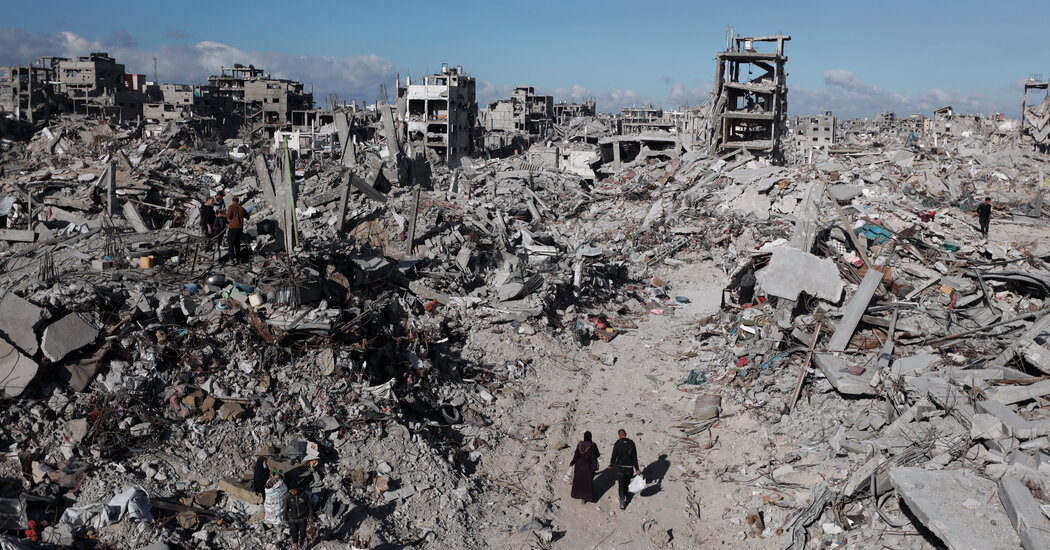
Gazans took in the scale of devastation to their old neighborhoods and Israelis awaited news about three newly released hostages as a day-old cease-fire between Hamas and Israel continued to hold on Monday.
With the 15-month war paused, Palestinians have been returning to parts of the Gaza Strip they had fled, picking their way through vast swaths of rubble and trying to salvage what they could — a sofa, a mattress, a chair or a crate — from the wreckage of their former homes.
“People can barely recognize the crushed places where they used to live,” said Montaser Bahja, an English teacher, a day after visiting his old neighborhood in the northern city of Jabaliya.
In a video shared with The New York Times, Mr. Bahja, 50, can be seen hurrying through the streets with his son Alhassan, 21, and trying to reconcile the piles of rubble that loom on either side with their memories.
“This is Fahmy Abu Warda’s home; this is Abu Shaaban’s home,” Alhassan is heard saying.
In Israel, which celebrated the return of the first group of hostages released by Hamas as part of the truce, the authorities offered only the broadest of descriptions of their conditions. The Israeli health ministry and Sheba Medical Center, where the three women are staying in a closed wing with family members, said their primary commitment was to safeguard the former captives’ privacy as they received medical and psychological care.
“I’m happy to report that they are in stable condition,” said one of their doctors, Prof. Itai Pessach. “That allows us, and them, to focus on what is the most important thing for now: uniting with their families.”
But Israelis did hear from one of the women on Monday.
“I have returned to life,” Emily Damari, 28, said on social media, describing herself as “the happiest person in the world.”
Ms. Damari was one of about 250 people taken hostage in the Hamas-led attack of Oct. 7, 2023. About a hundred are believed to still be in Gaza, and about a third of those are believed to be dead. The militants also killed some 1,200 people that day, Israel says.
Under the terms of the cease-fire, Hamas agreed to free 33 hostages in exchange for the release of more than 1,000 Palestinians from Israel’s prisons. The return of the three hostages was followed by the release of 90 prisoners, and the exchanges are to take place once a week during the 42-day truce.
Palestinians in the Gaza have rejoiced at the pause in fighting. Gazan health officials say more than 47,000 people have been killed during the Israel assault that began after the 2023 Hamas attack; they do not distinguish between civilians and fighters.
But the scenes playing out in the enclave and in Israel on Monday embodied the bittersweet emotions felt on both sides of the border.
As the truce came into effect on Sunday, celebrations replaced explosions, and hundreds of trucks with aid began rolling into Gaza, where residents have endured a harsh year of hunger and deprivation. In Israel, the returned hostages were met with jubilant embraces from relatives and friends. And fireworks and cheering crowds greeted the newly freed Palestinian prisoners in the Israeli-occupied West Bank.
But joy was shadowed by uncertainty. The next round of negotiations between Hamas and Israel are expected to be even more difficult than the ones that led to the 42-day cease-fire.
The fate of more than 60 other hostages and thousands of other Palestinian prisoners in Israel, to say nothing of the prospect of a long-term end to the fighting, depends on the extension of the deal.
“This is a moment of tremendous hope — fragile, yet vital,” Tom Fletcher, the United Nations undersecretary general for humanitarian affairs, said on social media.
The rejoicing has also been dimmed by the expectations of prolonged hardship to come and the knowledge that there is as yet no comprehensive plan for how Gaza will be rebuilt. Many of the two million residents there have been displaced at least once.
The task ahead is unimaginably daunting.
Gazans returning to the southern city of Rafah found it mostly flattened. The mayor said that 60 percent of homes had been destroyed, as well as 70 percent of the city’s sewage system.
But after 15 months of hunger and scarcity, food and other vital supplies are now surging into Gaza. More than 630 trucks entered the enclave on the first day of the cease-fire, according to United Nations officials.
During the fighting, far fewer made it in — and when they did, it was often too dangerous to get aid to where it was needed. Israel’s military campaign beat Hamas back without replacing it, creating a power vacuum. As the enclave descended into lawlessness, desperate crowds and organized gangs swarmed the trucks in hopes of securing a package of food or a bag of flour.
The scenes were not repeated on Sunday and Monday.
“What was very noticeable is that none of the trucks that entered yesterday were looted,” said Nebal Farsakh, a spokeswoman for the Palestinian Red Crescent, a humanitarian aid organization.
But violence did break out in the West Bank, where Israeli settlers set upon Palestinian villages amid anger over the planned release of Palestinian prisoners, some of whom were convicted of deadly attacks against Israelis, in the cease-fire deal.
In Sinjil, a village south of Nablus, dozens of men, some carrying slingshots, threw stones and set houses on fire, according to residents and videos verified by The Times.
“People screamed as their homes were burning,” said one resident, Ayed Jafry, 45. Several people were injured, including an 86-year-old man, he said.
In the aftermath of the Hamas attack that set off the war in Gaza, Israeli leaders vowed to wipe out the militants once and for all. But in the first two days of the cease-fire, Hamas has been making clear that it intends to remains a major force in the territory.
In an interview with The Times, a Hamas official, Mousa Abu Marzouk, suggested that at least some senior members of the group hoped to engage in “dialogue” with the United States, even though the American government has designated it as a terrorist organization since 1997.
Mr. Abu Marzouk, who is based in Qatar, said Hamas was ready to welcome an envoy from the Trump administration despite a longstanding American policy to provide Israel with weapons and defend it at international institutions.
“He can come and see the people and try to understand their feelings and wishes,” he said of the envoy, “so that the American position can be based on the interests of all the parties, and not only one party.”
Reporting was contributed by Hiba Yazbek, Natan Odenheimer, Fatima AbdulKarim, andAfif Amireh.