

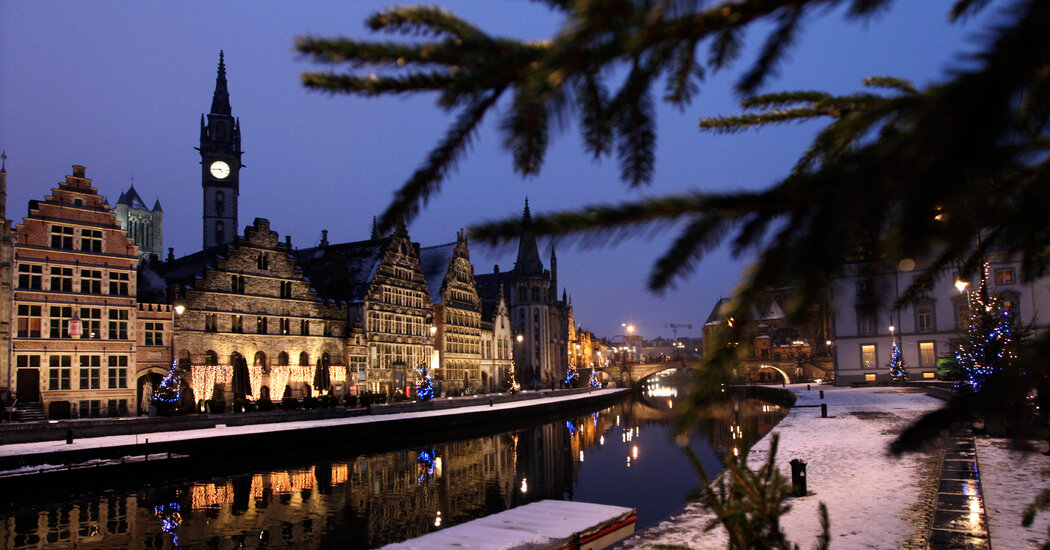
Go ahead and recycle your Christmas tree. But please, the Belgian authorities say, don’t try to eat it.
The country’s federal food agency delivered that unusual warning this week after a suggestion from the climate-friendly city of Ghent.
If you’re trying to cut down on holiday food waste, the city recently said on an environment page of its website, why not make a “delicious spruce needle butter” with the leftover needles from your holiday tree?
“It’s a breeze,” the city’s post read. “That way your Christmas tree is not 100 percent waste.”
The city acknowledged that there could be health dangers in the bristly boughs. Yew, an evergreen, can be poisonous. Trees treated with pesticides and fire retardants are also hazardous, it said.
Ghent credited Scandinavian cooks with the idea of picking the needles, boiling and drying them, and then turning them into flavored butter. “In Scandinavia,” the city wrote, “they have been doing it for a long time.”
That turned out to be not quite true — Scandinavian food historians said it was far from a widespread tradition. And Belgium’s food agency quickly urged the public against such a gastronomic experiment.
“Christmas trees are not intended to end up in the food chain,” Hélène Bonte, an agency spokeswoman, said in an email on Wednesday.
A consumer may not know if their tree had flame retardants, she said. Pesticides are a threat, with Christmas trees “often treated intensively.” A misidentification could be deadly, as eating yew “can have serious, even fatal, consequences,” Ms. Bonte said.
And even if parts of evergreens are sometimes used in cooking, she said, not all are edible: “There is a difference between using needles from pristine nature and needles from trees specifically grown for Christmas and to be decorated at home.”
Ghent later edited the post on its website, adding information about pesticides and changing “Eat your Christmas tree” to “Scandinavians eat Christmas trees.”
The assertion surprised some of those who know the region’s food best. “We don’t eat our own Christmas trees,” said Bettina Buhl, a curator and food historian at the Green Museum in Auning, Denmark.
“I have a lot of old cookbooks published in Denmark,” she added, chuckling, “and I haven’t seen this. It’s quite a new one.”
In a response to questions, Ghent’s climate team said that it had always urged caution about consuming evergreens and that the city was focused on green policies.
“The social media post about the culinary uses of Christmas tree needles fits within a broader context of reuse, recycling, and a circular economy,” it said in an email on Wednesday.
Ghent’s suggestion is hardly the only creative approach to trying to recycle a holiday tree. Although the carcasses of many holiday evergreens are discarded with trash bags, others often find a useful, sustainable second life.
In Britain and Germany, castaway trees have been used as toys for zoo animals. In New York City, they are turned into wood chips and mulch to nourish trees in parks. Gardeners around the world replant them. Birders use them for feeders. Crafters make sachets and coasters.
But snacks do not appear to be common. And the Scandinavian connection is tenuous at best, food historians said.
“There is kind of this idea around the world that we in Scandinavia, we eat absolutely everything green,” said Nina Bauer, a Danish food historian. “We just go around in the forests and we eat everything.”
Yes, she said, many people do forage for ingredients. Some people may use evergreen materials to infuse spirits or smoke other ingredients. And high-end chefs at innovative restaurants like Noma, where diners have also been served grilled reindeer heart on a bed of fresh pine, have used evergreen trees for ingredients.
But Ms. Bauer had only heard of home cooks in Denmark eating their own holiday trees in dire times, like during World War II. Cookbooks from the time suggested that people sometimes used Christmas trees for tea during food shortages, she said.
And she was unequivocal about the region’s cuisine: “It’s not a tradition to eat your Christmas tree in Scandinavia.”
Koba Ryckewaert contributed reporting.