

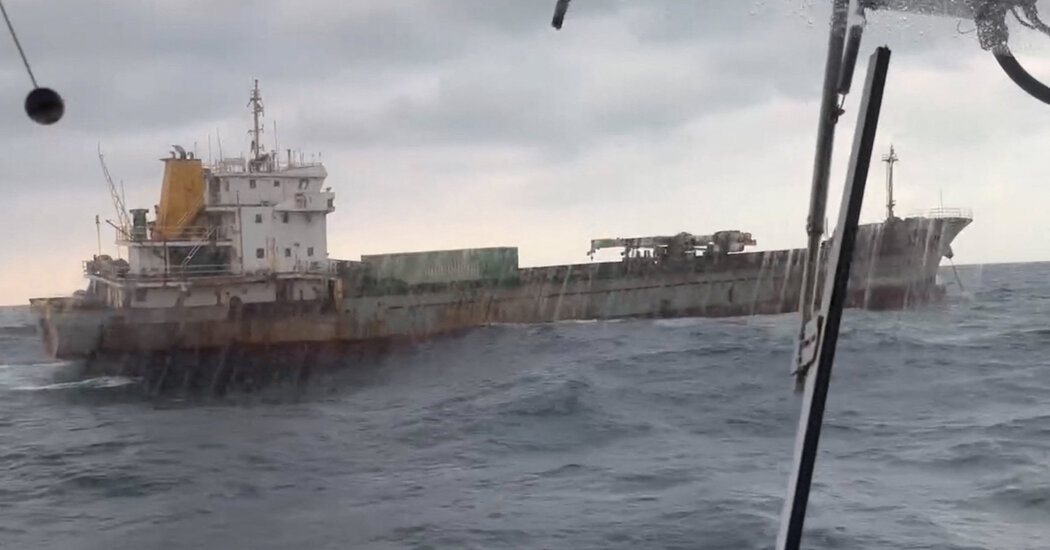
Taiwan is investigating whether a ship linked to China is responsible for damaging one of the undersea cables that connects Taiwan to the internet, the latest reminder of how vulnerable Taiwan’s critical infrastructure is to damage from China.
The incident comes as anxiety in Europe has risen over apparent acts of sabotage, including ones aimed at such undersea communication cables. Two fiber-optic cables under the Baltic Sea were severed in November, prompting officials from Sweden, Finland and Lithuania to halt a Chinese-flagged commercial ship in the area for weeks over its possible involvement.
In Taiwan, communications were quickly rerouted after the damage was detected, and there was no major outage. The island’s main telecommunications provider, Chunghwa Telecom, received a notification on Friday morning that the cable, known as the Trans-Pacific Express Cable, had been damaged. That cable also connects to South Korea, Japan, China and the United States.
That afternoon, Taiwan’s Coast Guard intercepted a cargo vessel off the northern city of Keelung, in an area near where half a dozen cables make landfall. The vessel was owned by a Hong Kong company and crewed by seven Chinese nationals, the Taiwan Coast Guard Administration said.
The damaged cable is one of more than a dozen that help keep Taiwan online. These fragile cables are susceptible to breakage by anchors dragged along the sea floor by the many ships in the busy waters around Taiwan.
Analysts and officials say that while it is difficult to prove whether damage to these cables is intentional, such an act would fit a pattern of intimidation and psychological warfare by China directed at weakening Taiwan’s defenses.
Taiwan said the cargo vessel it intercepted had registered under the flags of both Cameroon and Tanzania. “The possibility of a Chinese flag-of-convenience ship engaging in gray zone harassment cannot be ruled out,” the Coast Guard Administration said on Monday in a statement.
Such harassment, which inconveniences Taiwanese forces but stops short of overt confrontation, has a desensitizing effect over time, according to Yisuo Tzeng, a researcher at the Institute for National Defense and Security Research, a think tank funded by Taiwan’s defense ministry. That puts Taiwan at risk of being caught off guard in the event of a real conflict, Mr. Tzeng said.
Taiwan experiences near-daily incursions into its waters and airspace by the People’s Liberation Army. Last month, China sent nearly 90 naval and coast guard vessels into waters in the area, its largest such operation in almost three decades.
China has also deployed militarized fishing boats and its coast guard fleet in disputes around the South China Sea region, and stepped up patrols just a few miles off the shore of Taiwan’s outer islands, increasing the risk of dangerous confrontations.
Such harassment has been a “defining marker of Chinese coercion against Taiwan for decades, but over the last couple years has really stepped up,” said Gregory Poling, the director of the Asia Maritime Transparency Initiative at the Center for Strategic and International Studies.
And in situations like this one and the recent damage to the cables under the Baltic Sea, it is difficult for the authorities to calibrate their response when a ship’s true identity is uncertain.
“Do you deploy a Coast Guard vessel every time there is an illegal sand dredger or, in this case, a ship that is registered to a flag of convenience and has Chinese ties damages a submarine cable?” Mr. Poling asked.
Ship tracking data and vessel records analyzed by The Times show that the ship may have been broadcasting its positions under a fake name.
Taiwan said the ship appeared to use two sets of Automatic Identification System equipment, which is used to broadcast a ship’s position. On Jan. 3, at the moment that Taiwan said the cable was damaged, a ship named Shun Xing 39 was reporting its AIS positions in the waters off Taiwan’s northeastern coast.
About nine hours later, at around 4:51 p.m. local time, Shun Xing 39 stopped transmitting location data. That was shortly after the time that the Taiwan Coast Guard said it had located the ship and requested that it return to waters outside of Keelung port for an investigation.
One minute later, and 50 feet away, a ship called Xing Shun 39, which had not reported a position since late December, began broadcasting a signal, according to William Conroy, a maritime analyst with Semaphore Maritime Solutions, who analyzed AIS data on the ship-tracking platform Starboard.
In the ship-tracking database, both Xing Shun 39 and Shun Xing 39 identify themselves as cargo ships with a class A AIS transponder. Typically, a cargo ship equipped with this class of transponder would be large enough to require registration with the International Maritime Organization and obtain a unique identification number known as an IMO number. Xing Shun 39 has an IMO number, but Shun Xing 39 does not appear in the IMO database. This suggests “Xing Shun 39” is the ship’s real identity and “Shun Xing 39” is fake, according to Mr. Conroy.
The Taiwan Coast Guard has publicly identified the vessel as Shun Xing 39.
Vessel and corporate records show that Jie Yang Trading Ltd, a Hong Kong-based company, took over as the owner of Xing Shun 39 in April 2024.
The waves were too large to board the cargo vessel to investigate further, the Taiwan Coast Guard Administration said. Taiwan is seeking help from South Korea because the crew of the cargo vessel said it was headed to that country, the administration said.
In 2023, the outlying Matsu Islands, within view of the Chinese coast, endured patchy internet for months after two undersea internet cables broke. These fiber optic cables that connect Taiwan to the internet suffered about 30 such breaks between 2017 and 2023.
The frequent breakages are a reminder that Taiwan’s communication infrastructure must be able to withstand a crisis.
To help ensure that Taiwan can stay online if cables fail, the government has been pursuing a backup, including building a network of low-Earth orbit satellites capable of beaming the internet to Earth from space. Crucially, officials in Taiwan are racing to build their system without the involvement of Elon Musk, whose rocket company, SpaceX, dominates the satellite internet industry, but whose deep business links in China have left them wary.