

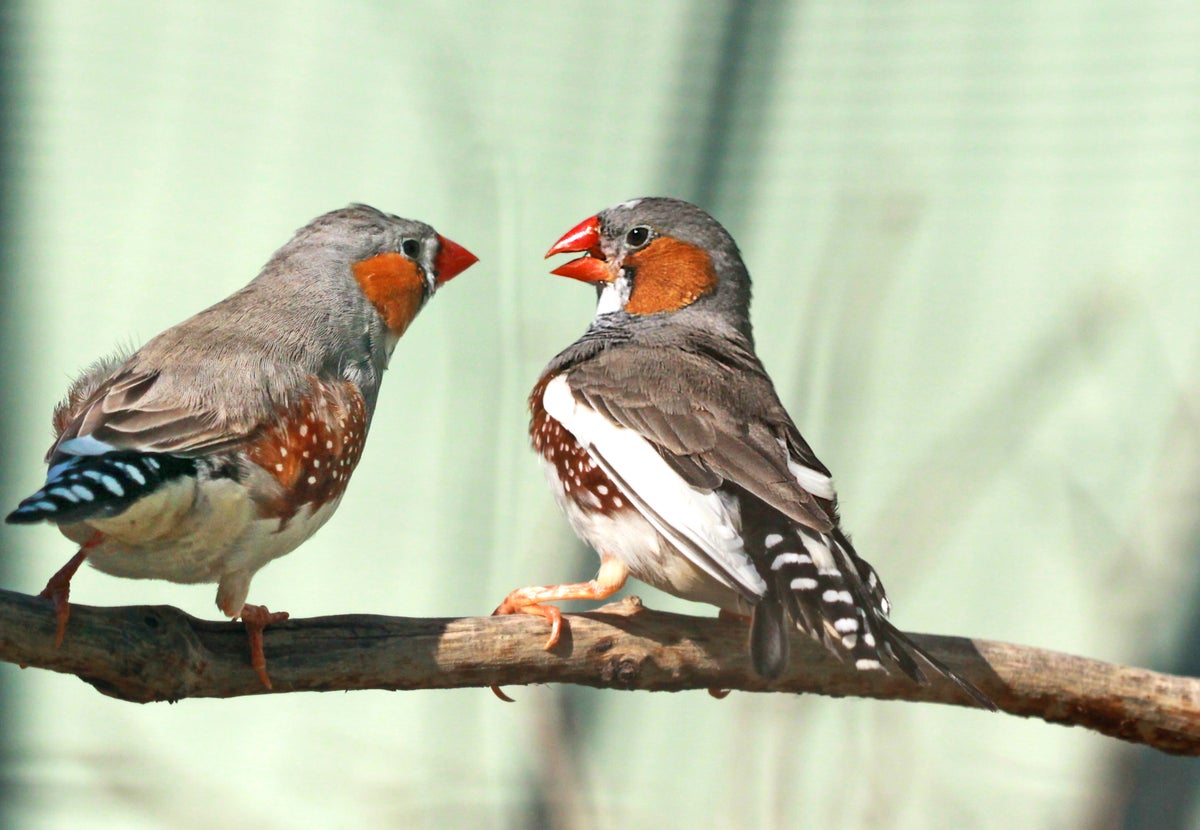
Julie Elie has spent a lot of time listening to zebra finches. These chatty little birds are a popular animal model for studying communication, but most research focuses on the males’ complicated songs. Elie, a researcher at the University of California, Berkeley, spends her time listening in on the finches’ other vocalizations, though: the more quotidian calls and chirps they make to communicate with each other.
Using data collected over years of painstaking observation, Elie discovered 11 core calls that make up the zebra finch vocabulary, such as calls for distress, hunger and saying hello. She found that the birds not only announce who they are and what they are doing, but they also use individual signatures that enable their companions to recognize them. And she managed to validate her research by questioning the birds themselves about the calls.
She and her colleagues set up tests in which the birds had to discriminate and categorize calls by their meaning. They started by testing whether the birds could recognize other individuals based on a certain call type, the distance call.
On supporting science journalism
If you’re enjoying this article, consider supporting our award-winning journalism by subscribing. By purchasing a subscription you are helping to ensure the future of impactful stories about the discoveries and ideas shaping our world today.
“And then I said, ‘okay, let’s export that to the other call types and see whether they can identify each other throughout the repertoire,’ and surely, they would, they were able to do it,” Elie says. Sometimes the birds made a mistake, but “still, they were always above chance level,” she says.
In another test, the birds were tasked with validating the call classifications Elie and her team had come up with—and they seemed to be correct. “This is comforting to me, and so, yeah, cool. I’ve not been hallucinating for all these years. They agree with my organization,” she says. And the birds consistently categorized calls according to their perceived meaning, not their sounds—the birds would occasionally confuse calls with those having similar meanings, such as aggression and distress, but not calls that sounded similar but had very different meanings.
This work has earned her the 2026 Coller-Dolittle Prize, a $100,000 reward for making progress toward interspecies communication—specifically, enabling humans to talk to animals, and for animals to talk back in a way we can understand. The competition has a grand prize of $10 million for cracking this problem in its entirety.
Elie used machine learning to help her and her team better parse the enormous set of observational data and match the zebra finch calls to behavior patterns. “I think the zebra finch is just right level of complexity,” she says. Just like hearing a human laugh and seeing a person smiling might lead you to conclude they are happy, you can make the same observations about the birds. She developed an algorithm that could classify calls using just the sound of the call, but she says it wasn’t always able to discern certain calls—such as distress and aggressive calls—apart.
“You want to have machine learning, you want to have artificial intelligence that helps you to capture acoustic differences between things,” she says. “But communication is not only about that, and having information about the behavior of the animal, like the context of the condition, is what really also puts some more light onto the language of the species you’re studying.”
Zebra finch calls are just complex enough that they encode meaning, and they are accessible and easy to observe in a lab. Doing this kind of work with other talkative animals, such as dolphins, would be much more difficult.
“But I have hope that by constructing level by level, we’ll be able to climb up there,” Elie says. “The aim of this challenge is to be able to establish a communication with the animal that goes both ways. It’s not only the human understanding what the animal says, but it’s also the human communicating to the animal, and the animal understanding it. And this, I think, is achievable.”
It’s Time to Stand Up for Science
If you enjoyed this article, I’d like to ask for your support. Scientific American has served as an advocate for science and industry for 180 years, and right now may be the most critical moment in that two-century history.
I’ve been a Scientific American subscriber since I was 12 years old, and it helped shape the way I look at the world. SciAm always educates and delights me, and inspires a sense of awe for our vast, beautiful universe. I hope it does that for you, too.
If you subscribe to Scientific American, you help ensure that our coverage is centered on meaningful research and discovery; that we have the resources to report on the decisions that threaten labs across the U.S.; and that we support both budding and working scientists at a time when the value of science itself too often goes unrecognized.
In return, you get essential news, captivating podcasts, brilliant infographics, can’t-miss newsletters, must-watch videos, challenging games, and the science world’s best writing and reporting. You can even gift someone a subscription.
There has never been a more important time for us to stand up and show why science matters. I hope you’ll support us in that mission.