

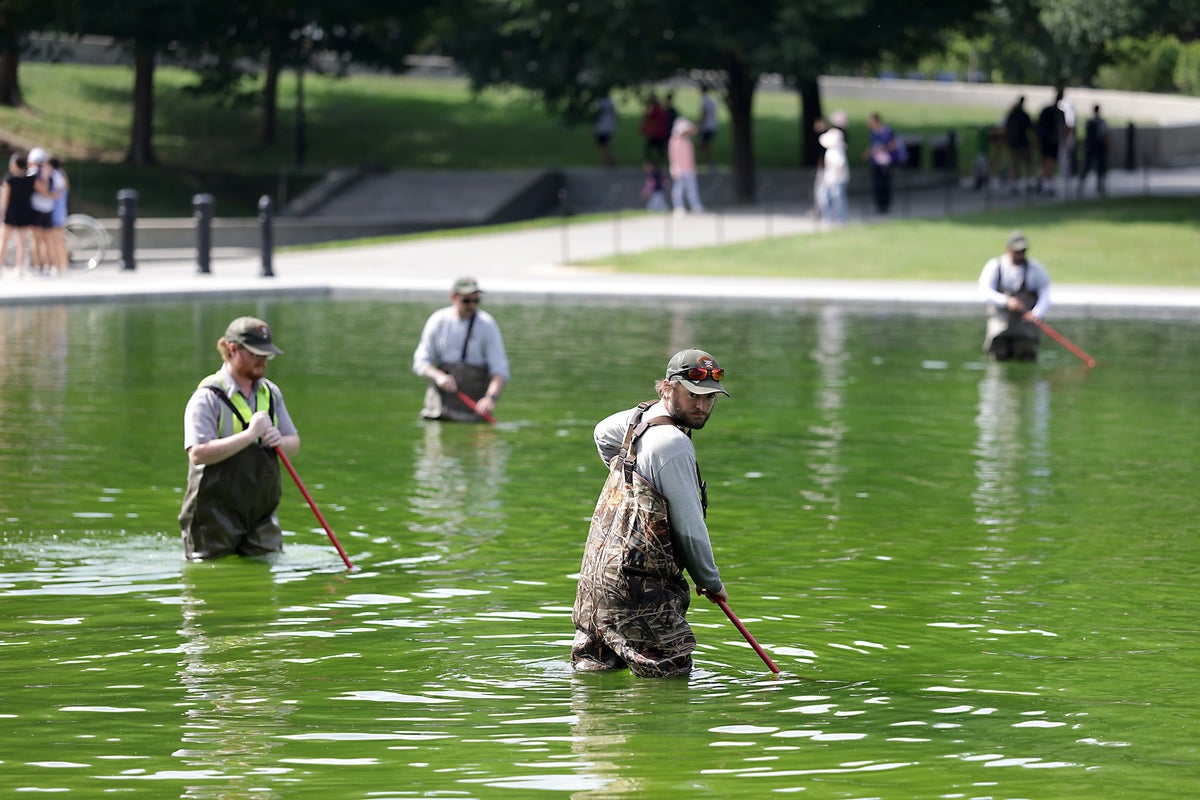
The Lincoln Memorial Reflecting Pool was intended to reopen as a patriotic showpiece of Donald Trump’s Washington, D.C., beautification plan, with the bottom of the pool freshly coated in what he called “American flag blue” and the feature ready for the country’s 250th anniversary. The project, which began in April, cost an estimated $14.7 million, according to a contract summary from the Department of the Interior.
In early June water began to flow back into the pool. Soon after the blue gave way to green, as algae spread across the shallow basin, and crews began trying to knock it back with hydrogen peroxide and other treatments. Efforts are ongoing.
The green pool quickly became an online spectacle, and scientists began weighing in on what the color could reveal about the water. Scientific American spoke with one of them—Ashley Bair, a senior research developer at Usalco, which makes coagulants and other water-treatment chemicals. Bair got her Ph.D. studying cyanobacteria. In the conversation, she explained what might be happening in the Reflecting Pool and what can be done about it.
On supporting science journalism
If you’re enjoying this article, consider supporting our award-winning journalism by subscribing. By purchasing a subscription you are helping to ensure the future of impactful stories about the discoveries and ideas shaping our world today.
[An edited transcript of the interview follows.]
When you first saw images of the Reflecting Pool turned green, what did you think?
Honestly, my pool turns green all the time, so it didn’t shock me. We could have predicted it, but there’s no guarantee that it was going to happen.
Why would algae bloom in a place like the Reflecting Pool?
The algae are either eukaryotic algae, such as green algae, or cyanobacteria, which are bacterial algae, or a combination of the two. But no matter what they are, they need nutrients to grow. So they need light for photosynthesis, nutrients, carbon dioxide from the atmosphere and some warmth for there to be any biochemical activity that allows them to happen. At this time of year, though, there’s plenty of light, and there’s plenty of heat.
How much of the bloom would you pin on the heat?
I know people are associating the painting of the bottom of the pool as causing more heat in the water. And maybe it increased the temperature slightly, but there’s plenty of heat in Washington, D.C., right now to fuel an algal bloom. So I do not believe that that was a major factor in this bloom.
In fact, back in 2012, when the pool was refilled, the same thing happened, and it hadn’t been painted at the time, right? So really what’s fueling this, the only thing that’s going to be limiting an algal bloom this time of year, are nutrients.
Limiting nutrients for algae, whether they’re cyanobacteria or green algae, are going to be phosphate and nitrogen. If [the algae are] cyanobacteria, they’re more likely to be limited by phosphates because a lot of them are capable of fixing atmospheric nitrogen.
I do know that the water, if it is filled from the Tidal Basin, is treated somewhat, with filtration and ozone for disinfection. But that’s not going to remove phosphate. Typically, for that, you’re going to need to coagulate your water, which will remove organics and phosphates.
If phosphates are basically alga food, why would the water in the Reflecting Pool have phosphates in it?
From what I understand, [the National Park Service] converted the pool to fill from the Tidal Basin back in 2009. And I believe they did that so that they wouldn’t have to go to the expense of using the city water supply, especially when you’re completely refilling that pool at 6.5 million gallons. The Tidal Basin fills from the Potomac River, so it’s natural water and can contain some runoff contaminants.
There can be high levels of phosphate from [pollution] point sources or from agricultural runoff, which is a big issue.
If phosphate is helping fuel the bloom, how would operators remove it from the water?
I would have recommended that they do some sort of coagulation treatment to remove the phosphate.
Coagulants are metal-based chemicals, either aluminum coagulants or iron coagulants. And what these do is form complexes with organics and phosphates. And [the coagulant] takes these dissolved organics and phosphates and precipitates them [so they fall to the bottom of the pool]. And then you can either vacuum it out or, if you were treating it prior to it going into the pool…, just let [the water without phosphates] go over a weir, and the sludge stays at the bottom.
Why might hydrogen peroxide fail to get rid of the algae?
They didn’t use enough of it. The Reflecting Pool is stagnant. It’s reflecting, so you want it to be very still. It’s designed that way. Peroxide doesn’t have time to diffuse into the middle before it’s done. So they only poured it around the edges…. They should have covered it evenly.
Peroxide is actually a very effective algicide. There are peroxide-based products that are used as algicides. Now, typically, when they’re labeled as an algicide, they’re going to be a stabilized form because peroxide doesn’t last very long. It breaks down really easily. Fortunately, it breaks down into oxygen and water, which [are nontoxic, and that’s] why it’s so great. I call it the nuclear option. If you really want to just kill your bloom, you use it, but it’s not going to last.
The other issue is: once you use it, you’re lysing those cells. So you’re breaking down the cells, which means phosphates are released back into the water. So now you have dissolved phosphates coming from the breakdown of these algal cells that you’ve killed with algicide. So you’re going to fuel “bloomageddon.” Typically, when you use a peroxide-based algicide, if you don’t follow up with either a phosphate-removal treatment or a copper treatment as a static algicide, you’re going to have a rebound growth. And I would expect that within a week or two, more likely a week.
Could a bloom in the Reflecting Pool be more than just a cosmetic problem for America’s 250th?
I’ve seen pictures with surface scums coming from [the Reflecting Pool] that are typically indicative of cyanobacteria, [which] have the potential to produce cyanotoxins, which have the potential to be fatal if ingested. It’s important that we understand that this is a serious thing. It’s not just something to laugh about.
There was just a lot of misinformation going around. I just wanted to share my thoughts on “Hey, this is what I think is happening.” It’s kind of a cool thing, and I’d like to see this dealt with because, you know, there is potential for this bloom to have cyanobacteria in it.