

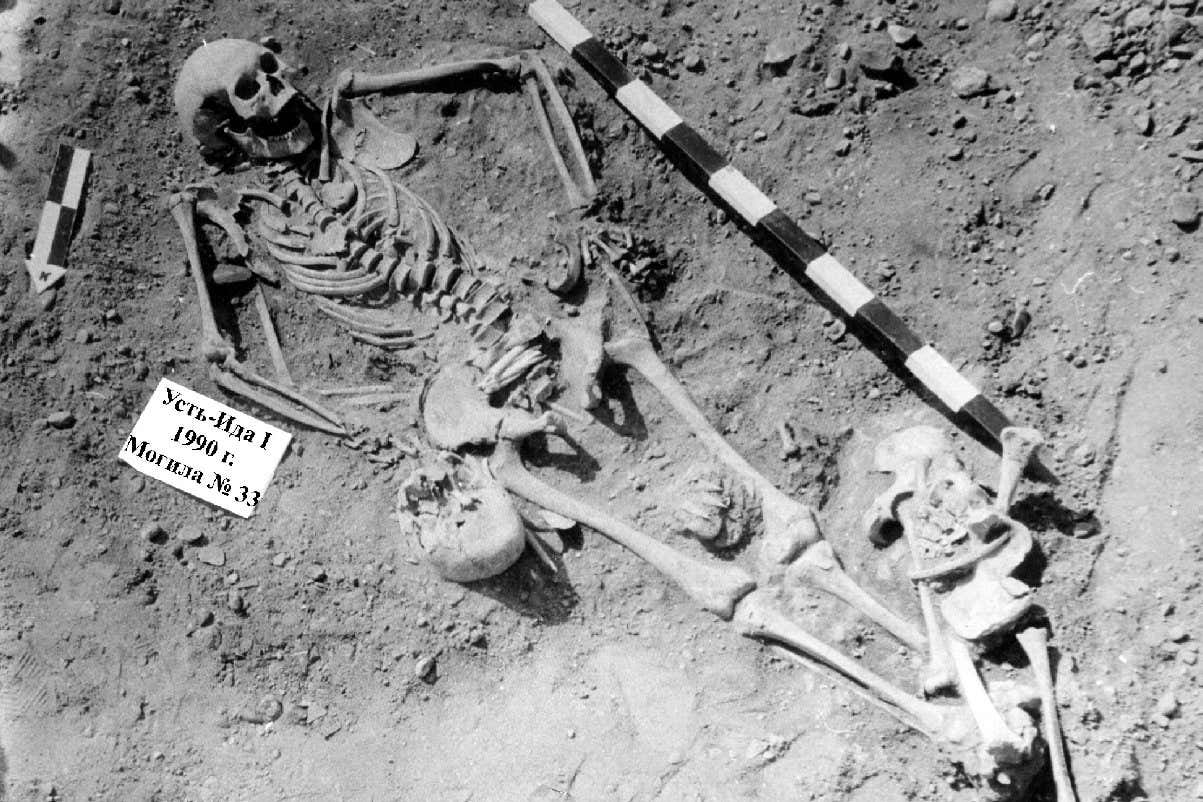
The shared grave of a boy and girl, whose remains were found to carry traces of Yersinia pestis DNA
Vladimiri Bazaliiskii
Ancient DNA from hunter-gatherers buried near Lake Baikal in what is now Siberia suggests there were deadly outbreaks of the plague as long as 5500 years ago. The finding runs counter to the long-standing idea that major disease outbreaks arose along with the adoption of farming during the so-called Neolithic revolution.
“The expectation is that big outbreaks of disease affecting entire communities didn’t exist at all before the Neolithic revolution,” says Ruairidh Macleod at the University of Oxford. “What we see here is clear evidence for a really devastating outbreak of plague that’s affecting an entire community of hunter-gatherers at Baikal, and that flies in the face of that.”
The bacterium Yersinia pestis has caused some of the deadliest pandemics in history: the Plague of Justinian that began in AD 541, the Black Death from 1346 and a third plague pandemic that began in 1855 and killed at least 15 million people worldwide.
Y. pestis can infect people’s lungs or their blood, causing pneumonic or septicaemic plague respectively. More common, however, is bubonic plague, in which flea bites enable the bacterium to infect lymph nodes, causing them to swell hugely and form large “buboes”.
With the development of techniques for sequencing ancient DNA, it has become possible to detect the presence of Y. pestis in the bones and teeth of people buried hundreds or thousands of years ago. This has revealed that the plague was infecting farming communities in places such as Sweden as long as 5000 years ago.
These discoveries have led some to suggest that the plague was responsible for the so-called Neolithic decline around this time, when population numbers plummeted in Europe. But these studies also revealed that early forms of Y. pestis lacked a key gene that enables the bacterium to spread by flea bites.
In an infected flea, the protein encoded by this ymt gene clogs up its gut, starving it and allowing plague bacteria to accumulate near its mouthparts. “This deprives the flea of the blood meal from its host and causes it to bite anything it can like crazy,” says Macleod.
It has been suggested that Y. pestis didn’t cause large, deadly outbreaks until it acquired the ymt gene, he says. But Macleod’s team has found the bacterium in 18 of 42 hunter-gatherers found buried in four sites around Lake Baikal.
“We do finally have really compelling evidence that the strains of plague at this time were deadly as well,” says Macleod.
There appear to have been two outbreaks, with the first starting around 5500 years ago. “We see cases of siblings being buried in the same graves, apparently having died around about the same time,” says Macleod. “And we see shared graves with up to four or five people, all apparently having died at the same time.”

The skull of a girl aged 9 to 11 who died and was buried along with plague victims
Angela Lieverse
Many of the likely plague victims were children or teenagers. The high proportion of dead children and teenagers at these sites had long puzzled the researchers who first excavated them in the 1980s, but it fits with evidence from historical records that children were much more likely to die of the plague.
It is also clear that some people survived to bury the dead, which was done with the usual ceremony. “It’s really touching that we have that insight as to how these hunter-gatherer communities responded,” says Macleod.
Hunter-gatherers would have had more contact with wild animals than farmers did, says Macleod. So they would have had a higher chance of being exposed to animal viruses and bacteria that might be capable of infecting humans.
The team thinks these hunter-gatherers probably caught the plague from marmots, as they are the main reservoir of plague and there is evidence from other sites nearby that they were hunted for food. People in this region today still sometimes get the plague from coming into contact with marmots or from eating undercooked marmot meat, says Macleod.
Once one hunter-gatherer got infected, the disease may have spread as pneumonic plague, through people coughing.
Based on analysis of the bacterial genomes, the team thinks Y. pestis first evolved between 9800 and 5700 years ago, with the more recent date being more likely. So there may have been even older plague outbreaks – but not much older.
“There are many elements that make this study unique,” says Nicolás Rascovan at the Pasteur Institute in Paris. It deals with the oldest known plague outbreak, the furthest to the east and one in hunter-gatherers rather than farmers, he says.
“It is clear evidence of an outbreak in prehistoric times that argues against agricultural lifestyles as the major driver of plague emergence,” says Rascovan.
“The study demonstrates that [Y. pestis] was already producing deadly outbreaks in non-agricultural societies, which is certainly very interesting, but I believe that during the decline of European populations at the end of the Neolithic, it may well have played an important role in decimating these populations,” he says.
Topics: