

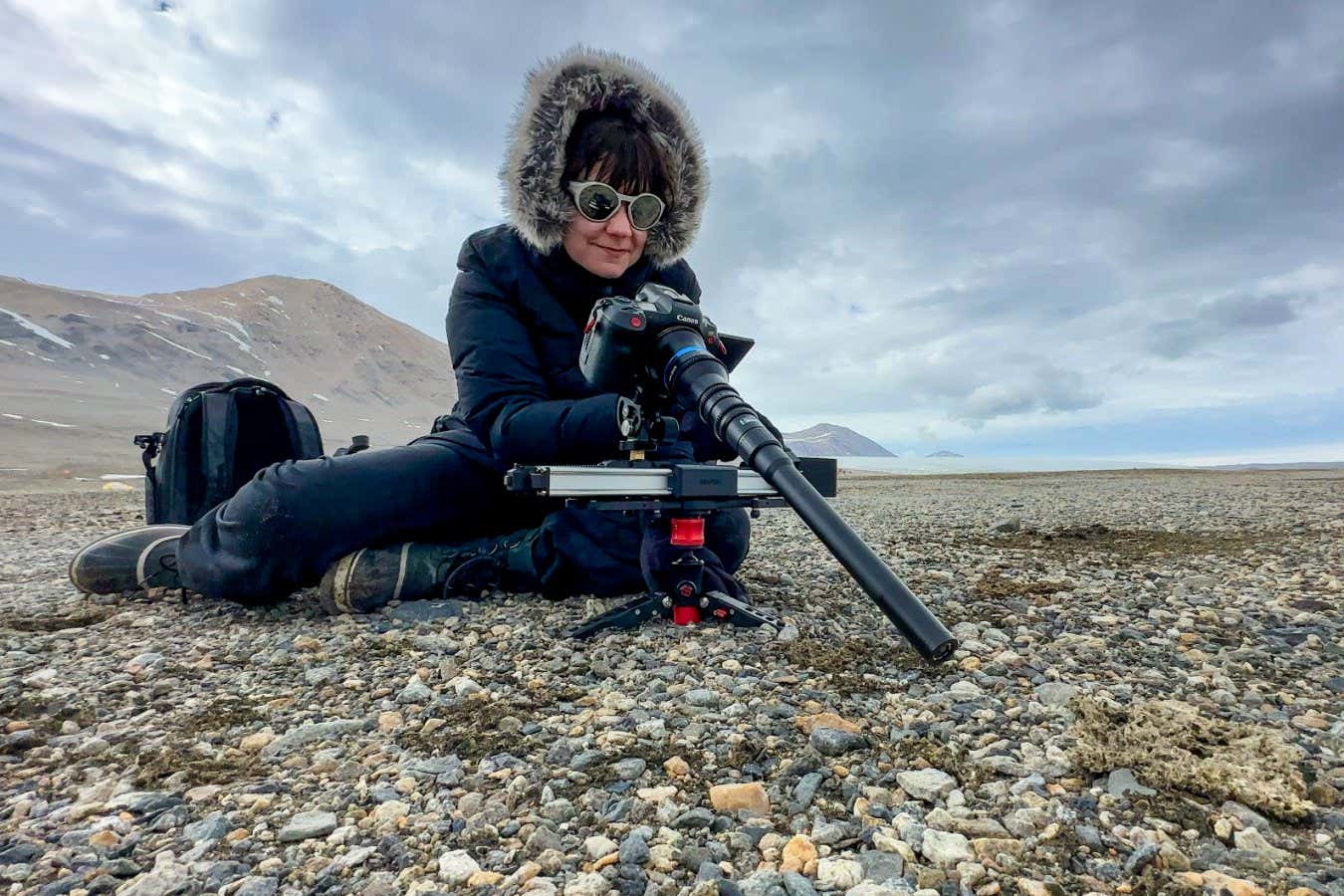
Using a macro probe lens, Ariel Waldman filmed microbial mats in the desert valleys of Antarctica
Ariel Waldman
Ariel Waldman is standing all alone on a planet that looks a lot like Mars. At her feet are rock shards and barren soil. Overhead are jagged mountains streaked with dusty ice. The sky is a hazy white; the sun appears very far away. And then, Waldman smiles, explaining that she’s in Antarctica’s dry valleys, a vast stretch of deep-brown earth between frozen mountains and ancient glaciers. Maybe she’s not coming to you live from another planet, but in her new docuseries Life Unearthed, she may convince you that Earth is more alien than you realised.
Now available on PBS and YouTube, Waldman’s 6-episode series is a journey into the microscopic jungle that lurks in our planet’s crust. Embedded with a soil-science team on Earth’s southernmost continent, Waldman brought her own microscopes, a macro probe lens that captures depth of field when shooting minute landscapes, a drone, and several complicated camera mounts to film the world’s most unsung wildlife in situ. She also filmed herself as she worked, creating a fascinating record of what it’s like to study an ecosystem that is undergoing a rapid, and sometimes violent, transformation due to climate change.
From the seemingly lifeless valleys of Antarctica to the bubbling wetlands of the North American prairies, she introduces us to animals including nematodes, rotifers and tardigrades, tiny creatures who shape and nourish our ecosystems while remaining invisible to the naked eye. Most impressive of all, she filmed her journey to Antarctica entirely on her own.
Sitting in her cozy office in San Francisco, surrounded by microscopes and cabinets full of photographic equipment, Waldman told me that a big part of her motivation is to chronicle environments in Antarctica and the prairies before they disappear. “If you want to do a nature documentary in [the dry valleys] of Antarctica, you need microscopes to see the animals that exist there,” she told me. The same goes for the prairies, where the vast majority of biomass lurks deep in the soggy ground.
As the official curator of the San Francisco Microscopical Society, Waldman also wants to normalise the idea that we should look at the dirt through microscopes as often as we peer through telescopes at the sky. That’s another reason she loves the microcosmos. “When we’re thinking about finding life on other planets or moons, our best guess is that we would find something microscopic.” In Life Unearthed, she films tardigrades (also known as water bears) under the microscope, wiggling their puffy legs and booping into plant cells. These cute little guys can survive in the extreme cold of Antarctica and the sweltering prairies – and even the vacuum of space. They hint at the kinds of characters we might find beyond the safe envelope of our atmosphere.
I first met Waldman when she was working with NASA and running Spacehack, an organisation that connects citizen scientists with space-exploration projects. She introduced me to CubeSat, a group of people who launch DIY satellites into orbit. Later, she created Science Hack Day, a global event I attended where scientists and enthusiasts can collaborate on everything from data gathering to software development. Since then, we’ve become friends, and I’ve followed her unique career that blends science, art and community organising.
I visited her the day before she left for Antarctica, when her biggest worry was how she would get as much equipment as possible into her suitcases. Unlike the scientists she works with, Waldman’s deep academic background is in graphic design. She doesn’t merely want to research the planet, she wants to show it to people, to encourage them to get a cheap microscope and “just throw things under it”. When people can see life in all its diversity, she believes, we become more confident about advocating for its conservation.
Influenced by the famous 1977 Eames short film Powers of Ten, Waldman thinks that scale is a key way to understand our place in the universe. That’s why she needs drones for aerial views, as well as her beloved microscopes – and, when she’s chasing prairie crayfish in their underground burrows, she even uses a camera on a long wire that’s designed for snaking into clogged pipes. “Humans are both very small in the universe and very large in the universe, depending on your perspective,” she mused. So much of life is “virtually invisible to us without technology”.
Waldman hopes that Life Unearthed inspires more people to pick up a microscope and check out all the invisible wildlife beneath their feet. To understand the true wonder of nature, we need to see it first.
Topics: